Flutter vs React Native: Which Cross-Platform Framework Wins in 2026?
Home » Flutter vs React Native: Which Cross-Platform Framework Wins in 2026?
Flutter vs React Native: Which Cross-Platform Framework Wins in 2026?
Cross-platform mobile development has become an attractive option for businesses that want to launch applications on both Android and iOS without maintaining two completely separate codebases.
Two of the most popular technologies in this space are Flutter and React Native.
Both frameworks allow development teams to reuse a significant amount of code across platforms, helping businesses reduce development effort and launch products faster.
But when comparing Flutter vs React Native, which framework should you choose in 2026?
The answer depends on your application requirements, development team, performance expectations, UI complexity, integrations, and long-term product strategy.
Let’s compare both technologies.
Flutter vs React Native: Which Should You Choose in 2026?
Cross-platform mobile development has become an attractive option for businesses that want to launch applications on both Android and iOS without maintaining two completely separate codebases.
Two of the most popular technologies in this space are Flutter and React Native.
Both frameworks allow development teams to reuse a significant amount of code across platforms, helping businesses reduce development effort and launch products faster.
But when comparing Flutter vs React Native, which framework should you choose in 2026?
The answer depends on your application requirements, development team, performance expectations, UI complexity, integrations, and long-term product strategy.
Let’s compare both technologies.
What Is Flutter?
Flutter is an open-source UI framework created by Google for building applications from a shared codebase.
Flutter primarily uses the Dart programming language.
Developers can use Flutter to build applications for platforms including:
- Android
- iOS
- Web
- Desktop
One of Flutter’s major strengths is its UI system.
Flutter provides a large collection of widgets that allow developers to create highly customized interfaces and maintain a consistent visual experience across platforms.
What Is React Native?
React Native is an open-source framework created by Meta for developing mobile applications using JavaScript and React.
It allows development teams to build Android and iOS applications while sharing much of the application logic.
React Native is especially attractive to businesses that already have developers experienced with:
- JavaScript
- TypeScript
- React
- Web development
This can make the transition from web development to mobile application development easier for some teams.
Flutter vs React Native: Quick Comparison
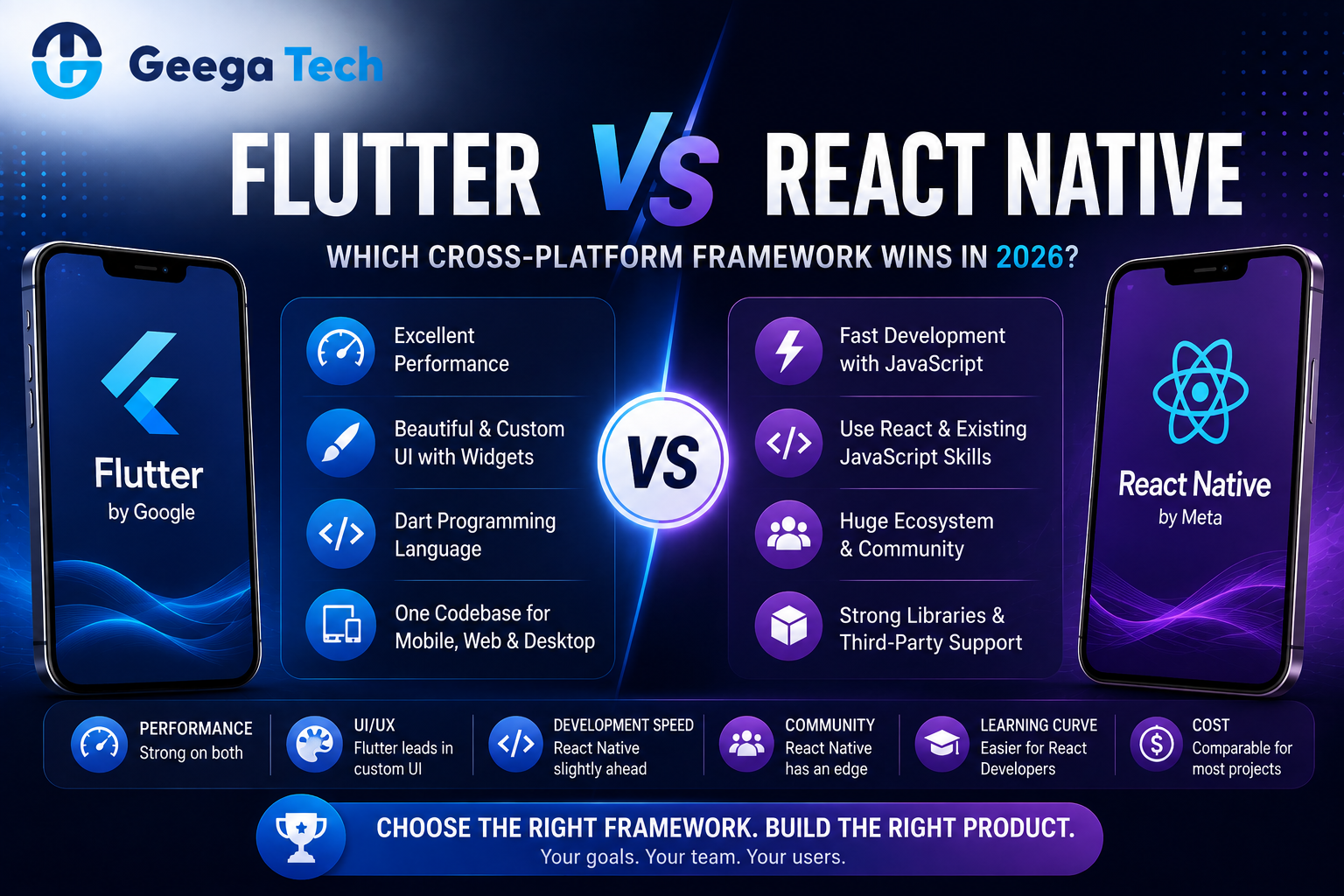
| Factor | Flutter | React Native |
|---|---|---|
| Primary Language | Dart | JavaScript / TypeScript |
| Created By | Meta | |
| Android Support | Yes | Yes |
| iOS Support | Yes | Yes |
| Shared Code | High | High |
| Custom UI | Excellent | Very Good |
| Performance | Strong | Strong |
| Web Developer Adoption | Moderate | High |
| React Ecosystem | No | Yes |
| Learning Curve | Requires Dart | Easier for React developers |
Both frameworks are capable of building production-quality mobile applications.
Flutter vs React Native Performance
Performance is one of the most common areas businesses compare.
Flutter Performance
Flutter controls much of its rendering system, which gives developers significant control over UI performance and animations.
It can be a strong option for applications with:
- Custom interfaces
- Complex animations
- Interactive dashboards
- Consistent cross-platform designs
React Native Performance
React Native also provides strong performance for most standard business applications.
It works particularly well for:
- eCommerce apps
- Social applications
- SaaS mobile apps
- Booking applications
- Business applications
- Customer portals
For most business applications, architecture and code quality often matter more than small framework-level performance differences.
UI and Design
Flutter
Flutter provides its own rich widget ecosystem.
Developers can create highly customized interfaces that look consistent across Android and iOS.
This makes Flutter attractive for applications where visual design is a major product requirement.
React Native
React Native works closely with native platform capabilities and provides a familiar development approach for React developers.
It can be particularly effective when the application needs a platform-friendly experience while still sharing code across Android and iOS.
Winner?
There is no universal winner.
For highly customized interfaces, Flutter can be particularly attractive.
For teams already comfortable with React and JavaScript, React Native may provide a smoother development experience.
Development Speed
Both technologies are designed to reduce cross-platform development effort.
Instead of:
Android Codebase + iOS Codebase
businesses can use:
Shared Codebase → Android + iOS
This can reduce:
- Development time
- Duplicate coding
- Testing effort
- Maintenance effort
However, some platform-specific development may still be required regardless of the framework.
Flutter vs React Native Development Cost
Development cost depends on more than framework choice.
Important factors include:
- Number of screens
- Backend complexity
- APIs
- User roles
- Payment integration
- Admin dashboard
- Real-time features
- UI complexity
- Security
- Third-party integrations
Both Flutter and React Native can potentially reduce costs compared with maintaining completely separate native Android and iOS applications.
The more important question is which framework best matches your development team and product requirements.
Programming Language
Flutter — Dart
Flutter uses Dart.
Dart is designed to work closely with the Flutter ecosystem, but developers unfamiliar with the language need to learn it.
React Native — JavaScript / TypeScript
React Native uses JavaScript and commonly TypeScript.
JavaScript has a very large development ecosystem and is widely used in web development.
Companies already using React for web applications may find React Native particularly convenient.
For example:
React Web Team → React Native Mobile Development
Some development knowledge and patterns can be shared across teams.
Developer Ecosystem
Both Flutter and React Native have large developer communities.
React Native benefits from the broader JavaScript and React ecosystem.
Flutter has developed a strong ecosystem around Dart and cross-platform UI development.
When selecting a framework, businesses should evaluate:
- Developer availability
- Required packages
- Third-party integrations
- Community support
- Long-term maintenance
- Internal team expertise
The framework with the strongest ecosystem for your specific application may be more valuable than the one with the most developers overall.
Native Device Features
Mobile applications often require access to:
- Camera
- GPS
- Bluetooth
- Microphone
- Biometrics
- Push notifications
- Local storage
- Sensors
Both Flutter and React Native can access native device functionality.
However, certain advanced features may require:
- Native modules
- Platform-specific configuration
- Custom Android/iOS code
Businesses should confirm framework support for critical device functionality before development begins.
Flutter vs React Native for MVP Development
Both frameworks can be excellent options for MVP development.
Startups typically want:
Fast Development + Android + iOS + Controlled Budget
A shared codebase can help achieve these goals.
Choose Flutter When:
- Highly customized UI is important.
- Your team is comfortable adopting Dart.
- Consistent cross-platform design is a priority.
Choose React Native When:
- Your team already knows React.
- JavaScript/TypeScript is part of your existing technology stack.
- You want to leverage the broader React ecosystem.
Flutter vs React Native for SaaS Applications
SaaS businesses often have:
Web Application + Android App + iOS App + Backend APIs
React Native can be particularly attractive when the web product already uses React or Next.js because development teams share similar technologies.
For example:
Next.js Web App
↓
Node.js APIs
↓
React Native Mobile App
However, Flutter can also be a strong choice when the product requires a highly customized mobile experience.
The backend architecture remains independent of either mobile framework.
Flutter vs React Native for Enterprise Apps
Enterprise applications often require:
- Authentication
- Role-based permissions
- API integrations
- Offline functionality
- Security
- Analytics
- Push notifications
- Large datasets
- Device features
Both Flutter and React Native can support enterprise applications.
The decision should consider long-term maintenance and the organization’s existing development expertise.
Security Comparison
Neither Flutter nor React Native is automatically more secure.
Application security depends largely on implementation.
Development teams should consider:
- Secure authentication
- API security
- Token storage
- Data encryption
- Role-based access
- Input validation
- Secure network communication
- Dependency security
- Backend protection
Sensitive business logic should generally be enforced on secure backend systems rather than relying only on the mobile application.
App Maintenance
Cross-platform development can simplify maintenance because much of the application uses shared code.
For example:
Bug Found → Shared Code Updated → Android + iOS Updated
However, developers still need to test both platforms.
Operating-system updates can also require platform-specific changes.
Businesses should therefore budget for continuous mobile application maintenance regardless of the framework selected.
Flutter vs React Native: Pros and Cons
| Flutter | React Native | |
|---|---|---|
| Advantages | Strong UI control, excellent custom designs, shared code | JavaScript ecosystem, React familiarity, strong cross-platform development |
| Challenges | Requires Dart knowledge | Some features may require native modules |
| Best Fit | UI-heavy cross-platform apps | React/JavaScript-focused teams |
| MVP | Excellent | Excellent |
| Enterprise Apps | Strong | Strong |
When Should You Choose Flutter?
Flutter may be a strong choice when:
- Your app requires a highly customized UI.
- Consistent design across platforms is important.
- Complex animations are central to the experience.
- Your team is comfortable with Dart.
- You want a strong cross-platform UI framework.
When Should You Choose React Native?
React Native may be a strong choice when:
- Your team already works with React.
- JavaScript or TypeScript is your preferred ecosystem.
- Your company has an existing React/Next.js web application.
- Fast cross-platform development is important.
- You want to reuse development knowledge across web and mobile teams.
Flutter vs React Native: Which Wins in 2026?
There is no absolute winner.
For many projects:
Flutter wins when highly customized cross-platform UI is the priority.
React Native wins when React ecosystem compatibility and existing JavaScript expertise are major priorities.
The better framework is the one that matches:
Product Requirements + Team Expertise + Performance Needs + Budget + Long-Term Roadmap
Businesses should avoid selecting technology based only on popularity.
Why Choose Geega Technologies for Cross-Platform App Development?
At Geega Technologies, we help startups and enterprises build secure and scalable mobile applications.
Our development capabilities include:
- React Native Development
- Cross-Platform App Development
- Native App Development
- Hybrid App Development
- Android App Development
- iOS App Development
- Mobile App Development
- Backend Development
- API Development & Integration
- Admin Panel Development
- Cloud Application Development
- App Maintenance & Scaling
Our team helps businesses select mobile technologies based on actual product requirements rather than following framework trends.
Final Thoughts
The Flutter vs React Native debate does not have a single answer for every application.
Flutter provides strong UI capabilities and a highly integrated development ecosystem.
React Native provides strong cross-platform development while benefiting from JavaScript, TypeScript, and React expertise.
For businesses, the decision should come down to:
Features + UI + Team Skills + Integrations + Performance + Maintenance + Budget
Both frameworks can be excellent choices when used for the right project.