How to Choose a Custom Software Development Company in 2026: The Ultimate Enterprise & Startup Guide
Home » Blog » How to Choose a Custom Software Development Company in 2026: The Ultimate Enterprise & Startup Guide
How to Choose a Custom Software Development Company in 2026: The Ultimate Enterprise & Startup Guide
Selecting the right custom software development company in 2026 is one of the highest-stakes technical and capital decisions an enterprise leader, CTO, or tech founder will make. With modern software demanding deep integration of AI agents, cloud-native microservices, strict cybersecurity compliance (ISO 27001, SOC 2, HIPAA), and predictable sprint velocity, traditional agency vetting criteria are no longer sufficient.
1. The 2026 Software Development Landscape: What Has Changed?
Over the past three years, software engineering has undergone a fundamental architectural transformation. Building bespoke software is no longer about writing CRUD (Create, Read, Update, Delete) interfaces in PHP or basic JavaScript frameworks. In 2026, enterprise software engineering mandates:
- AI-First System Design: Embedding Retrieval-Augmented Generation (RAG), LLM orchestrations, and autonomous task agents directly into workflow pipelines.
- Distributed Cloud Resilience: Deploying multi-region, Kubernetes-orchestrated microservices on AWS, Azure, or Google Cloud with zero-trust security postures.
- Standardized Process Governance: Working with companies operating under formal process maturity models such as CMMI Level 3 to guarantee documented, repeatable engineering standards.
- Transparent Code Ownership: Immediate transfer of full IP, commit history, automated testing suites, and Infrastructure as Code (IaC) templates upon milestone sign-off.
When searching for a partner to build your core digital platform, explore their specialized capability in custom software development and verify whether they maintain dedicated R&D engineering labs.
2. Five Core Pillars of Partner Evaluation
To eliminate ambiguity and project risk, evaluate prospective software engineering firms across these five critical dimensions:
Pillar 1: Formal Process Maturity (CMMI Level 3 vs. Ad-Hoc Teams)
The vast majority of offshore and nearshore dev shops operate on ad-hoc, informal processes. When key developers transition off your project, institutional memory is lost, codebases deteriorate into spaghetti architectures, and technical debt compounds exponentially.
In contrast, a CMMI Level 3 appraised software company adheres to standardized, documented organizational engineering standards across all 20 defined process areas. Every sprint follows institutionalized peer reviews, automated regression testing, architectural gating, and risk management protocols. This ensures your project timeline and budget remain predictable from Day 1 through long-term maintenance.
Pillar 2: Technical Breadth & Specialized Stack Depth
A capable software engineering firm must demonstrate deep proficiency across contemporary, high-performance technology stacks rather than forcing your requirements into a single monolithic framework they happen to know:
| Layer | Enterprise Recommended Technologies | Evaluation Criteria |
|---|---|---|
| Backend & APIs | Node.js, Python, Go, Java, .NET Core | Microservices capability, high-concurrency throughput, API gateway design |
| Frontend & Mobile | React, Next.js, Vue, Flutter, React Native, Swift, Kotlin | Core Web Vitals scores, native 60fps mobile responsiveness, offline-first sync |
| AI & Data Engineering | PyTorch, LangChain, LlamaIndex, Pinecone, pgvector | RAG pipelines, token latency optimization, local LLM fine-tuning |
| Cloud & DevOps | AWS, Azure, GCP, Docker, Kubernetes, Terraform | Automated CI/CD, Infrastructure as Code, zero-downtime blue/green deployments |
Pillar 3: Transparency & Agile Engineering Cadence
Demand radical visibility into the development cycle. Your development partner should integrate seamlessly into your communications and tracking infrastructure:
- Direct access to Jira, Linear, or ClickUp project tracking boards.
- Direct Git commit access on private repositories (GitHub, GitLab, or Bitbucket) with daily PR merges.
- Bi-weekly sprint demos showcasing working software deployed to automated staging environments.
- Daily asynchronous Slack or Microsoft Teams standups across overlapping time-zone windows.
Pillar 4: Intellectual Property & Legal Protection
Never sign an agreement without explicit, ironclad IP assignment language. Under enterprise contracts with Geega Technologies, 100% of custom source code, documentation, architectural schemas, and trade secrets are legally assigned to the client upon milestone payment.
Pillar 5: Post-Launch SLA & Annual Maintenance Contracts (AMC)
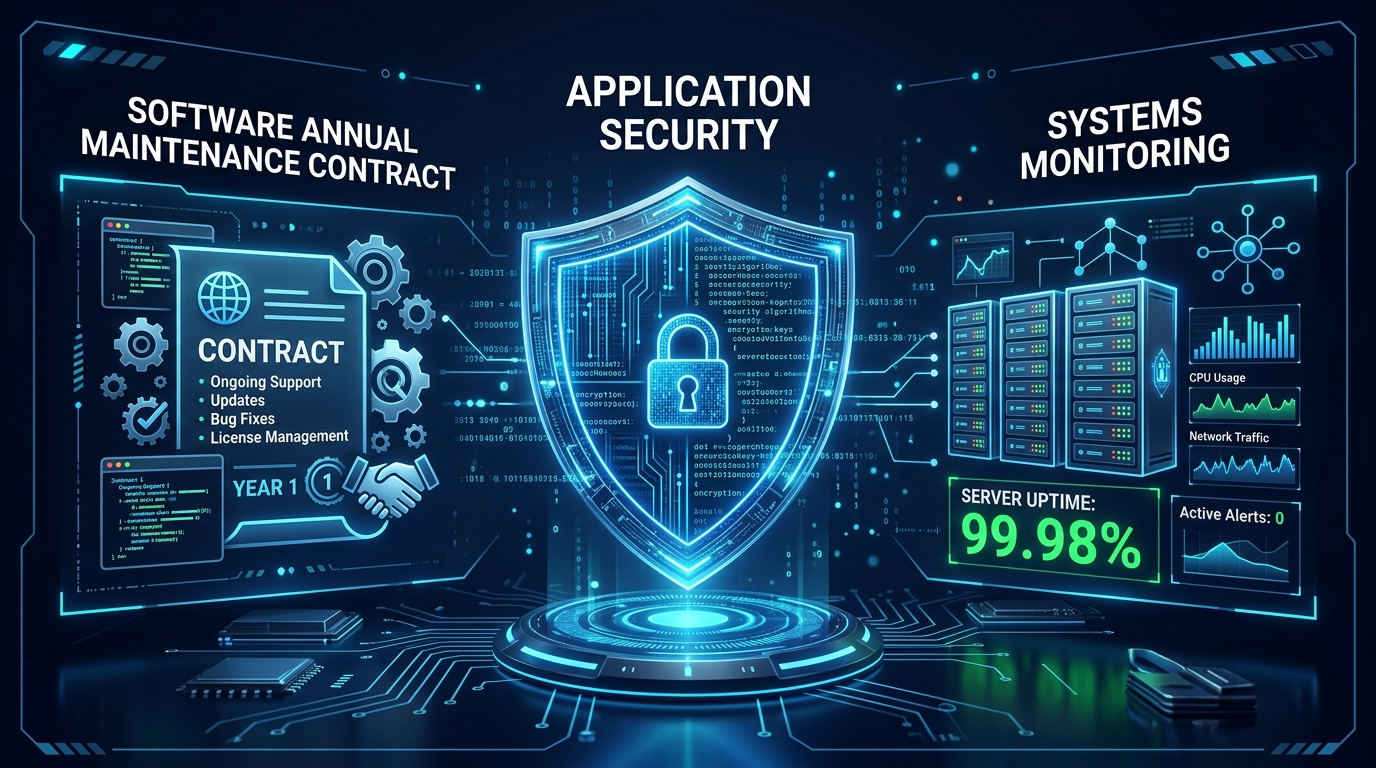
Software delivery does not end at production deployment. Modern operating systems, browser security standards, and third-party APIs update continuously. Verify that your partner provides dedicated 24/7 SLA contracts under structured software annual maintenance contracts (AMC) with guaranteed 15-minute response times for critical incidents.
3. Comparing Engagement Models: Fixed-Bid vs. Time & Materials vs. Dedicated Team
Selecting the wrong pricing and engagement model can derail project economics before writing the first line of code:
| Model | Best Suited For | Pros | Risk Profile |
|---|---|---|---|
| Fixed-Price (Milestone-Based) | Well-defined MVPs, specific integrations, scoped modules | Budget certainty, vendor accountability for timeline | Inflexible to scope pivots during sprint cycle |
| Time & Materials (T&M) | Evolving products, exploratory R&D, complex enterprise legacy modernization | Maximum agility, pay only for hours logged | Requires strong internal product owner oversight |
| Dedicated Engineering Team | Scale-ups, long-term roadmaps, continuous product enhancement | Dedicated full-time talent, deep domain expertise, 50-60% cost reduction | Monthly retainer commitment (typically 3-6 month minimum) |
4. The 10-Point Technical RFP & Interview Checklist
When interviewing prospective software engineering firms, test their real-world capabilities with these specific questions:
- How do you handle automated unit, integration, and end-to-end testing? (Acceptable answer: Minimum 80% coverage on core business logic using Jest, Cypress, Playwright, or PyTest).
- Can you share an anonymized architectural schema and Git repository from a recent project? (Look for clean folder structures, modular design patterns, and descriptive commit histories).
- What is your formal CMMI or ISO accreditation status? (Verify certificate numbers and official assessment partner validity).
- How do you protect sensitive data during development? (Ensure strict compliance with ISO 27001 data masking, VPN-restricted dev environments, and zero production data in local databases).
- What is your developer turnover rate, and what happens if a core engineer leaves? (A CMMI L3 firm maintains documented standard operating procedures and shadowing redundancy so transitions happen seamlessly).
- How do you handle cloud infrastructure provisioning? (Ensure they use Terraform or CloudFormation rather than manual console clicking).
- What time-zone overlap will our team have with the engineering leads? (Look for minimum 3-4 hours of daily synchronous overlap).
- Do you provide multi-platform coverage across web and mobile? (Review their mobile app development company capabilities).
- How do you calculate sprint velocity and scope burn-down? (Look for formal Agile Scrum story point estimations and burndown reporting).
- What warranties and defect guarantee periods do you provide post-launch? (Industry standard for tier-1 firms is 30 to 90 days of complimentary defect remediation).
5. Global Delivery Models: Onshore, Nearshore, and Offshore India
Modern enterprises increasingly adopt hybrid global engineering models. Pairing local product management in the United States or United Kingdom with high-velocity offshore engineering from India enables continuous 24-hour engineering cycles while reducing overall development budgets by 50% to 65%.
6. Deep-Dive: Contract Terms, IP Ownership & Red Flags in Master Services Agreements (MSA)
When entering into an agreement with a custom software development partner, the Master Services Agreement (MSA) and Statement of Work (SOW) serve as your legal and technical insurance policy. Over 40% of software disputes stem from poorly drafted statements of work rather than coding incompetence.
Essential MSA Contract Clauses You Must Insist Upon
- Unconditional Work-Made-for-Hire Assignment: Ensure that all code, algorithms, database architectures, designs, workflows, and documentation are categorized as “work made for hire” under US Copyright law or equivalent jurisdiction. Avoid contracts where the vendor retains ownership of “underlying core frameworks” unless they are standard, permissive open-source libraries (MIT, Apache 2.0).
- Non-Solicitation and Non-Compete Protections: Dual-direction non-solicitation protecting both parties from team poaching, coupled with enforceable non-compete restrictions preventing the vendor from building a clone for a direct competitor within 12 to 24 months.
- Warranty and Defect Remediation Window: An explicit warranty period (minimum 60 to 90 days post-launch) during which any bugs or deviation from agreed acceptance criteria must be remediated at zero additional cost to the client.
- Escrow and Source Code Repository Commit Cadence: Requirements that developers commit code daily to client-owned Git repositories, paired with automated dependency auditing to prevent contaminated GPL licensing risks.
7 Red Flags to Watch for When Evaluating Software Vendors
- Suspiciously Low Hourly Rates ($10-$12/hr): In software engineering, rates far below market averages inevitably signal bait-and-switch tactics, where senior engineers attend initial sales pitches but junior interns or unvetted subcontractors write the production code.
- Lack of Real CMMI or ISO Certifications: Unaccredited shops frequently claim “we follow CMMI processes” without having undergone formal appraisals. Always verify appraisal numbers on the official CMMI Institute partner database.
- Refusal to Provide Client References: Reputable enterprise partners readily provide references to CTOs and VP of Engineering peers who can speak directly to their delivery reliability and problem-solving velocity.
- Vague Architectural Estimates: Proposals that bundle design, frontend, backend, and DevOps into single undifferentiated lump sums without detailed work-breakdown structures (WBS) indicate lack of technical discovery depth.
- No Automated Testing Strategy: If a vendor relies exclusively on manual click-testers rather than automated unit, integration, and CI/CD pipelines, your platform will suffer regression bugs on every subsequent release.
- Hostile Exit Clauses: Contracts that hold code or deployment environments hostage if you decide to transition to in-house teams are immediate deal-breakers.
- Zero Overlap with Your Working Hours: Complete timezone disconnection results in 24-hour delays for simple clarifications, dragging sprints out to twice their necessary duration.
7. Step-by-Step Vendor Selection Workflow
Follow this 4-week selection schedule to choose your engineering partner with complete confidence:
- Week 1 — RFP Drafting & Longlisting: Define core functional requirements, non-functional requirements (scalability, latency, compliance), and identify 5-8 qualified vendors.
- Week 2 — Technical Discovery & Capability Scoring: Hold 45-minute technical discovery calls with lead architects, review anonymized codebases, and verify CMMI/ISO credentials.
- Week 3 — Proposal Review & Architecture Deep-Dive: Compare architectural blueprints, sprint velocity estimates, and rate cards across shortlisted vendors.
- Week 4 — Paid Discovery Sprint or Prototype: Commission a 1-to-2 week paid discovery sprint (architecture blueprint, technical feasibility assessment, and interactive Figma clickable prototype) before committing to a full engagement.
Frequently Asked Questions (FAQ)
How much does it cost to hire a custom software development company in 2026?
Hourly rates vary significantly by geography: US/UK onshore rates range from $120 to $250/hour, Eastern Europe ranges from $50 to $90/hour, while verified CMMI Level 3 companies in India range from $18 to $45/hour. A production-ready enterprise MVP typically ranges between $25,000 and $75,000.
Why is CMMI Level 3 important when choosing a software development partner?
CMMI Level 3 indicates that an engineering organization has established defined, standardized, and repeatable processes across its entire software development lifecycle. This drastically reduces defect rates, eliminates code spaghetti, and guarantees predictable project delivery.
How long does a typical custom software development project take?
A well-scoped MVP or digital prototype typically delivers within 8 to 12 weeks. Comprehensive enterprise ERP or multi-platform cloud systems generally take 4 to 9 months, structured across bi-weekly agile sprint releases.
Need a Technical Assessment for Your Software Project?
Discuss your architecture requirements, timeline, and cost estimates with our lead solutions architects today.
Schedule Free Architecture Consultation →Looking to Build Custom Software or Integrate Enterprise AI?
Geega Technologies specializes in CMMI Level 3 certified software development, scalable enterprise cloud architecture, and mission-critical engineering solutions.
Consult Our Tech Leaders →