AI-Ready Data Infrastructure: Why It Is Essential for Business Success in 2026

Home » AI-Ready Data Infrastructure: Why It Is Essential for Business Success in 2026

AI-Ready Data Infrastructure: Why It Is Essential for Business Success in 2026

Artificial intelligence has become a major part of business transformation in 2026. Companies are using AI for customer support, workflow automation, data analysis, software development, sales forecasting, fraud detection, and business decision-making.

However, simply purchasing an AI tool or integrating an AI model does not guarantee successful results.

The real performance of an AI system depends heavily on the quality, accessibility, security, and structure of the data behind it. If business data is incomplete, outdated, scattered across different systems, or poorly managed, even the most advanced AI solution may provide inaccurate and unreliable results.

This is why businesses now need to build an AI-ready data infrastructure before adopting AI at scale.

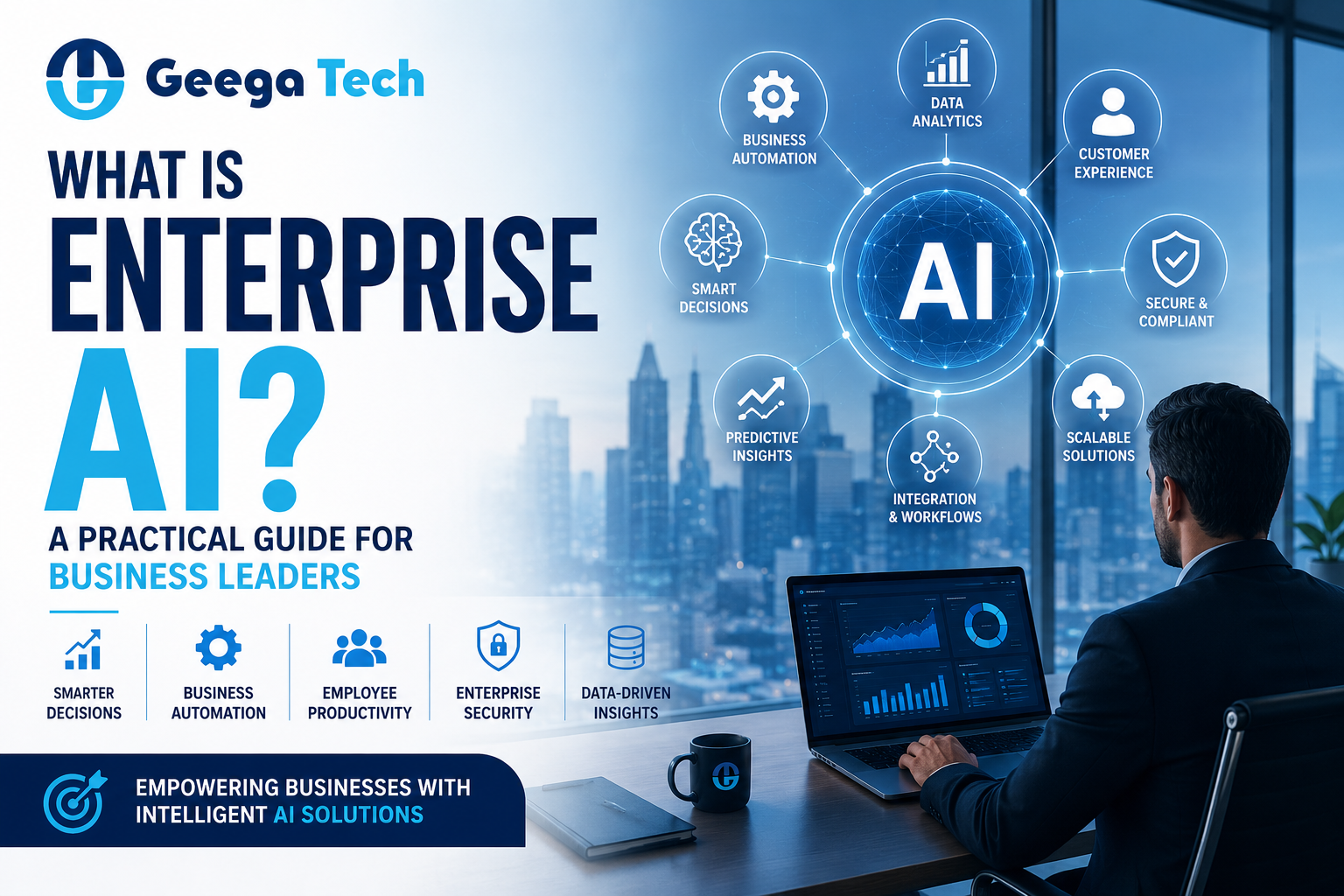
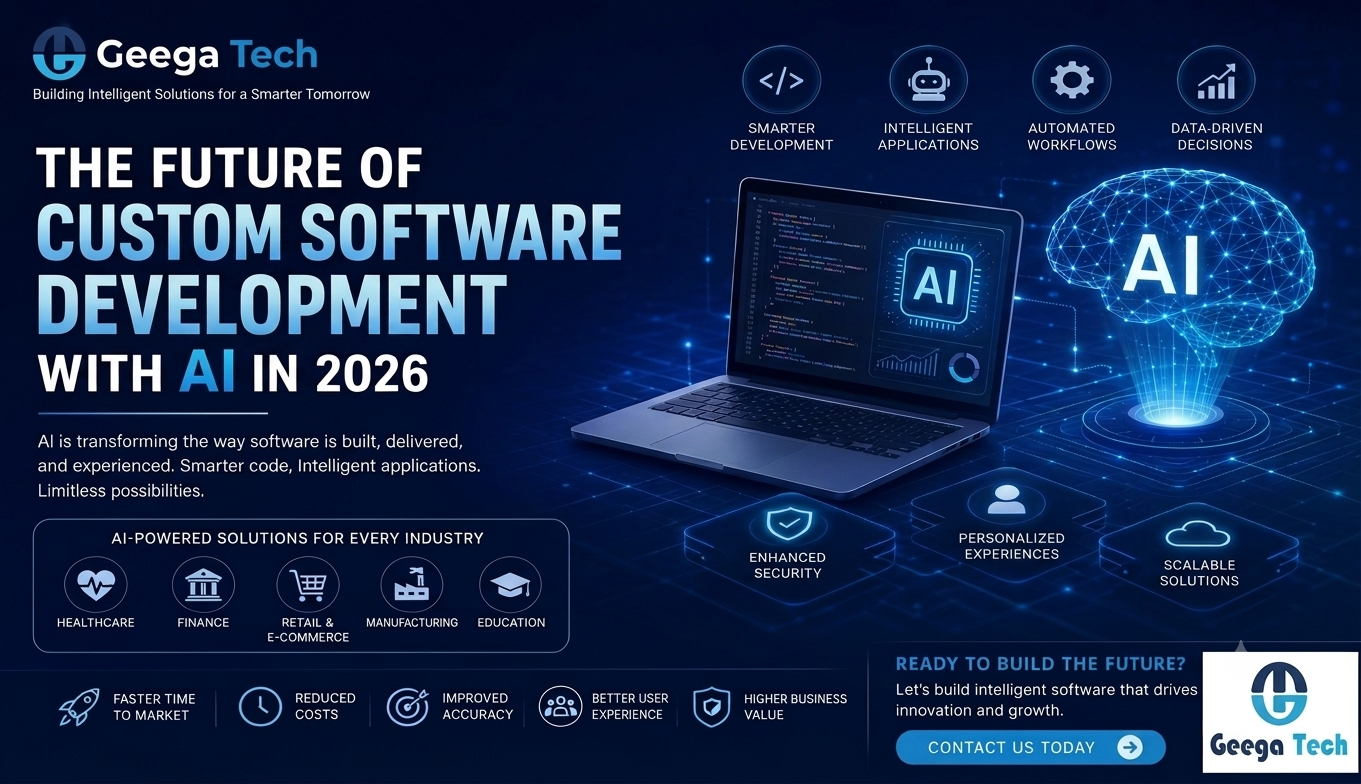
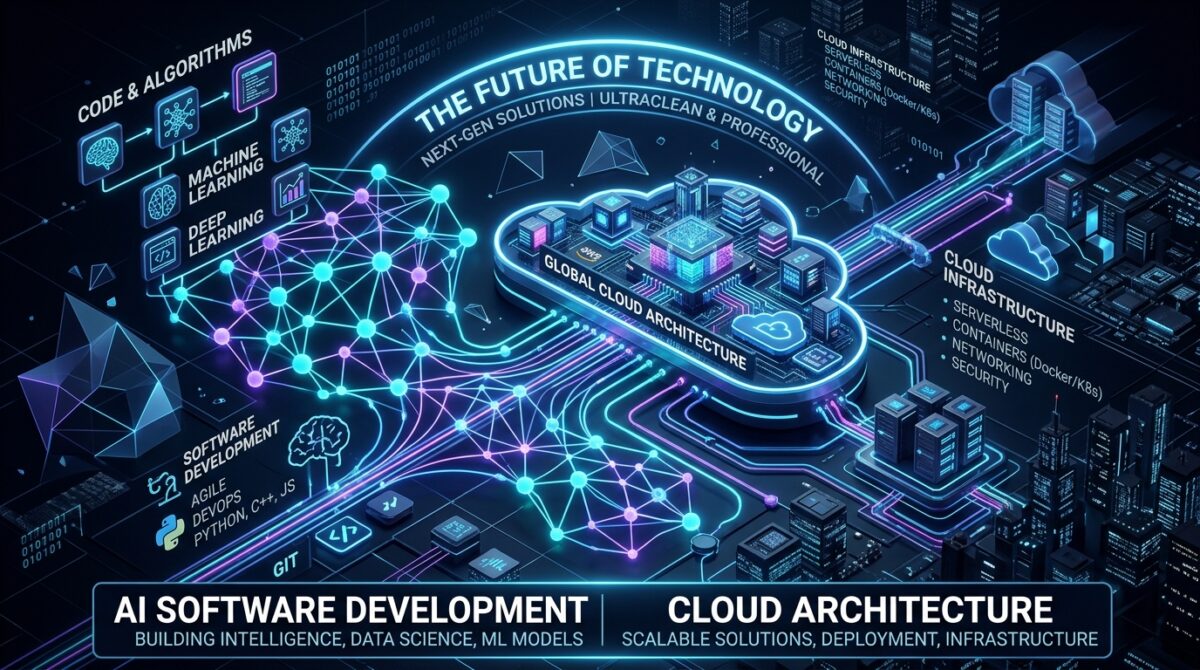
AI-ready data infrastructure helping businesses automate operations in 2026

What Is AI-Ready Data Infrastructure?

AI-ready data infrastructure is a technology environment designed to collect, store, organize, process, protect, and deliver data for artificial intelligence applications.

It connects business data from sources such as:

  • CRM and ERP software

  • Websites and mobile applications

  • Customer support platforms

  • Accounting and payroll systems

  • Cloud databases

  • Marketing platforms

  • IoT devices

  • Internal documents

  • Third-party applications

Instead of keeping information isolated in separate systems, an AI-ready infrastructure makes relevant data available in a consistent and controlled format.

This enables AI applications to understand business information and generate more accurate outcomes.

Why Data Quality Matters for AI

AI systems learn, analyse, and make decisions using the information provided to them. Therefore, the quality of an AI output is directly connected to the quality of its input data.

Common data problems include:

  • Duplicate customer records

  • Missing information

  • Incorrect data formats

  • Outdated contact details

  • Inconsistent product names

  • Unstructured documents

  • Disconnected databases

  • Unverified information

For example, an AI-powered sales forecasting system cannot produce reliable predictions if historical sales data is incomplete. Similarly, a customer support AI agent may provide incorrect answers when product and policy information is outdated.

Before implementing AI, businesses must clean, validate, standardize, and organize their data.

Why AI Projects Fail Without the Right Data Foundation

Many organizations begin their AI journey by selecting tools and models first. They focus on features such as automation, intelligent chatbots, predictive analytics, and autonomous AI agents.

However, they often ignore the condition of their existing data infrastructure.

As a result, AI projects may face several challenges:

1. Inaccurate AI Responses

When an AI application receives incomplete or incorrect information, its responses become unreliable. This may create confusion for customers and employees.

2. Limited Automation

AI agents need access to multiple systems to complete business tasks. If these systems are not properly connected, the agent can only perform limited actions.

3. Security and Privacy Risks

Uncontrolled data access may expose confidential customer, employee, or financial information. Every AI implementation requires proper permissions and security policies.

4. Poor Scalability

An AI prototype may work successfully with a small dataset but fail when used across multiple departments, locations, or thousands of users.

5. Low Employee Trust

Employees will hesitate to use AI solutions if the system repeatedly generates incorrect suggestions or decisions.

A strong data foundation helps businesses avoid these problems before expanding AI across their operations.

Key Components of AI-Ready Data Infrastructure

Centralized Data Integration

Business information is often distributed across different software platforms. Data integration connects these systems through APIs, middleware, or automated data pipelines.

This allows AI applications to access relevant information without requiring employees to transfer it manually.

Cloud-Based Architecture

Cloud platforms provide flexible computing resources for storing and processing large amounts of data. Businesses can increase or reduce resources depending on application demand.

Cloud infrastructure also supports real-time processing, remote accessibility, backup management, and easier integration with AI services.

Clean and Standardized Data

Data should follow consistent formats and naming conventions. Duplicate, outdated, or incorrect records must be identified and corrected regularly.

Automated data validation can help maintain accuracy as new information enters the system.

Strong Data Governance

Data governance defines how information is collected, accessed, modified, retained, and deleted.

A proper governance framework should answer questions such as:

  • Who owns the data?

  • Who can access it?

  • Where is it stored?

  • How long should it be retained?

  • How is sensitive data protected?

  • Which AI applications can use it?

Real-Time Data Processing

Many AI applications require current information rather than data that is several hours or days old.

Real-time processing is especially important for fraud detection, inventory management, customer support, logistics, monitoring, and personalized recommendations.

Security and Access Control

AI applications should only access the minimum information required to complete a task.

Businesses should implement:

  • Role-based access control

  • Data encryption

  • Secure APIs

  • Activity logging

  • User authentication

  • Backup and recovery systems

  • Regular security audits

These controls reduce the risk of unauthorized access and data misuse.

Benefits of Building an AI-Ready Data Foundation

More Accurate AI Results

Clean and organized data enables AI models to generate more reliable recommendations, predictions, and responses.

Faster Business Automation

Integrated systems allow AI agents to complete multi-step workflows without repeatedly requesting information from employees.

For example, an AI agent could receive a customer enquiry, check the CRM, verify product availability, prepare a quotation, and schedule a follow-up.

Better Business Decisions

AI-powered analytics can identify customer behaviour, operational problems, sales opportunities, and financial trends when it has access to accurate business data.

Improved Customer Experience

Connected data helps businesses provide faster and more personalized customer service across websites, mobile applications, email, and support platforms.

Lower Long-Term Development Costs

Fixing data problems during or after AI deployment can be expensive. Preparing the infrastructure early reduces integration issues, redevelopment, and operational disruption.

Easier Scalability

A properly designed architecture enables businesses to introduce new AI features, add more users, connect additional systems, and process larger amounts of data.

How Businesses Can Become AI-Ready

Businesses do not need to transform their complete technology infrastructure at once. They can begin with a structured, step-by-step approach.

Step 1: Identify the Business Problem

Start with a clear objective instead of implementing AI simply because it is popular.

The objective may be reducing customer response time, automating manual reporting, improving lead qualification, or forecasting inventory demand.

Step 2: Audit Existing Data

Identify where important business information is stored and evaluate its quality, security, structure, and accessibility.

Step 3: Clean and Organize the Data

Remove duplicates, correct errors, standardize formats, and define common data structures.

Step 4: Connect Business Systems

Use secure APIs and data pipelines to integrate relevant applications, databases, and cloud services.

Step 5: Define Security and Governance Rules

Establish user permissions, approval processes, monitoring, and data retention policies before giving AI systems access.

Step 6: Start with a Small AI Use Case

Launch a controlled pilot project with measurable goals. Evaluate its accuracy, performance, security, and business impact.

Step 7: Monitor and Improve

AI systems require continuous evaluation. Businesses should review output quality, update data sources, monitor system actions, and collect employee feedback.

The Importance of Human Oversight

AI-ready infrastructure does not mean removing humans from every business process.

Human oversight remains essential for:

  • High-impact decisions

  • Financial approvals

  • Legal or compliance-related tasks

  • Sensitive customer interactions

  • Reviewing unusual AI actions

  • Correcting inaccurate outputs

The most effective approach is to let AI handle repetitive and data-intensive tasks while employees manage strategy, creativity, judgment, and final approvals.

How Geega Technologies Can Help

Geega Technologies helps startups and businesses plan, build, scale, and optimize secure digital solutions.

Our team can help organizations with:

  • AI application development

  • Business process automation

  • Custom software development

  • Cloud application development

  • API and third-party integrations

  • Data management solutions

  • AI-powered dashboards

  • Legacy software modernization

  • Mobile and web application development

  • Application maintenance and scaling

We focus on building practical AI solutions that connect with your existing business systems and support measurable operational goals.

Conclusion

In 2026, successful AI adoption depends on more than selecting a powerful AI model. Businesses need accurate data, connected systems, secure access, reliable infrastructure, and clear governance policies.

An AI-ready data infrastructure creates the foundation required for trustworthy automation, intelligent decision-making, and long-term digital growth.

Organizations that prepare their data before scaling AI will be better positioned to reduce operational costs, improve customer experiences, and build more efficient business processes.

Planning to introduce AI into your business?

Connect with Geega Technologies to build secure, scalable, and business-focused AI solutions tailored to your requirements.


Get in touch with us

Looking for a certified tech partner? Contact Geega Technologies today.

Why Every Growing Business Needs Custom CRM Software in 2026

Home » Why Every Growing Business Needs Custom CRM Software in 2026

Why Every Growing Business Needs Custom CRM Software in 2026

Custom CRM Software 2026 is helping growing businesses manage customer data, automate sales follow-ups and improve team productivity. A CRM designed around your unique business workflow can reduce manual work, prevent missed opportunities and support long-term growth. Managing customer relationships becomes more difficult as a business grows. Customer enquiries arrive through websites, emails, phone calls, WhatsApp, social media and other channels. When this information is stored in spreadsheets or scattered across multiple applications, important leads can easily be missed.

In 2026, businesses need a smarter and more organized way to manage customer interactions. Custom CRM software helps companies centralize their customer data, automate repetitive processes and give their teams the information they need to close more deals.

Custom CRM Software 2026 for growing businesses

What Is Custom CRM Software?

CRM stands for Customer Relationship Management. CRM software helps a business manage its leads, customers, sales activities, communication and follow-ups from a single platform.

Custom CRM software is designed specifically around the processes, teams and requirements of a particular organization. Unlike a ready-made CRM that provides the same features to every company, a custom CRM contains the workflows and tools that a business actually needs.

A custom CRM may include:

  • Lead and enquiry management
  • Customer profiles
  • Sales pipeline tracking
  • Automated follow-up reminders
  • Email and WhatsApp integration
  • Task assignment
  • Quotation management
  • Customer support tickets
  • Reports and analytics
  • Role-based dashboards
  • Mobile access
  • Third-party integrations

Why Traditional Customer Management Is No Longer Enough

Many small and growing businesses initially manage their leads using spreadsheets, notebooks, emails or messaging applications. These methods may work when the number of customers is limited, but they become difficult to manage as operations expand.

Common problems include:

  • Customer details stored in different places
  • Missed calls and follow-ups
  • Duplicate customer records
  • No visibility into the sales pipeline
  • Difficulty measuring employee performance
  • Delays in responding to enquiries
  • Inaccurate reports
  • Lack of data security
  • Dependence on individual employees

Custom CRM software solves these problems by creating a central and structured customer management system.

Benefits of Custom CRM Software in 2026

1. Centralized Customer Information

A custom CRM stores customer contact details, conversations, enquiries, documents, quotations and previous activities in one location.

Authorized employees can access the latest information without searching through spreadsheets, email threads or personal messages. This improves collaboration and reduces the chances of losing important customer data.

2. Better Lead Management

Not every enquiry becomes a customer immediately. Leads need to be contacted, qualified, followed up and moved through different sales stages.

A custom CRM can organize leads into stages such as:

  • New enquiry
  • Contacted
  • Qualified
  • Proposal shared
  • Negotiation
  • Won
  • Lost

This provides a clear view of the sales pipeline and helps the team focus on the most promising opportunities.

3. Automated Follow-Ups

Delayed follow-ups are one of the biggest reasons businesses lose potential customers. When employees manage hundreds of leads manually, some enquiries are likely to be forgotten.

Custom CRM software can automatically:

  • Create follow-up tasks
  • Send reminders to employees
  • Notify managers about overdue leads
  • Schedule emails or messages
  • Record follow-up history
  • Escalate important enquiries

Automation ensures that every lead receives timely attention.

4. A CRM Designed Around Your Workflow

Every company follows a different sales and customer management process. A real estate company, hospital, school, manufacturing business and software company will not have identical CRM requirements.

With custom CRM development, businesses can define:

  • Their own lead stages
  • Custom data fields
  • Approval processes
  • Team permissions
  • Dashboard layouts
  • Reports
  • Notification rules
  • Business-specific modules

Employees do not have to change their entire process to fit generic software. The software is developed around the way the business operates.

5. Improved Sales Team Productivity

Sales representatives often spend a large amount of time updating spreadsheets, preparing reports and searching for customer information.

A custom CRM reduces manual work by automating data entry, task creation, reminders and reporting. Employees can spend more time speaking with customers and closing sales.

Managers can also see:

  • Leads assigned to each employee
  • Follow-ups completed
  • Pending tasks
  • Conversion rates
  • Sales performance
  • Revenue generated
  • Lost lead reasons

This makes team performance more transparent and measurable.

6. Integration with Existing Business Tools

Businesses usually use multiple applications for communication, billing, marketing and operations. A custom CRM can connect these systems and create a more unified workflow.

Possible integrations include:

  • Website enquiry forms
  • Email platforms
  • WhatsApp Business
  • Calling systems
  • Accounting software
  • Payment gateways
  • ERP software
  • Marketing platforms
  • Customer support systems
  • Cloud storage
  • SMS services

For example, when a user submits a website enquiry, the CRM can automatically create a new lead, assign it to a sales representative and schedule a follow-up.

7. Role-Based Access and Data Security

Customer information is valuable and should not be accessible to every employee. Custom CRM software can provide role-based access according to an employee’s position and responsibilities.

For example:

  • Sales representatives can access their assigned leads.
  • Sales managers can view their team’s performance.
  • Accountants can access payment-related information.
  • Administrators can manage users and permissions.
  • Business owners can access complete reports.

The system can also maintain activity logs to show who viewed or modified important information.

8. Real-Time Reports and Analytics

Manual reporting can take hours and may contain incorrect or outdated information. A custom CRM generates reports using real-time business data.

Important reports can include:

  • Lead source performance
  • Sales conversion rate
  • Monthly revenue
  • Employee performance
  • Pending follow-ups
  • Average response time
  • Customer retention rate
  • Lost lead analysis
  • Product or service performance

These insights help business owners make better decisions based on actual data.

9. Better Customer Experience

Customers expect quick responses and personalized communication. When employees have access to complete customer history, they can understand previous conversations and provide more relevant assistance.

A custom CRM helps businesses deliver:

  • Faster responses
  • Personalized follow-ups
  • Consistent communication
  • Better after-sales support
  • Timely issue resolution
  • Accurate information

A smooth customer experience can improve satisfaction, trust and long-term retention.

10. Scalability for Future Growth

A growing business may need new modules, users, branches or integrations in the future. Custom CRM software can be developed with scalability in mind.

The system can gradually expand to support:

  • More employees
  • Multiple departments
  • Multiple office locations
  • Mobile applications
  • Customer portals
  • Advanced analytics
  • AI-powered automation
  • Additional third-party integrations

Businesses can add features as their requirements evolve instead of replacing the entire system.

Custom CRM vs Ready-Made CRM

Ready-made CRM solutions can be useful for businesses with simple and standard requirements. They provide quick setup and commonly used features.

However, they may also include limitations such as:

  • Unnecessary features
  • Limited customization
  • Per-user subscription costs
  • Restricted integrations
  • Dependence on the software provider
  • Difficulty matching unique workflows

A custom CRM may require a higher initial investment, but it gives the business greater control over its functionality, integrations and future expansion.

The right choice depends on the organization’s size, processes, budget and long-term goals.

How AI Is Improving CRM Software in 2026

Artificial intelligence is making CRM systems more intelligent and efficient. AI-powered CRM capabilities can help businesses analyze large amounts of customer and sales data.

Modern custom CRM systems can use AI for:

  • Lead scoring
  • Customer enquiry classification
  • Sales forecasting
  • Automated response suggestions
  • Customer sentiment analysis
  • Duplicate record detection
  • Follow-up recommendations
  • Sales trend identification
  • Intelligent chatbot integration

AI should support employees rather than completely replace human communication. The best results come from combining intelligent automation with personal customer service.

Signs Your Business Needs a Custom CRM

Your business may need custom CRM software if:

  • Employees are managing leads in multiple spreadsheets.
  • Customer follow-ups are frequently missed.
  • Managers cannot track sales activities.
  • Different departments have conflicting customer information.
  • Manual reporting takes too much time.
  • Your existing CRM cannot support your workflow.
  • You need integrations unavailable in ready-made software.
  • Subscription costs are increasing with every new user.
  • You want complete control over features and permissions.

How Geega Technologies Can Help

Geega Technologies develops secure, scalable and user-friendly custom software solutions for modern businesses. We work with organizations to understand their existing processes, identify operational challenges and build a CRM that fits their requirements.

Our custom CRM development process can include:

  1. Requirement analysis
  2. Workflow planning
  3. UI/UX design
  4. CRM development
  5. Third-party integrations
  6. Testing and quality assurance
  7. Deployment
  8. Training and technical support
  9. Future enhancements

Whether you need a simple lead management system or a complete multi-department CRM platform, our team can design a solution aligned with your business goals.

Conclusion

Custom CRM software is no longer only for large enterprises. In 2026, small and growing businesses also need a centralized system to manage leads, automate follow-ups, monitor sales and improve customer relationships.

A properly designed CRM can reduce manual work, prevent missed opportunities and give business owners better control over their operations. Most importantly, custom CRM software grows with the business and adapts to changing requirements.

If your customer data is scattered across spreadsheets and different applications, now may be the right time to build a centralized CRM solution. Custom CRM Software 2026 can help your organization centralize customer information, automate repetitive tasks and improve sales performance. Geega Technologies can develop a scalable CRM solution based on your teams, processes and future business requirements.

Ready to develop a CRM designed for your business? Contact Geega Technologies to discuss your requirements and turn your existing sales process into a smarter digital workflow.

Get in touch with us

Looking for a certified tech partner? Contact Geega Technologies today.

AI Agent Security in 2026: How Businesses Can Automate Without Putting Data at Risk

Home »AI Agent Security in 2026: How Businesses Can Automate Without Putting Data at Risk


AI Agent Security in 2026: How Businesses Can Automate Without Putting Data at Risk

Artificial intelligence has moved beyond simple chatbots and content-generation tools. In 2026, businesses are increasingly using AI agents that can independently complete tasks, interact with software, analyse information and make operational decisions.

An AI agent can answer customer questions, update CRM records, generate reports, process documents, monitor systems and coordinate workflows. This level of automation can significantly improve productivity—but it also introduces serious security risks.

The key question for modern businesses is no longer whether they should adopt AI agents. It is how they can adopt them without exposing sensitive business and customer data.

AI Agent Security in 2026 for secure business automation and data protection

What Is an AI Agent?

An AI agent is an intelligent software system that can understand a goal, plan the required steps and perform actions using connected applications or business data.

Unlike a traditional chatbot that only responds to questions, an AI agent may be authorised to:

  • Access company databases
  • Read and process documents
  • Send emails or notifications
  • Update customer information
  • Generate business reports
  • Execute predefined workflows
  • Communicate with other AI agents

Multi-agent systems, where specialised agents collaborate on complex processes, are becoming an important technology trend in 2026. Gartner’s technology trends highlight multi-agent systems and industry-specific AI models as significant developments shaping enterprise technology.

Why AI Agent Security Matters

AI agents often require access to multiple systems to perform useful work. If permissions are poorly configured, an agent may access information beyond what it actually needs.

A compromised or incorrectly designed agent could potentially expose customer records, modify business data, execute unauthorised actions or share confidential information with an external service.

The major security concerns include:

1. Excessive Access Permissions

An AI agent should not receive unrestricted access to the entire business infrastructure. A customer-support agent, for example, may need access to support tickets but should not be able to view payroll or financial records.

Businesses should follow the principle of least privilege—giving every agent only the minimum access required to complete its assigned tasks.

2. Prompt-Injection Attacks

Prompt injection occurs when malicious instructions are inserted into a document, email, webpage or user message processed by an AI system.

If the agent cannot distinguish trusted instructions from untrusted content, it may disclose sensitive information or perform an unwanted action.

Input validation, content isolation and approval checkpoints can help reduce this risk.

3. Sensitive Data Leakage

AI agents may process customer details, financial records, internal documents or intellectual property. Sending this information to an unapproved AI platform can lead to privacy and compliance problems.

Companies should clearly define:

  • What information an agent can access
  • Where that information is processed
  • How long the information is retained
  • Whether the data is used for model training
  • Who can review the agent’s activity

4. Unauthorised Autonomous Actions

AI agents can operate faster than human employees, but that also means a mistake can affect hundreds of records in a short period.

High-impact actions—such as processing payments, deleting data, changing permissions or communicating with customers—should require human approval.

5. Poor Activity Monitoring

Every important action performed by an AI agent should be recorded. Without proper logs, companies may not know what information an agent accessed, what decision it made or why a particular action occurred.

Detailed audit trails make it easier to investigate problems, meet compliance requirements and improve the AI system over time.

How Businesses Can Securely Implement AI Agents

Start With a Limited Use Case

Businesses should begin with a small, clearly defined workflow instead of immediately connecting AI to every department.

Good starting use cases include internal knowledge search, ticket classification, document summarisation and report preparation.

Create a Separate Identity for Every Agent

Each AI agent should have its own system identity and permissions. Companies should avoid using shared administrator accounts because they make it difficult to identify which agent performed an action.

Keep Humans in Control

AI agents should prepare recommendations and automate routine work, while critical decisions remain under human supervision.

Approval should be mandatory for financial transactions, permanent data deletion, legal communication and major account changes.

Protect Connected APIs

APIs used by AI agents should include authentication, rate limits, input validation and role-based access control. API credentials should be securely stored and regularly rotated.

Continuously Monitor Agent Behaviour

Businesses should track unusual login activity, unexpected data access, repeated failures and abnormal workflow patterns.

Security monitoring is especially important because AI agents can interact with several applications during a single task.

Test Before Production Deployment

Before an AI agent is released into a live environment, it should be tested against malicious prompts, incorrect data, unavailable services and unauthorised requests.

Regular security assessments should continue after deployment because models, integrations and business processes change over time.

AI Automation Must Be Secure by Design

AI agents can help businesses reduce repetitive work, deliver faster customer service and make better use of organisational data. However, automation without security can create new operational and privacy risks.

Security must therefore be included from the beginning—not added after the AI system has already been deployed.

Organisations that combine AI innovation with strong access control, continuous monitoring, human oversight and clear governance will be better prepared to benefit from intelligent automation.

Gartner predicts that AI-focused security platforms will become increasingly important as organisations protect against threats such as prompt injection, data leakage and unauthorised agent activity. Read Gartner’s 2026 security outlook.

How Geega Technologies Can Help

Geega Technologies helps businesses design and develop secure, scalable and AI-powered software solutions.

Our team can support organisations with:

  • Custom AI agent development
  • Business process automation
  • Secure API integration
  • Role-based access control
  • Cloud application development
  • AI-enabled dashboards
  • Legacy system modernisation
  • Security-focused software architecture

Whether you are exploring your first AI automation project or upgrading an existing business platform, we can help you build a solution that is practical, secure and ready to scale.

Ready to introduce secure AI automation into your business? Contact Geega Technologies today to discuss your requirements.

Get in touch with us

Looking for a certified tech partner? Contact Geega Technologies today.

AI-First Software Development: Why Businesses Are Building Smarter Applications in 2026

Home »AI-First Software Development: Why Businesses Are Building Smarter Applications in 2026

Why AI Agents Are Transforming Enterprise Operations in 2026

AI Agents Enterprise Operations are changing how modern businesses manage daily workflows and business processes. Artificial Intelligence has evolved far beyond chatbots and content generation. In 2026, businesses are adopting AI Agents that can independently perform tasks, automate workflows, analyze data, and support decision-making with minimal human intervention.

From customer support and HR to software development and finance, AI agents are becoming an essential part of modern enterprise operations. Organizations are using them to reduce costs, improve productivity, and deliver faster business outcomes. This reflects the broader shift toward AI-driven enterprise operations and software modernization across industries.

Why AI Agents Are Transforming Enterprise Operations in 2026 | Geega Tech

What Are AI Agents?

AI Agents are intelligent software systems capable of:

  • Understanding business goals
  • Planning multi-step tasks
  • Making logical decisions
  • Interacting with different software tools
  • Learning from previous actions
  • Completing workflows with minimal human supervision

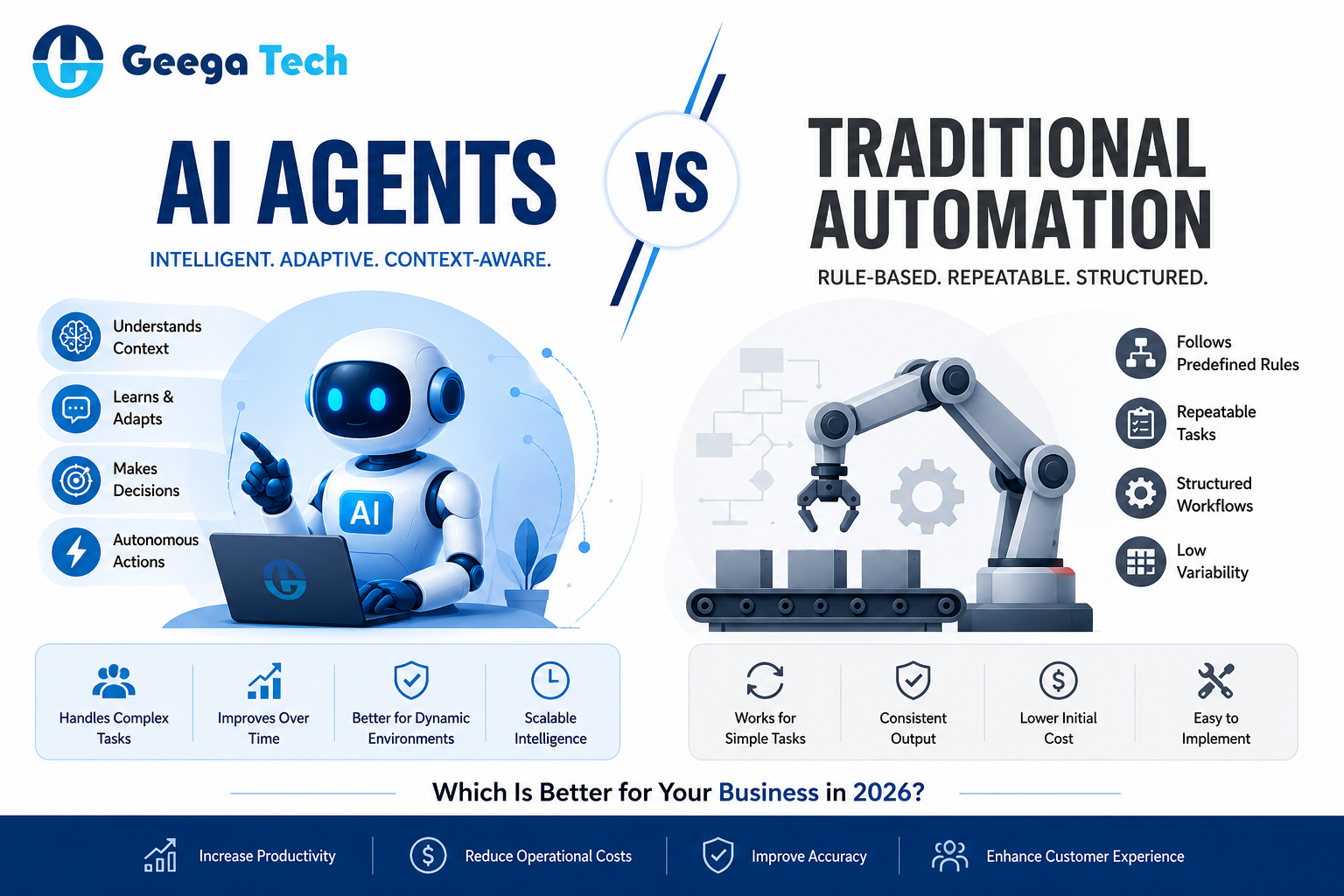
Unlike traditional automation, AI Agents can adapt to changing situations and continuously improve their performance.

How Businesses Are Using AI Agents

Customer Support

AI Agents provide 24/7 customer assistance by answering queries, creating support tickets, tracking orders, and resolving common issues.

Software Development

Development teams use AI Agents to:

  • Generate code
  • Detect bugs
  • Review pull requests
  • Create documentation
  • Perform automated testing

This helps developers focus on solving complex business problems instead of repetitive coding tasks.

HR & Recruitment

Businesses automate:

  • Resume screening
  • Interview scheduling
  • Candidate communication
  • Employee onboarding

Finance

AI Agents assist with:

  • Invoice processing
  • Expense management
  • Financial reporting
  • Fraud detection

Sales & Marketing

Companies use AI Agents for:

  • Lead qualification
  • Email personalization
  • CRM updates
  • Customer insights
  • Marketing automation

Benefits of AI Agents

✅ Faster business operations

✅ Reduced operational costs

✅ Improved employee productivity

✅ Better customer experience

✅ Data-driven decision making

✅ 24/7 availability

✅ Scalable business automation

Industries Benefiting the Most

  • Healthcare
  • Banking & Finance
  • Manufacturing
  • Retail & E-commerce
  • Logistics
  • Education
  • IT Services
  • SaaS Companies

Future of AI Agents in Enterprise Operations

AI Agents are expected to become even more intelligent over the next few years. Instead of handling isolated tasks, future AI Agents will collaborate across departments, coordinate with multiple business systems, and continuously optimize workflows based on real-time data.

Organizations adopting AI Agents today will gain a competitive advantage through increased efficiency, lower operational costs, improved customer experiences, and faster innovation. As AI technologies continue evolving, intelligent agents will become a standard part of every modern enterprise.

Why Businesses Should Start Now

Early adopters of AI Agents are already gaining a competitive advantage through higher efficiency, lower costs, and faster decision-making. Recent industry trends show enterprises increasingly prioritizing AI, governance, and automation as core business capabilities rather than experimental projects.

Why Choose Geega Tech for AI Agent Development?

At Geega Tech, we help startups, SMEs, and enterprises build AI-powered software solutions that automate repetitive tasks, improve operational efficiency, and accelerate digital transformation. Our team specializes in custom AI agent development, enterprise software modernization, workflow automation, cloud integration, and scalable web and mobile applications. Whether you’re looking to automate customer support, streamline business processes, or integrate AI into your existing systems, we deliver secure, scalable, and future-ready solutions tailored to your business needs.

How Geega Technologies Can Help

At Geega Technologies, we help businesses integrate AI-powered solutions into their existing software and workflows. Whether you need intelligent automation, custom AI development, enterprise software modernization, or business process optimization, our team builds scalable and secure solutions tailored to your organization.

Conclusion

AI Agents Enterprise Operations will continue driving digital transformation for enterprises in the coming years. AI Agents are reshaping the way businesses operate. Instead of replacing human teams, they enhance productivity by automating repetitive tasks and enabling employees to focus on strategic work. Organizations that embrace AI today will be better prepared for the future of digital transformation.

Get in touch with us

Looking for a certified tech partner? Contact Geega Technologies today.

Why AI Agents Are Transforming Enterprise Operations in 2026

Home »Why AI Agents Are Transforming Enterprise Operations in 2026


Why AI Agents Are Transforming Enterprise Operations in 2026

AI Agents Enterprise Operations are changing how modern businesses manage daily workflows and business processes. Artificial Intelligence has evolved far beyond chatbots and content generation. In 2026, businesses are adopting AI Agents that can independently perform tasks, automate workflows, analyze data, and support decision-making with minimal human intervention.

From customer support and HR to software development and finance, AI agents are becoming an essential part of modern enterprise operations. Organizations are using them to reduce costs, improve productivity, and deliver faster business outcomes. This reflects the broader shift toward AI-driven enterprise operations and software modernization across industries.

AI agents transforming enterprise operations through intelligent automation in 2026

What Are AI Agents?

AI Agents are intelligent software systems capable of:

  • Understanding business goals
  • Planning multi-step tasks
  • Making logical decisions
  • Interacting with different software tools
  • Learning from previous actions
  • Completing workflows with minimal human supervision

Unlike traditional automation, AI Agents can adapt to changing situations and continuously improve their performance.

How Businesses Are Using AI Agents

Customer Support

AI Agents provide 24/7 customer assistance by answering queries, creating support tickets, tracking orders, and resolving common issues.

Software Development

Development teams use AI Agents to:

  • Generate code
  • Detect bugs
  • Review pull requests
  • Create documentation
  • Perform automated testing

This helps developers focus on solving complex business problems instead of repetitive coding tasks.

HR & Recruitment

Businesses automate:

  • Resume screening
  • Interview scheduling
  • Candidate communication
  • Employee onboarding

Finance

AI Agents assist with:

  • Invoice processing
  • Expense management
  • Financial reporting
  • Fraud detection

Sales & Marketing

Companies use AI Agents for:

  • Lead qualification
  • Email personalization
  • CRM updates
  • Customer insights
  • Marketing automation

Benefits of AI Agents

✅ Faster business operations

✅ Reduced operational costs

✅ Improved employee productivity

✅ Better customer experience

✅ Data-driven decision making

✅ 24/7 availability

✅ Scalable business automation

Industries Benefiting the Most

  • Healthcare
  • Banking & Finance
  • Manufacturing
  • Retail & E-commerce
  • Logistics
  • Education
  • IT Services
  • SaaS Companies

Future of AI Agents in Enterprise Operations

AI Agents are expected to become even more intelligent over the next few years. Instead of handling isolated tasks, future AI Agents will collaborate across departments, coordinate with multiple business systems, and continuously optimize workflows based on real-time data.

Organizations adopting AI Agents today will gain a competitive advantage through increased efficiency, lower operational costs, improved customer experiences, and faster innovation. As AI technologies continue evolving, intelligent agents will become a standard part of every modern enterprise.

Why Businesses Should Start Now

Early adopters of AI Agents are already gaining a competitive advantage through higher efficiency, lower costs, and faster decision-making. Recent industry trends show enterprises increasingly prioritizing AI, governance, and automation as core business capabilities rather than experimental projects.

Why Choose Geega Tech for AI Agent Development?

At Geega Tech, we help startups, SMEs, and enterprises build AI-powered software solutions that automate repetitive tasks, improve operational efficiency, and accelerate digital transformation. Our team specializes in custom AI agent development, enterprise software modernization, workflow automation, cloud integration, and scalable web and mobile applications. Whether you’re looking to automate customer support, streamline business processes, or integrate AI into your existing systems, we deliver secure, scalable, and future-ready solutions tailored to your business needs.

How Geega Technologies Can Help

At Geega Technologies, we help businesses integrate AI-powered solutions into their existing software and workflows. Whether you need intelligent automation, custom AI development, enterprise software modernization, or business process optimization, our team builds scalable and secure solutions tailored to your organization.

Conclusion

AI Agents Enterprise Operations will continue driving digital transformation for enterprises in the coming years. AI Agents are reshaping the way businesses operate. Instead of replacing human teams, they enhance productivity by automating repetitive tasks and enabling employees to focus on strategic work. Organizations that embrace AI today will be better prepared for the future of digital transformation.

Get in touch with us

Looking for a certified tech partner? Contact Geega Technologies today.

AI-Native Software Development: Why Businesses Need More Than Just AI Coding Tools in 2026

Home »AI-Native Software Development: Why Businesses Need More Than Just AI Coding Tools in 2026


AI-Native Software Development: Why Businesses Need More Than Just AI Coding Tools in 2026

Artificial Intelligence has completely changed how software is developed. Today, developers can generate code, automate testing, create documentation, and even debug applications using AI. However, many businesses believe that simply using AI coding tools is enough to build enterprise software.

The reality is different.

Successful digital products are no longer built by AI alone—they are built by AI-native development teams that combine AI automation with experienced software architects, developers, security experts, and business analysts.

At Geega Technologies, we help businesses leverage AI to build faster, smarter, and more reliable software while ensuring enterprise-grade quality, scalability, and security.

AI-Native Software Development Services by Geega Technologies

What is AI-Native Software Development?

AI-Native Software Development is an approach where AI becomes a core part of the entire software development lifecycle instead of just assisting with coding.

It combines:

  • AI-assisted coding
  • Automated testing
  • Intelligent documentation
  • AI-powered code reviews
  • Performance optimization
  • Security scanning
  • DevOps automation
  • Continuous monitoring

The goal is not to replace developers—but to make development faster, more accurate, and more cost-effective. AI is increasingly being used throughout software development, but organizations still need strong engineering practices for scalable, secure systems.

Why AI Alone Isn’t Enough

Many AI-generated applications face challenges like:

  • Poor architecture
  • Security vulnerabilities
  • Scalability issues
  • Performance bottlenecks
  • Lack of maintainability
  • Inconsistent coding standards

Without proper human oversight, these problems can become expensive as the application grows.

Benefits of AI-Native Development

Faster Development

AI automates repetitive coding tasks, helping development teams deliver software significantly faster.

Better Code Quality

Automated reviews and intelligent suggestions help reduce common coding errors before deployment.

Improved Security

AI can identify vulnerabilities early in the development cycle, reducing security risks.

Lower Development Cost

Automation reduces manual effort, enabling businesses to optimize budgets without compromising quality.

Faster Testing

AI-powered testing generates and executes test cases automatically, accelerating release cycles.

Better Maintenance

AI continuously monitors applications, detects anomalies, and recommends improvements after deployment.

Where Businesses Can Use AI-Native Development

  • Custom ERP Systems
  • CRM Solutions
  • Healthcare Applications
  • FinTech Platforms
  • Manufacturing Software
  • Logistics Platforms
  • E-commerce Applications
  • SaaS Products
  • Enterprise Dashboards
  • AI Business Automation Solutions

Technologies We Use

At Geega Technologies, we combine modern technologies with AI-powered workflows:

  • Node.js
  • React
  • Next.js
  • Angular
  • Python
  • .NET
  • Java
  • MongoDB
  • PostgreSQL
  • Docker
  • Kubernetes
  • AWS
  • Azure
  • OpenAI APIs
  • AI Agents
  • DevSecOps

Why Choose Geega Technologies?

We don’t just generate software using AI—we engineer production-ready digital solutions.

Our team focuses on:

  • AI-powered software architecture
  • Enterprise-grade security
  • Cloud-native applications
  • Performance optimization
  • Scalable system design
  • Modern UI/UX
  • DevOps automation
  • Long-term maintenance and enhancement

This ensures your software is future-ready, secure, and built to scale.

Final Thoughts

AI has transformed software development, but successful businesses understand that AI is a powerful accelerator—not a replacement for engineering expertise. Companies that combine intelligent automation with experienced development teams can deliver software faster while maintaining reliability, security, and long-term scalability. Current industry trends show AI is shifting software teams toward higher-value engineering work rather than eliminating the need for experienced developers.

If you’re looking to modernize existing software or build a new AI-powered application, Geega Technologies can help you turn your ideas into scalable, intelligent business solutions.

Get in touch with us

Looking for a certified tech partner? Contact Geega Technologies today.

AI-Powered Virtual Assistance Services in 2026: The Smarter Way to Run Your Business

Home »AI-Powered Virtual Assistance Services in 2026: The Smarter Way to Run Your Business


AI-Powered Virtual Assistance Services in 2026: The Smarter Way to Run Your Business

Businesses today spend countless hours on repetitive tasks like managing emails, scheduling meetings, updating CRMs, preparing reports, handling customer queries, processing documents, and organizing business data. While these tasks are essential, they often consume valuable time that could be invested in business growth.

In 2026, companies are moving beyond traditional Virtual Assistants and adopting AI-Powered Virtual Assistance Services. By combining Artificial Intelligence, workflow automation, and human expertise, businesses can automate routine operations, improve accuracy, reduce operational costs, and achieve higher productivity.

At Geega Technologies, we provide next-generation AI-Powered Virtual Assistance Services that combine intelligent AI Agents with experienced professionals to create a smarter, faster, and more efficient business support system.

AI-Powered Virtual Assistance Services by Geega Technologies featuring AI agents, business automation, workflow automation, customer support, and remote virtual assistant solutions.

What Are AI-Powered Virtual Assistance Services?

AI-Powered Virtual Assistance Services use Artificial Intelligence to automate repetitive business processes while experienced professionals oversee quality, handle exceptions, and manage strategic tasks.

Instead of relying solely on manual work, AI performs the majority of repetitive operations, allowing businesses to complete tasks faster, reduce errors, and operate more efficiently.

This modern approach delivers the perfect balance between automation and human expertise.


Why Businesses Are Switching to AI-Powered Virtual Assistants

Traditional virtual assistants are valuable, but AI can perform many repetitive tasks in seconds. Businesses are adopting AI-powered virtual assistance because it offers:

  • Faster task completion
  • Reduced operational costs
  • 24/7 business support
  • Improved productivity
  • Higher accuracy
  • Scalable operations
  • Better customer experiences
  • Intelligent workflow automation
  • Faster business decisions
  • More time for strategic growth

AI-Powered Services We Offer

AI Email Management

Our AI systems organize inboxes, prioritize emails, draft responses, categorize conversations, and schedule follow-ups automatically.


AI Calendar & Meeting Management

Automate appointment scheduling, calendar organization, reminders, meeting coordination, and conflict resolution.


AI Customer Support

Provide instant support through AI-powered chat assistants that answer common questions, create support tickets, and escalate complex issues when needed.


AI Lead Generation

Identify potential customers, collect business information, qualify leads, organize CRM data, and prepare outreach lists using intelligent automation.


AI Research Assistant

Perform competitor analysis, market research, product research, industry monitoring, and business intelligence within minutes.


AI Data Entry & Data Processing

Automate repetitive data entry tasks, spreadsheet updates, document processing, CRM management, and database maintenance with improved accuracy.


AI Report Generation

Generate daily reports, weekly performance summaries, dashboards, business analytics, and operational insights automatically.


AI Content & Documentation

Create professional documentation including SOPs, reports, presentations, proposals, meeting notes, product descriptions, and business documents.


AI SEO Assistance

Support your marketing efforts with keyword research, content optimization, metadata creation, competitor analysis, and SEO reporting.


AI Workflow Automation

Connect your business applications and automate repetitive workflows across departments, reducing manual effort and increasing efficiency.


Human Expertise Where It Matters

While AI performs repetitive operations, experienced professionals ensure quality, accuracy, and business alignment.

Our experts handle:

  • Final quality assurance
  • Client communication
  • Business decision support
  • Exception handling
  • Process optimization
  • Workflow supervision
  • Strategic planning
  • Performance monitoring

This hybrid approach ensures businesses receive the speed of AI along with the reliability of experienced professionals.


Industries We Support

Our AI-Powered Virtual Assistance Services help organizations across multiple industries:

  • Healthcare
  • IT & Software
  • Manufacturing
  • E-commerce
  • Real Estate
  • Finance
  • Education
  • Marketing Agencies
  • Logistics
  • Startups
  • Professional Services

Why Choose Geega Technologies?

Geega Technologies delivers more than traditional virtual assistance. We build AI-powered business support systems that improve efficiency, reduce costs, and help organizations scale with confidence.

When you partner with us, you receive:

  • AI-powered business automation
  • Dedicated Virtual Assistant
  • Intelligent AI Agents
  • Daily automated reporting
  • Weekly performance reviews
  • Secure business operations
  • SLA-driven support
  • Time tracking and productivity monitoring
  • Scalable engagement models
  • Continuous workflow optimization
  • Professional communication standards
  • Dedicated account management

Our AI-Powered Virtual Assistance Process

1. Business Discovery

We analyze your business processes, operational challenges, and automation opportunities.

2. Workflow Assessment

Our specialists identify repetitive tasks that can be automated using AI.

3. AI Implementation

We deploy AI-powered tools, intelligent workflows, and automation systems tailored to your business.

4. Human Supervision

Dedicated professionals monitor AI performance, verify outputs, and manage exceptions.

5. Continuous Optimization

We regularly improve workflows, automation rules, and reporting to maximize business productivity.


Benefits of AI-Powered Virtual Assistance

  • Reduce operational costs
  • Save hundreds of working hours every month
  • Improve response times
  • Increase employee productivity
  • Eliminate repetitive manual work
  • Improve reporting accuracy
  • Scale your business without increasing overhead
  • Deliver better customer experiences
  • Support business growth with intelligent automation

The Future of Business Operations

The future belongs to businesses that combine Artificial Intelligence with skilled professionals. Instead of hiring large teams for repetitive work, organizations are investing in AI-powered virtual operations that deliver faster results, lower costs, and greater flexibility.

AI is no longer replacing people—it is empowering them to focus on innovation, strategy, and business growth.


Conclusion

AI-Powered Virtual Assistance Services are transforming how businesses operate in 2026. By combining intelligent AI Agents with experienced professionals, organizations can automate routine work, improve productivity, reduce operational expenses, and scale efficiently.

At Geega Technologies, we help businesses embrace this new way of working through secure, scalable, and intelligent virtual assistance solutions. Whether you need administrative support, customer service, research, reporting, sales assistance, or workflow automation, our AI-powered team is ready to help your business grow smarter and faster.

Ready to transform your operations with AI? Contact Geega Technologies today and discover how AI-Powered Virtual Assistance Services can accelerate your business success.

Get in touch with us

Looking for a certified tech partner? Contact Geega Technologies today.

Why Businesses Are Choosing AI Workflow Automation Over Manual Processes in 2026

Home »Why Businesses Are Choosing AI Workflow Automation Over Manual Processes in 2026


Why Businesses Are Choosing AI Workflow Automation Over Manual Processes in 2026

Businesses in 2026 are under constant pressure to deliver faster services, reduce operational costs, and improve customer experiences. Traditional manual workflows often lead to delays, repetitive tasks, and human errors that slow business growth.

This is why organizations across industries are rapidly adopting AI Workflow Automation. Instead of replacing employees, AI empowers teams by automating repetitive work, improving decision-making, and allowing people to focus on higher-value tasks.

At Geega Technologies, we help businesses implement AI-powered workflow automation solutions that streamline operations, increase productivity, and support long-term digital transformation.

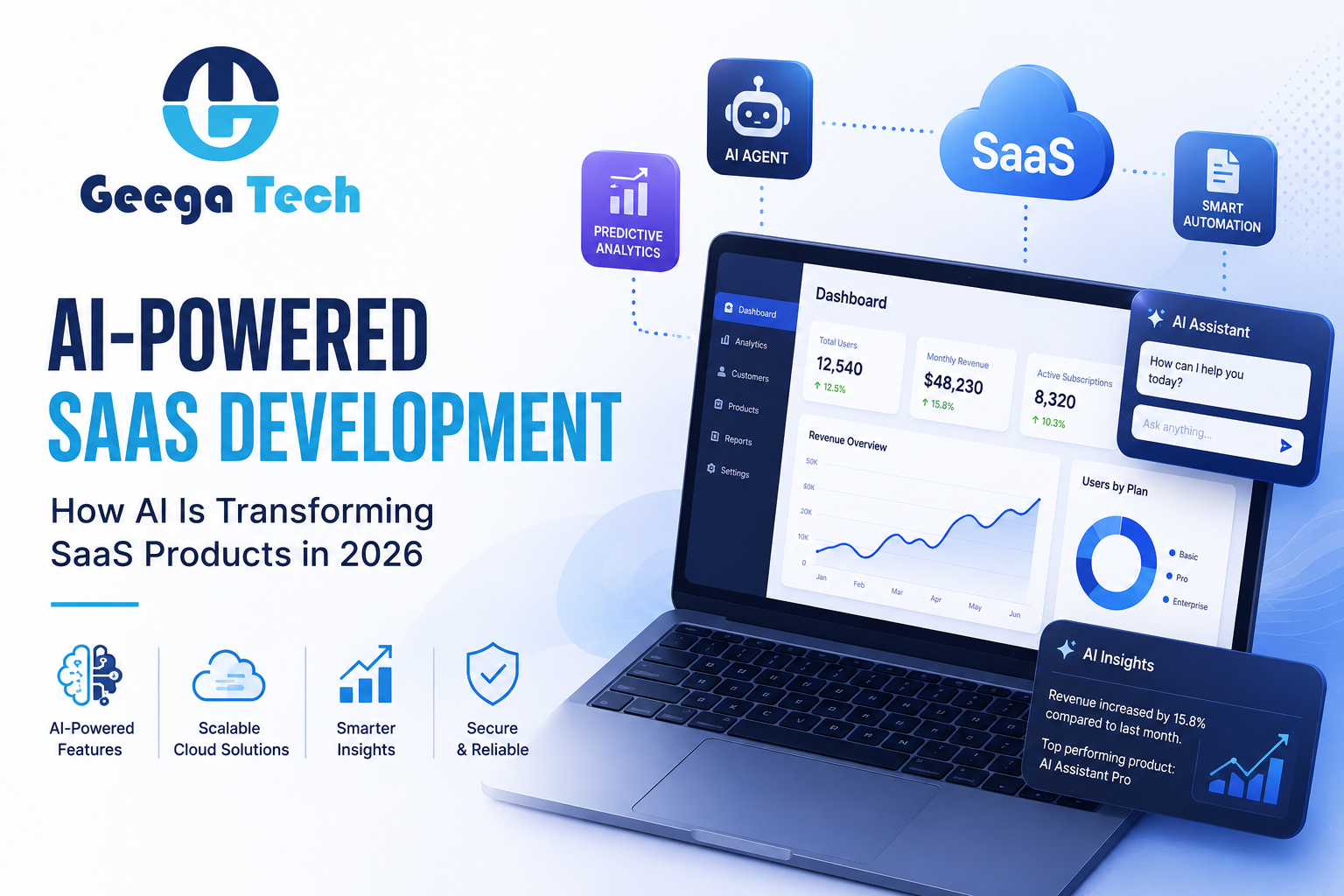
AI Workflow Automation dashboard with business process automation solutions by Geega Tech

What Is AI Workflow Automation?

AI Workflow Automation combines Artificial Intelligence with business processes to automate routine tasks while making intelligent decisions based on real-time data.

Unlike traditional automation, AI systems can:

  • Analyze large volumes of data
  • Learn from historical information
  • Predict outcomes
  • Automate complex workflows
  • Improve continuously over time

This enables businesses to operate more efficiently while maintaining accuracy and scalability.

Why Manual Processes Are Holding Businesses Back

Many companies still rely on spreadsheets, emails, and manual approvals for critical operations. As businesses grow, these methods become increasingly difficult to manage.

Common challenges include:

  • Slow approval processes
  • Data entry errors
  • Repetitive administrative work
  • Limited visibility into operations
  • Higher operational costs
  • Delayed customer responses

These inefficiencies directly impact profitability and customer satisfaction.

Benefits of AI Workflow Automation

Faster Business Operations

AI automates repetitive tasks in seconds, significantly reducing turnaround times.

Improved Accuracy

Automated workflows minimize human errors and ensure consistent execution across departments.

Lower Operational Costs

Reducing manual work allows businesses to optimize resources and lower administrative expenses.

Better Customer Experience

AI-powered systems provide faster responses, quicker issue resolution, and personalized interactions.

Real-Time Insights

Automation platforms generate dashboards and analytics that help management make informed business decisions.

Easy Scalability

As your business grows, automated workflows can easily adapt without requiring significant additional resources.

Industries Benefiting from AI Workflow Automation

Organizations across multiple sectors are already seeing measurable improvements through automation.

These include:

  • Healthcare
  • Manufacturing
  • Finance
  • Retail & E-commerce
  • Logistics
  • Education
  • Real Estate
  • Human Resources
  • Customer Support
  • IT Services

Regardless of industry, automation helps eliminate repetitive work while improving efficiency.

AI Workflow Automation Use Cases

Businesses commonly automate processes such as:

  • Employee onboarding
  • Customer support ticket routing
  • Invoice processing
  • Purchase approvals
  • HR document management
  • Lead qualification
  • CRM updates
  • Inventory tracking
  • Sales reporting
  • Vendor management

These workflows save time while improving consistency and transparency.

Why Choose Geega Technologies?

At Geega Technologies, we build intelligent automation solutions tailored to your business goals.

Our expertise includes:

  • AI Workflow Automation
  • Custom Software Development
  • Business Process Automation
  • Enterprise Application Development
  • Cloud Solutions
  • API Integration
  • Data Analytics
  • Legacy Software Modernization
  • Mobile & Web Applications

Every solution is designed to improve productivity, reduce operational costs, and prepare your business for future growth.

The Future of Business Automation

AI Workflow Automation is no longer a competitive advantage—it is becoming a business necessity.

Companies that automate today can respond faster to market changes, improve operational efficiency, and deliver better customer experiences than those relying on manual processes.

As AI technologies continue to evolve, businesses investing in intelligent automation will be better positioned for sustainable growth.

Conclusion

Manual processes limit growth, increase costs, and reduce operational efficiency. AI Workflow Automation enables businesses to streamline operations, improve accuracy, and scale confidently.

Whether you’re a startup or a large enterprise, implementing AI-powered workflows can transform the way your business operates.

At Geega Technologies, we help organizations build intelligent automation solutions that drive innovation, efficiency, and long-term success.

Ready to automate your business? Contact Geega Technologies today to discover how AI Workflow Automation can transform your operations.

Get in touch with us

Looking for a certified tech partner? Contact Geega Technologies today.

AI Agents for Business in 2026: 10 Smart Ways They Are Transforming Enterprises

Home »AI Agents for Business in 2026: 10 Smart Ways They Are Transforming Enterprises


AI Agents for Business in 2026: 10 Smart Ways They Are Transforming Enterprises

Artificial Intelligence has moved far beyond simple chatbots and automation tools. In 2026, businesses are embracing AI Agents—intelligent software systems capable of understanding goals, analyzing information, making decisions, and executing complex tasks with minimal human intervention.

Unlike traditional software that follows predefined rules, AI agents continuously learn from data and improve their performance over time. They integrate seamlessly with CRM, ERP, HRMS, accounting software, customer support platforms, and other enterprise applications, helping organizations automate repetitive work and improve operational efficiency.

From startups to large enterprises, AI agents are helping businesses reduce costs, improve productivity, deliver better customer experiences, and make faster data-driven decisions. Instead of replacing employees, AI agents work alongside teams by handling routine and time-consuming tasks, allowing employees to focus on innovation, strategy, and customer relationships.

At Geega Technologies, we help businesses build intelligent AI-powered software solutions that automate workflows, modernize existing applications, and accelerate digital transformation.

AI Agents for Business in 2026 helping enterprises automate workflows, improve productivity, and accelerate digital transformation with Geega Technologies.

What Are AI Agents?

An AI agent is an intelligent software application that can perform tasks independently by understanding business objectives, analyzing information, making decisions, and taking appropriate actions.

Unlike traditional automation tools that only follow fixed workflows, AI agents can adapt to changing situations and interact with multiple business systems without constant human supervision.

An AI agent can:

  • Understand natural language
  • Analyze structured and unstructured data
  • Automate repetitive workflows
  • Generate reports and summaries
  • Schedule meetings
  • Process documents
  • Communicate with customers
  • Integrate with enterprise software
  • Learn from previous interactions

Think of an AI agent as a digital employee that works around the clock without getting tired, helping businesses improve efficiency and accuracy.

AI Agents vs Traditional Chatbots

Many businesses believe AI agents are simply advanced chatbots. In reality, AI agents are far more capable.

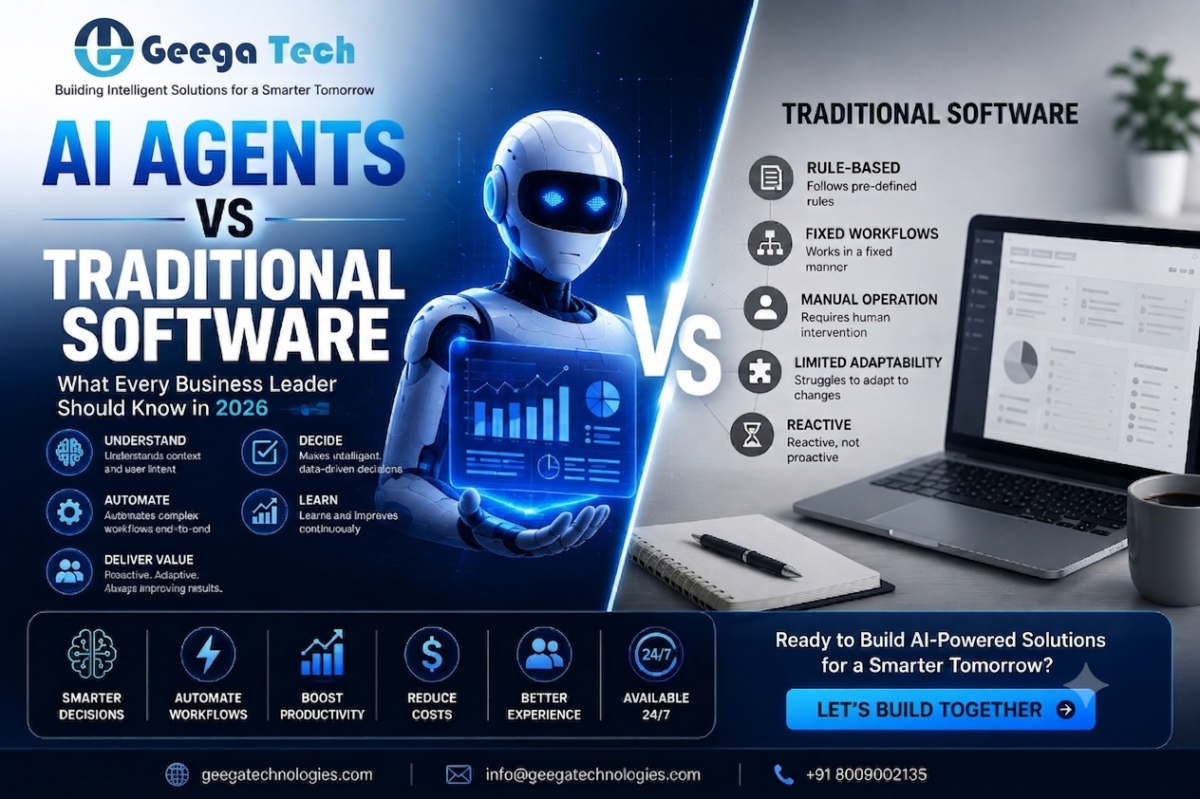
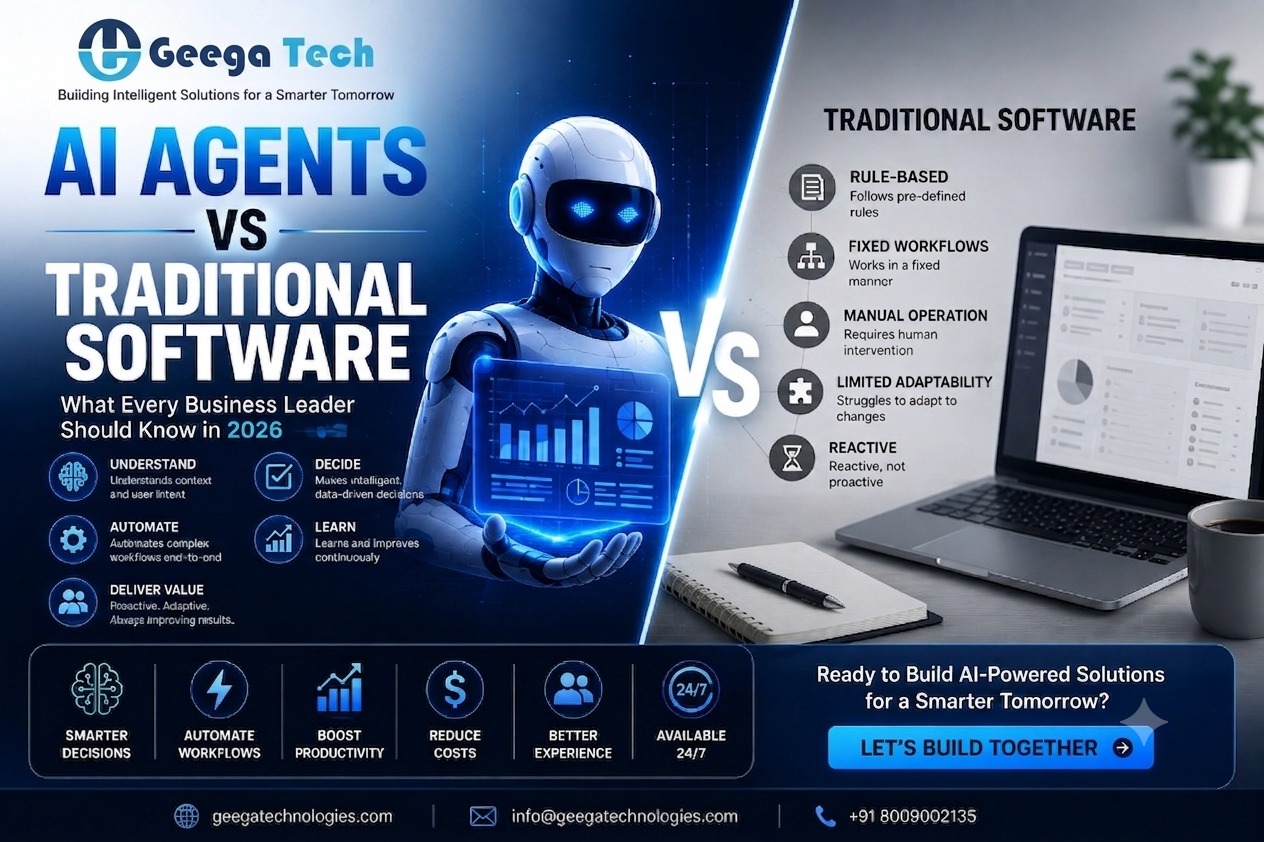
Traditional Chatbots AI Agents
Answer predefined questions Complete business tasks
Follow fixed scripts Make intelligent decisions
Limited integrations Connect with multiple enterprise systems
Reactive Proactive
Customer support focused Support every business department

For example, a chatbot may answer a customer’s question about an order. An AI agent can check inventory, verify payment, update the CRM, arrange shipping, notify the customer, and generate reports automatically.

This ability to perform actions instead of simply responding makes AI agents a game-changer for modern businesses.

How Businesses Are Using AI Agents in 2026

1. Sales Automation

AI agents help sales teams qualify leads, analyze customer behavior, update CRM systems, schedule meetings, and send personalized follow-up emails. By reducing administrative work, sales professionals can focus on building relationships and closing more deals.

2. Customer Support

Modern AI agents provide intelligent 24/7 customer support. They answer customer queries, create support tickets, process refunds, escalate complex issues, and recommend solutions based on previous interactions.

This improves customer satisfaction while reducing support costs.

3. Human Resources

Recruitment and employee management involve many repetitive tasks. AI agents automate resume screening, interview scheduling, onboarding documentation, employee support, and HR reporting, making recruitment faster and more efficient.

4. Finance & Accounting

Finance departments use AI agents to automate invoice processing, expense verification, payment reminders, financial reporting, fraud detection, and compliance monitoring.

This reduces manual errors while improving financial visibility.

5. Marketing Automation

Marketing teams use AI agents to generate content, personalize email campaigns, optimize SEO, analyze campaign performance, schedule social media posts, and identify potential customers.

AI-powered marketing helps businesses improve engagement and maximize ROI.

6. Healthcare Operations

Hospitals and healthcare providers use AI agents to manage appointments, verify insurance, summarize medical records, automate documentation, and improve patient communication.

This allows healthcare professionals to spend more time focusing on patient care.

7. Manufacturing & Production

Manufacturing companies rely on AI agents for predictive maintenance, inventory management, production planning, machine monitoring, and quality control.

This helps reduce downtime while increasing productivity.

8. Supply Chain & Logistics

AI agents optimize delivery routes, forecast inventory requirements, monitor shipments, coordinate warehouses, and improve supply chain visibility.

Businesses benefit from faster deliveries and lower transportation costs.

9. Software Development

Developers use AI agents to generate code, review pull requests, identify bugs, write documentation, create test cases, and recommend performance improvements.

This accelerates software development while maintaining high code quality.

10. Business Intelligence

AI agents analyze business data, generate dashboards, identify trends, prepare executive reports, and provide real-time recommendations that help organizations make faster and smarter decisions.

Benefits of AI Agents

Businesses implementing AI agents experience measurable improvements across multiple areas.

Some of the biggest benefits include:

  • Increased employee productivity
  • Reduced operational costs
  • Faster decision-making
  • Improved customer satisfaction
  • Higher data accuracy
  • Better workflow automation
  • Scalable business operations
  • 24/7 business support
  • Better resource utilization
  • Increased business agility

These benefits enable organizations to remain competitive in an increasingly digital marketplace.

Why Businesses Should Invest in AI Agents

As technology continues to evolve, businesses need intelligent systems that can adapt quickly to changing market demands. AI agents not only automate repetitive work but also provide valuable insights that help organizations improve efficiency, reduce costs, and deliver better customer experiences.

Companies adopting AI agents today are building a strong foundation for future growth while staying ahead of competitors that still rely on manual processes.

Whether your goal is to improve internal operations, enhance customer service, or optimize business performance, AI agents provide a scalable and cost-effective solution.

Why Choose Geega Technologies?

At Geega Technologies, we specialize in building secure, scalable, and enterprise-grade AI solutions tailored to business needs.

Our expertise includes:

  • AI Agent Development
  • Custom AI Software Development
  • AI Workflow Automation
  • Enterprise AI Solutions
  • Business Process Automation
  • AI Integration Services
  • Software Enhancement & Modernization
  • Cloud Application Development
  • Mobile & Web Application Development
  • Intelligent Analytics Solutions

Our experienced development team works closely with clients to understand their business challenges and create AI-powered solutions that deliver measurable results. From strategy and development to deployment and ongoing support, we help businesses unlock the full potential of Artificial Intelligence.

Conclusion

AI agents are transforming how businesses operate in 2026. They go far beyond traditional chatbots by automating complex workflows, supporting intelligent decision-making, and integrating seamlessly with existing business systems.

Organizations that invest in AI agents today can improve productivity, reduce operational costs, enhance customer experiences, and accelerate digital transformation.

If you’re planning to integrate AI into your business, Geega Technologies can help you design and develop customized AI solutions that align with your business goals and prepare your organization for the future of intelligent automation.

Get in touch with us

Looking for a certified tech partner? Contact Geega Technologies today.

AI Software Modernization in 2026: How Legacy Applications Are Becoming Intelligent Business Assets

Home » AI Software Modernization in 2026: How Legacy Applications Are Becoming Intelligent Business Assets


AI Software Modernization in 2026: How Legacy Applications Are Becoming Intelligent Business Assets

Many businesses still depend on software that was developed five, ten, or even twenty years ago. While these applications continue supporting daily operations, they often struggle with performance, security, scalability, and integration with modern technologies.

Replacing an entire system from scratch is expensive and risky. Instead, businesses are choosing AI-powered software modernization to upgrade existing applications while protecting previous investments.

In 2026, software modernization is no longer just about migrating applications to the cloud. It involves integrating Artificial Intelligence, automation, predictive analytics, modern architectures, and enhanced cybersecurity into existing systems.

At Geega Technologies, we help organizations modernize legacy software into intelligent, scalable, and future-ready digital platforms.

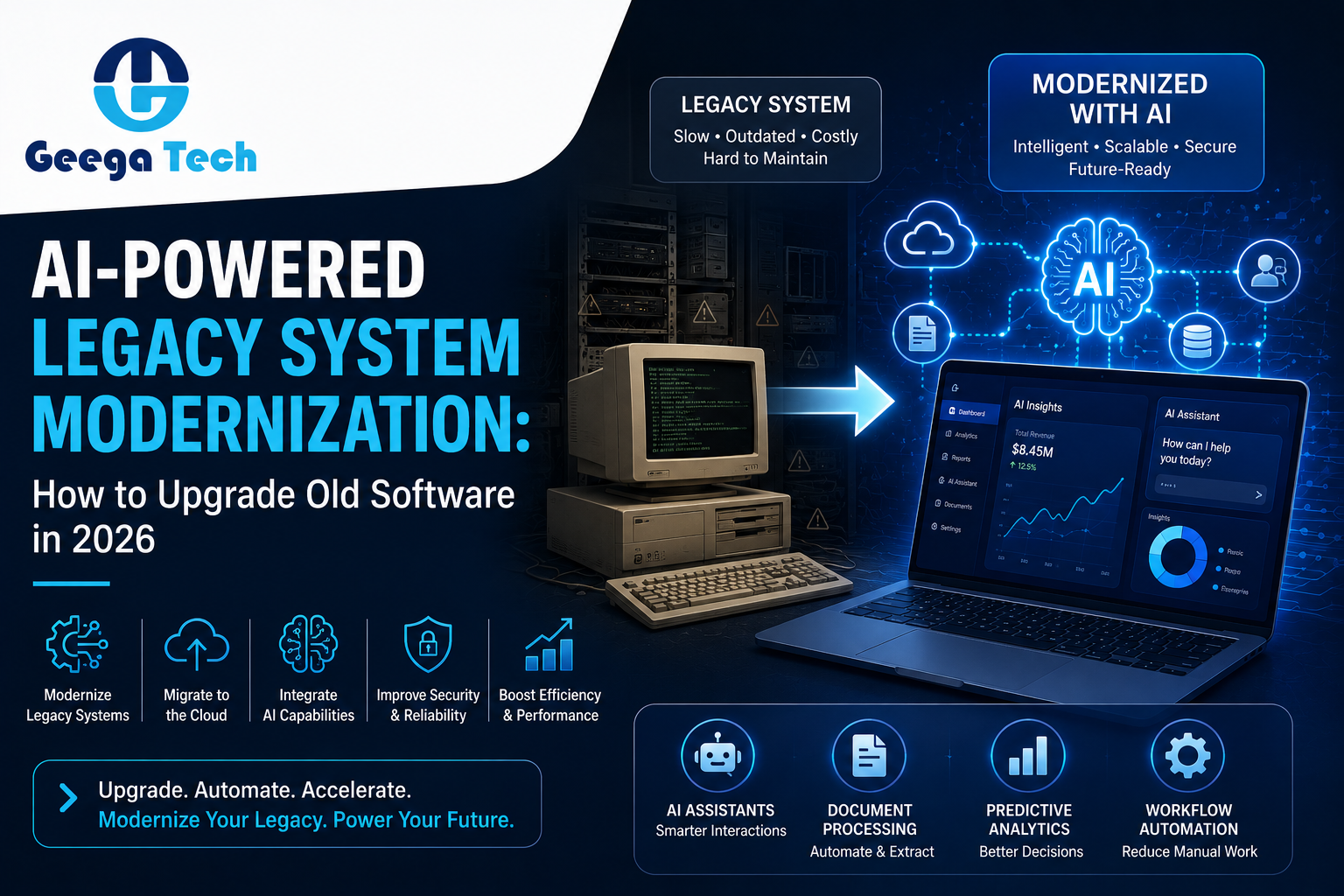
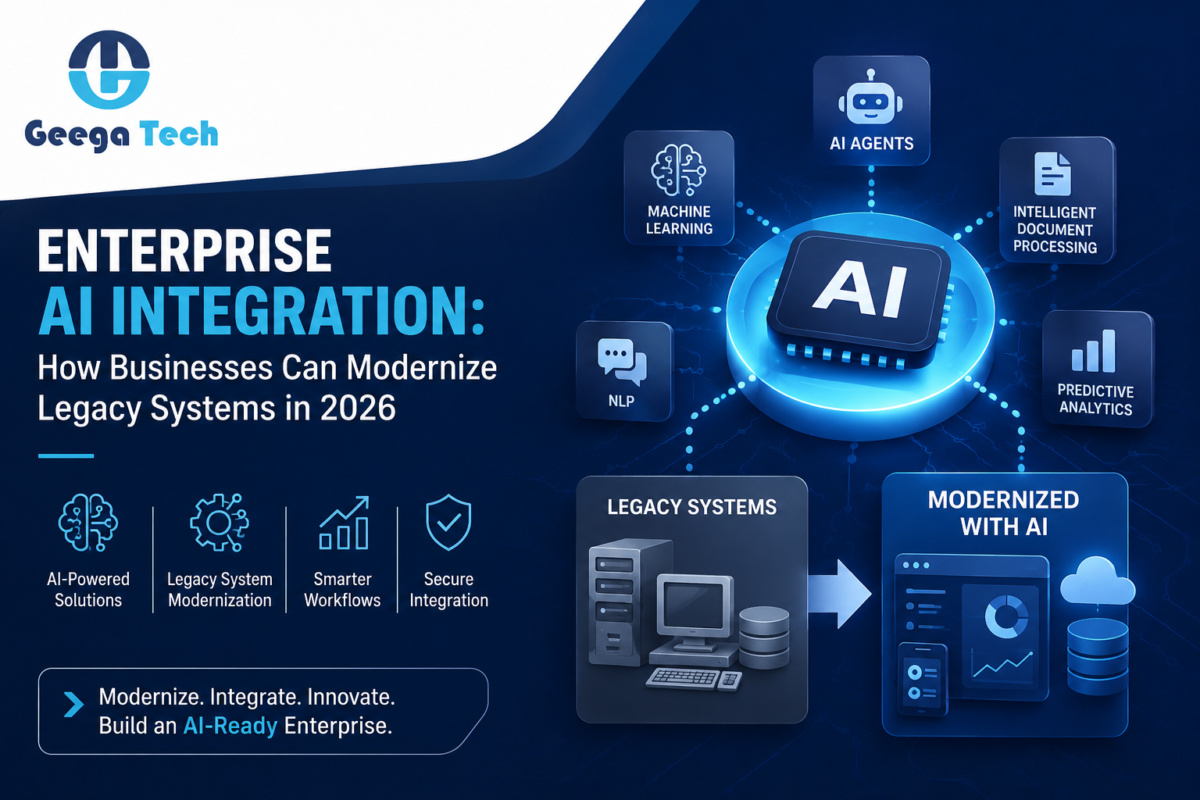
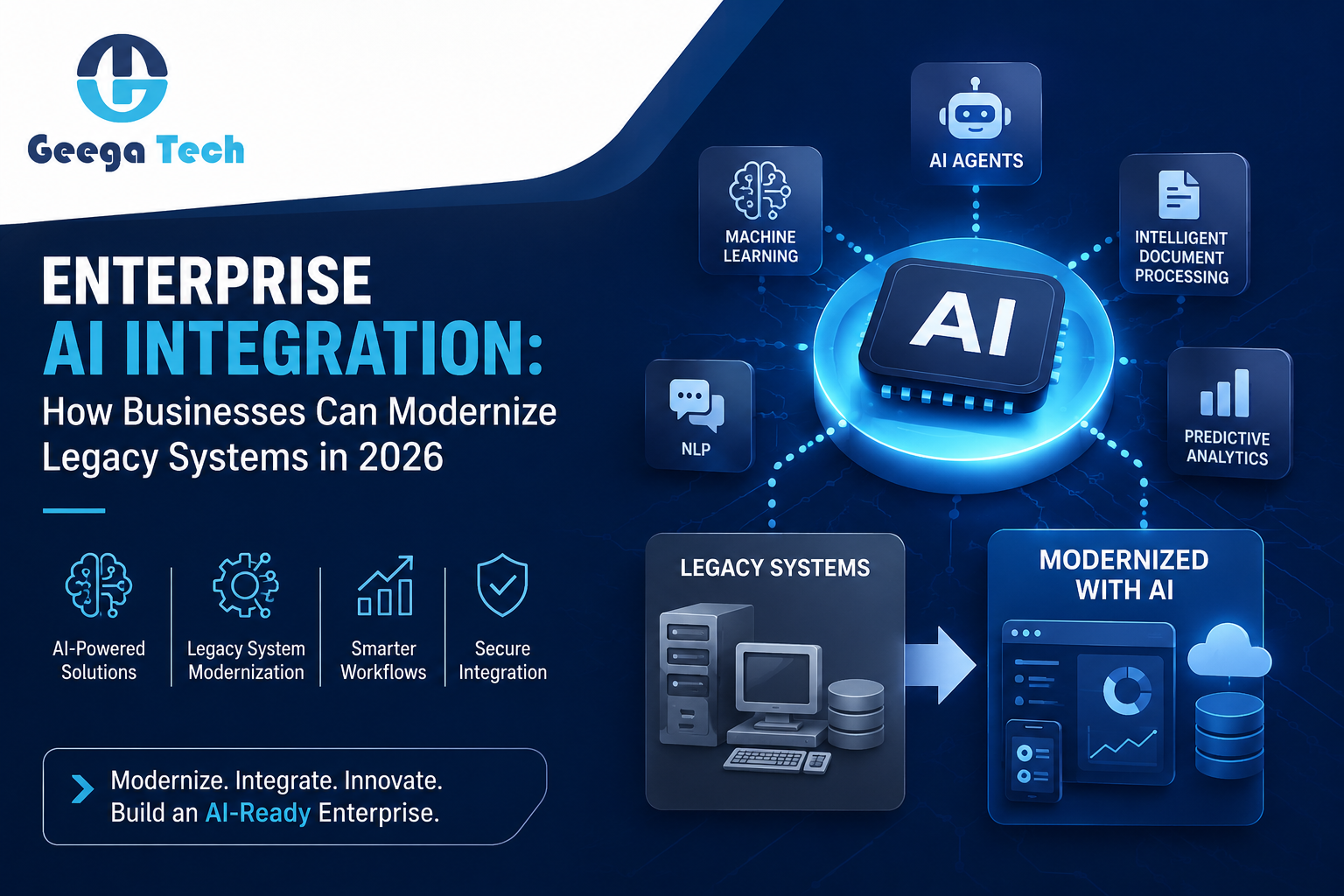
AI Software Modernization Services by Geega Technologies

What is AI Software Modernization?

AI Software Modernization is the process of upgrading existing applications using Artificial Intelligence, cloud technologies, automation, and modern development practices without disrupting business operations.

Instead of replacing software completely, businesses enhance:

  • Performance
  • Security
  • User Experience
  • Scalability
  • Automation
  • Analytics
  • Integration capabilities

The result is a smarter application that supports future business growth.

Why Legacy Applications Become Business Bottlenecks

Older software often faces several challenges:

Poor Performance

Applications become slower as data volume increases.

Difficult Maintenance

Outdated frameworks make development expensive and slow.

Security Risks

Older systems often lack modern authentication and security standards.

Limited Integrations

Connecting CRMs, ERPs, payment gateways, or AI platforms becomes difficult.

Bad User Experience

Employees expect fast, responsive, and mobile-friendly applications.

How AI Is Transforming Legacy Software

Artificial Intelligence adds new capabilities without requiring businesses to rebuild everything.

Intelligent Automation

Routine business operations can be automated, reducing manual work and operational costs.

Predictive Analytics

AI analyzes historical business data to forecast demand, customer behavior, inventory, and operational trends.

AI Chatbots

Customer support becomes available 24/7 through intelligent assistants.

Smart Search

Instead of keyword searches, AI understands user intent and delivers accurate results.

Personalized Dashboards

Users automatically receive insights based on their role and behavior.

Key Technologies Used in Modernization

Modern software modernization commonly includes:

  • React
  • Next.js
  • Node.js
  • .NET
  • Java
  • Python
  • Cloud Infrastructure
  • Docker
  • Kubernetes
  • REST APIs
  • GraphQL
  • AI Models
  • Machine Learning
  • Business Intelligence

These technologies create secure, scalable, and maintainable enterprise applications.

Benefits of AI Software Modernization

Businesses typically experience:

  • Faster application performance
  • Lower maintenance costs
  • Improved customer satisfaction
  • Better scalability
  • Enhanced cybersecurity
  • Automated workflows
  • Faster reporting
  • Better business decisions
  • Improved employee productivity
  • Long-term technology sustainability

Industries Benefiting from AI Modernization

Almost every industry benefits from upgrading legacy software.

Healthcare

  • Electronic Medical Records
  • Patient Portals
  • Hospital Management Systems

Finance

  • Loan Processing
  • Risk Analysis
  • Fraud Detection

Manufacturing

  • Production Monitoring
  • Predictive Maintenance
  • Inventory Optimization

Retail

  • Customer Analytics
  • Smart Recommendations
  • Order Management

Logistics

  • Fleet Tracking
  • Route Optimization
  • Warehouse Automation

Signs Your Business Needs Software Modernization

Your business should consider modernization if:

  • Software crashes frequently.
  • Development has become slow.
  • Integrations are difficult.
  • Security vulnerabilities are increasing.
  • Cloud migration is impossible.
  • Customer complaints are rising.
  • Reporting is mostly manual.
  • Maintenance costs continue growing.

Why Choose Geega Technologies?

Geega Technologies specializes in AI-powered software enhancement and modernization.

Our services include:

  • Legacy Software Assessment
  • Software Re-engineering
  • AI Integration
  • Performance Optimization
  • UI/UX Modernization
  • Cloud Migration
  • API Development
  • Security Hardening
  • DevOps Implementation
  • Long-term Maintenance

Our experienced team helps organizations modernize existing software while minimizing downtime and maximizing return on investment.

Final Thoughts

Legacy software doesn’t have to hold your business back. With AI-powered modernization, organizations can extend the life of existing systems, improve efficiency, reduce operational costs, and unlock new business opportunities.

The future belongs to businesses that modernize intelligently—not those that simply replace everything.

If your organization is planning a digital transformation, AI software modernization is one of the smartest investments you can make in 2026.

Get in touch with us

Looking for a certified tech partner? Contact Geega Technologies today.