Home » What Is Enterprise AI? A Practical Guide for Business Leaders
Artificial Intelligence is rapidly becoming an important part of modern business operations. Companies are using AI to automate repetitive work, analyze large amounts of data, improve customer experiences, support employees, and make business processes more efficient.
However, using a simple AI tool and implementing AI across an organization are very different things.
This is where Enterprise AI comes in.
Enterprise AI refers to the use of artificial intelligence technologies within organizations to solve real business problems, automate processes, analyze business data, and support decision-making at scale.
Unlike basic AI tools designed for individual users, enterprise AI solutions need to work securely with existing business applications, databases, employees, workflows, and infrastructure.
For business leaders, understanding enterprise AI is becoming increasingly important as AI moves from experimentation toward real business applications.
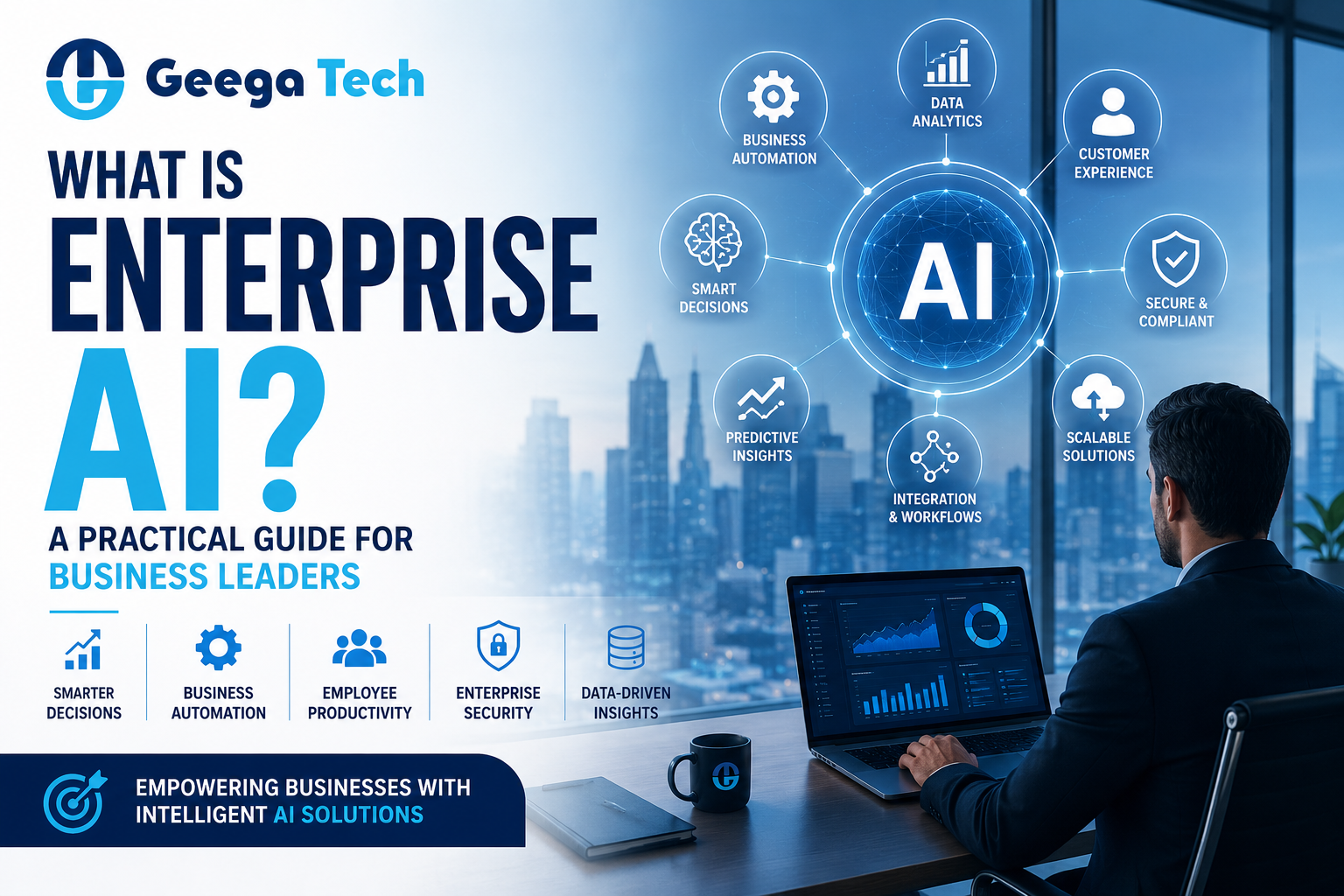
Artificial Intelligence is rapidly becoming an important part of modern business operations. Companies are using AI to automate repetitive work, analyze large amounts of data, improve customer experiences, support employees, and make business processes more efficient.
However, using a simple AI tool and implementing AI across an organization are very different things.
This is where Enterprise AI comes in.
Enterprise AI refers to the use of artificial intelligence technologies within organizations to solve real business problems, automate processes, analyze business data, and support decision-making at scale.
Unlike basic AI tools designed for individual users, enterprise AI solutions need to work securely with existing business applications, databases, employees, workflows, and infrastructure.
For business leaders, understanding enterprise AI is becoming increasingly important as AI moves from experimentation toward real business applications.
Enterprise AI combines artificial intelligence with an organization’s existing technology ecosystem.
A simplified enterprise AI architecture may look like:
Business Data → AI System → Analysis & Intelligence → Business Application → Action
Enterprise AI systems may connect with:
For example, an enterprise AI system connected to a CRM could analyze customer interactions, identify promising opportunities, summarize previous conversations, and help sales teams prioritize leads.
The objective is not simply to add AI to software.
The goal is to integrate AI into actual business workflows.
Traditional software generally follows predefined logic.
For example:
User submits request → System validates information → Database updates → Confirmation generated
Enterprise AI can introduce an additional intelligence layer.
For example:
Customer Request → AI Understands Intent → Business Data Retrieved → AI Analyzes Context → Recommended Action
| Feature | Traditional Software | Enterprise AI |
|---|---|---|
| Logic | Predefined | AI-assisted |
| Data Processing | Mostly structured | Structured + unstructured |
| Decision Support | Rule-based | Context-aware |
| Natural Language | Limited | Advanced |
| Adaptability | Lower | Higher |
| Automation | Fixed workflows | Intelligent workflows |
| Analysis | Predefined reports | AI-assisted insights |
Enterprise AI does not necessarily replace traditional software.
In many cases, AI becomes an intelligent layer within existing applications.
Organizations generate enormous amounts of information every day.
This can include:
Employees often spend significant time searching, organizing, analyzing, and processing this information.
Enterprise AI can help businesses turn this information into useful actions and insights.
Enterprise AI can help automate repetitive knowledge-based processes.
For example, AI can assist with:
This can reduce repetitive manual work.
Business leaders often need to analyze information from multiple sources before making decisions.
Enterprise AI can help summarize and analyze large datasets faster.
For example, a sales manager could use AI to identify:
Human decision-makers can then use these insights to make informed decisions.
Employees spend significant time searching for information across different applications.
Enterprise AI assistants can potentially retrieve information from approved business sources and present relevant answers quickly.
Instead of manually checking multiple systems, employees may be able to ask:
“Show me the latest information about this customer account.”
The system could retrieve authorized information and provide a useful summary.
Enterprise AI can improve customer service by helping businesses respond faster.
AI-powered customer support systems can assist with:
Complex situations can still be transferred to human support teams.
As companies grow, the amount of operational work also increases.
Enterprise AI can help organizations process larger volumes of information without requiring every workflow to scale manually.
This can be particularly useful for growing SaaS companies, eCommerce businesses, service companies, and large enterprises.
Enterprise AI can support many departments.
AI systems can analyze support requests, search knowledge bases, suggest responses, and help prioritize tickets.
Sales teams can use AI for:
Enterprise AI can assist marketing teams with:
HR teams can use AI for:
AI can assist finance departments with:
AI systems can help analyze technical support requests, system logs, incidents, and internal documentation.
One of the major developments in enterprise AI is the rise of AI agents.
AI agents are software systems designed to work toward specific objectives by understanding information and using approved tools.
For example, an enterprise sales agent might:
This creates opportunities for businesses to automate multi-step workflows rather than individual tasks.
Generative AI is another important part of enterprise AI.
Businesses can use generative AI to assist with:
However, enterprise generative AI requires more control than public consumer AI tools.
Organizations need to consider what information AI systems can access and how generated outputs are validated.
Security is one of the most important requirements for enterprise AI.
AI systems may interact with confidential business information, customer data, financial information, or internal applications.
Organizations should implement appropriate controls such as:
Users should be properly authenticated before accessing enterprise AI systems.
Employees should only access information permitted by their roles.
Sensitive information should be protected during storage and transmission.
AI systems and agents should only have access to the tools and data required for their tasks.
Important AI interactions and actions should be logged.
Sensitive actions should require human authorization where appropriate.
Security should be considered during the architecture stage rather than added after development.
Enterprise AI provides significant opportunities, but implementation also creates challenges.
AI systems depend on reliable business information.
Incorrect, outdated, or poorly organized data can reduce output quality.
Enterprise AI may need to connect with existing applications, APIs, databases, and legacy systems.
AI-generated information may occasionally be incorrect or incomplete.
Important outputs should therefore be validated appropriately.
Businesses need to control how sensitive and personal information is processed.
Technology only creates value when employees understand how to use it effectively.
Enterprise AI requires development, infrastructure, integrations, monitoring, security, and ongoing optimization.
Businesses should approach enterprise AI strategically.
Start with a real operational challenge rather than implementing AI simply because it is popular.
Ask:
Where are employees spending unnecessary time?
Look for processes involving:
Determine:
Instead of implementing AI across the entire organization, start with one controlled workflow.
For example:
AI-assisted customer support
or
AI-powered internal knowledge search
Enterprise AI should work with existing business applications where practical.
This may require integration with:
Define clear rules around:
Track measurable outcomes such as:
Successful pilots can then be expanded gradually.
Consumer AI tools are generally designed for individual users.
Enterprise AI has additional requirements.
| Consumer AI | Enterprise AI |
| Individual usage | Organization-wide usage |
| General-purpose | Business-specific |
| Limited integrations | Enterprise integrations |
| Basic permissions | Role-based access |
| Public information focus | Internal business data |
| Limited governance | Strong governance required |
This is why businesses often need customized AI architecture rather than simply providing employees access to general AI tools.
Enterprise AI is likely to become increasingly integrated into business software.
Instead of opening a separate AI application, employees may interact with AI directly inside:
AI agents may also become responsible for increasingly sophisticated workflows while operating within clearly defined permissions.
The future enterprise technology stack may combine:
Business Software + Enterprise Data + AI Agents + Automation + Human Oversight
Organizations that establish strong AI foundations today may be better prepared to adopt these capabilities as they mature.
At Geega Technologies, we help businesses design and develop secure, scalable, and intelligent software solutions.
Our development capabilities include:
Whether you’re exploring your first AI use case or integrating AI into an existing enterprise application, a well-designed architecture can help turn AI experimentation into measurable business value.
Enterprise AI is about more than adding artificial intelligence to existing software.
It involves connecting AI with business data, applications, workflows, employees, and security systems to solve practical organizational problems.
Businesses should start with clearly defined use cases, implement strong data and security controls, measure results, and expand gradually.
The most successful enterprise AI strategies will likely combine:
AI Intelligence + Business Software + Automation + Human Expertise


Speak directly with our engineering team to audit your requirements, architecture, and timeline.