Home » How to Choose the Right AI Development Company in 2026
Artificial Intelligence has moved from experimentation to real-world business implementation.
Companies are now using AI to automate customer support, improve decision-making, analyze large datasets, build intelligent SaaS products, modernize enterprise applications, and automate complex business workflows.
However, successfully implementing AI requires much more than connecting an application to an AI model.
Businesses need secure software architecture, reliable data pipelines, scalable cloud infrastructure, strong integrations, effective user experiences, AI monitoring, and appropriate governance.
This makes choosing the right AI Development Company one of the most important decisions for organizations planning an AI project in 2026.
The right technology partner can help transform a business idea into a scalable AI product. The wrong partner can result in wasted development costs, security problems, unreliable AI outputs, and software that becomes difficult to maintain.
In this guide, we’ll explain what an AI development company does, what services to look for, important questions to ask, common mistakes to avoid, and how to choose the right AI technology partner for your business.
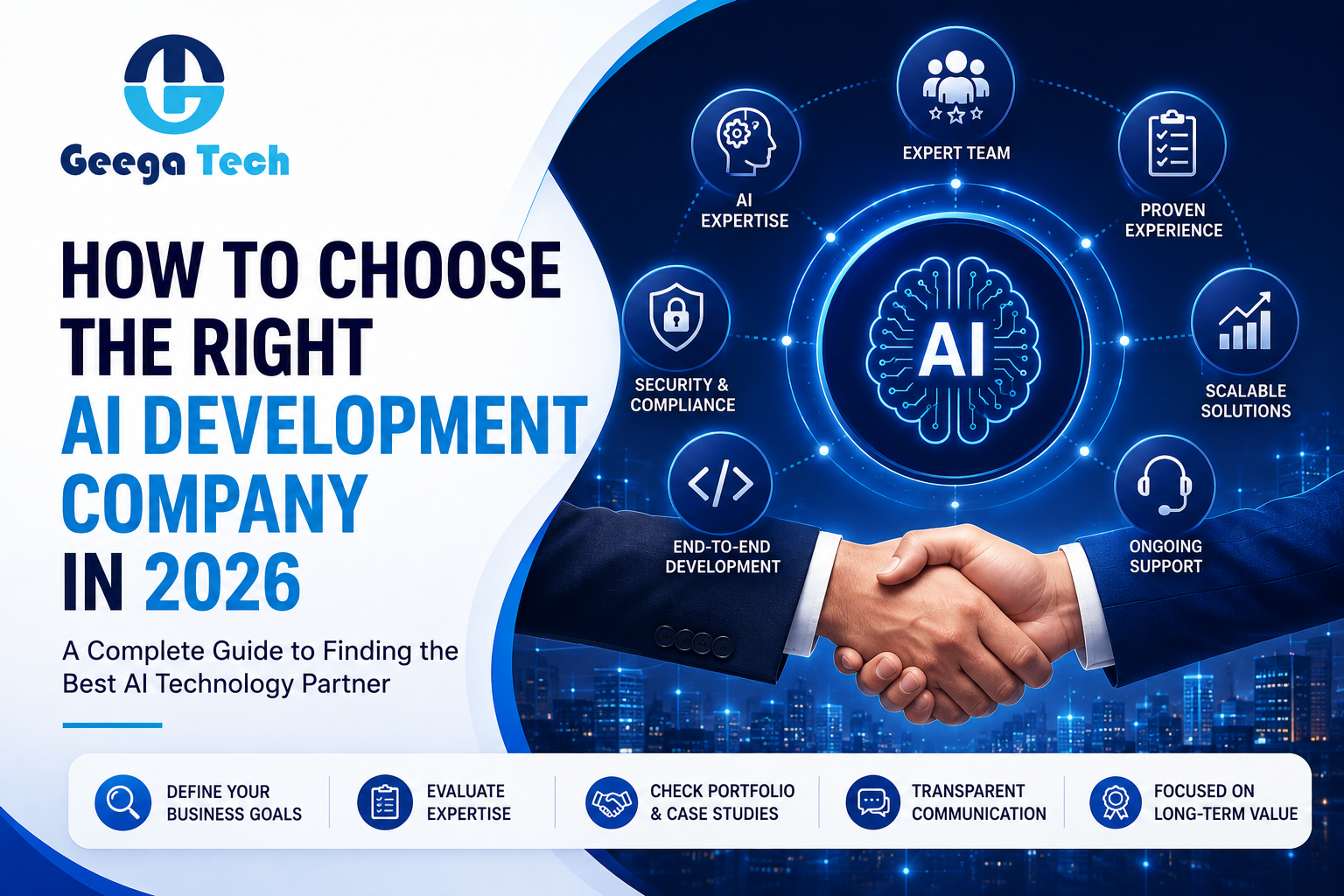
An AI Development Company specializes in designing, building, integrating, and maintaining software applications powered by artificial intelligence.
Unlike traditional software development companies, AI-focused teams combine software engineering with technologies such as:
An experienced AI development partner should understand both AI technology and the underlying software architecture required to build a production-ready application.
AI development companies help organizations turn business requirements into intelligent software solutions.
Services may include:
The exact service mix depends on the company’s expertise and the client’s requirements.
AI projects are often more complex than traditional software projects.
A production AI application may require several interconnected components.
For example:
Frontend → Backend → Database → AI Layer → APIs → Cloud Infrastructure → Security → Monitoring
Each component needs to work reliably with the others.
An experienced AI development company can help businesses manage this complexity while ensuring that AI capabilities solve a genuine business problem.
Before contacting an AI development company, clearly define the problem you want to solve.
Avoid starting with:
“We want AI in our business.”
Instead, identify a specific objective.
For example:
“We want to reduce customer support response time.”
“We want to automate invoice processing.”
“We want an AI assistant for our SaaS platform.”
“We want to automate sales follow-ups.”
“We want to analyze thousands of business documents.”
“We want to modernize our existing software using AI.”
A clearly defined business problem makes it easier to select the right technology and estimate development requirements.
AI alone does not create a complete software product.
Your development partner should also understand:
This is particularly important for AI SaaS products and enterprise applications.
A powerful AI feature inside poorly designed software will still create a poor user experience.
Ask potential development partners which AI technologies they have experience implementing.
Relevant capabilities may include:
The required expertise will depend on your specific use case.
AI agents are becoming an important part of business automation.
Unlike basic chatbots, AI agents can potentially perform multi-step workflows using approved tools and systems.
For example, an AI sales agent might:
If your business plans to implement AI agents, your development partner should understand:
These elements are critical when AI can perform actions rather than simply generate text.
Every business has different workflows, data, users, and requirements.
Your AI development company should not force every project into the same solution.
A good development process usually begins with:
Understanding the business problem and users.
Identifying features, workflows, integrations, and constraints.
Selecting an appropriate architecture and AI approach.
Testing the core idea before building everything.
Building the production application.
Evaluating software functionality and AI behavior.
Launching the application securely.
Tracking performance and improving the system after launch.
AI applications may process sensitive business or customer information.
Ask potential development partners:
Privacy requirements should be considered during architecture design, not after development.
Security is especially important for enterprise AI applications.
A production application may require:
Businesses in healthcare, finance, insurance, and other regulated sectors may require additional safeguards.
AI applications rarely work independently.
Your new AI system may need to connect with existing business platforms.
Common integrations include:
An AI Development Company with strong API and integration expertise can help reduce disruption to existing operations.
Generative AI systems can sometimes produce incorrect or unsupported information.
Businesses should therefore ask:
“How will you evaluate AI responses?”
A strong AI development strategy may include:
The appropriate controls depend on the risk level of the use case.
A prototype serving 20 users is very different from a production platform serving thousands of customers.
Your development partner should plan for:
A scalable architecture can reduce expensive redevelopment later.
Before beginning development, businesses should understand what is included in the estimate.
AI project pricing may depend on:
Very low quotes should be evaluated carefully.
Software that requires major rebuilding after launch can cost significantly more than developing a solid foundation initially.
A trustworthy development partner should not automatically recommend building every feature from day one.
For many AI products, an MVP is a better starting point.
An AI MVP allows businesses to validate:
After validation, businesses can invest in additional functionality with greater confidence.
Technical capability alone is not enough.
Strong communication is critical for successful software projects.
Before hiring an AI development company, understand:
Clear communication reduces misunderstandings and unnecessary development work.
AI applications require ongoing maintenance.
After launch, businesses may need:
Ask what happens after the application goes live.
A long-term technology partner can help the product evolve as business requirements change.
Businesses often consider building an internal team instead of outsourcing development.
Both approaches can work.
| In-House AI Team | AI Development Company |
|---|---|
| Direct internal control | Faster access to an existing team |
| Deep company knowledge | Broader project experience |
| Long-term internal capability | Flexible project capacity |
| Requires hiring | Reduced initial hiring effort |
| Higher fixed staffing costs | Project or engagement-based cost |
| Recruitment may take time | Potentially faster project start |
Large organizations may eventually use a combination of both approaches.
An external development partner can build initial capabilities while internal teams manage long-term strategy and operations.
Freelancers can be effective for smaller or highly specialized tasks.
However, larger AI applications may require multiple skill sets.
For example:
An established development company can provide these capabilities within one coordinated team.
The right choice depends on project size, complexity, budget, and risk.
Businesses should be cautious if a potential partner:
AI development involves trade-offs.
A reliable partner should explain both capabilities and limitations.
Use this checklist during your evaluation:
AI development pricing varies considerably based on scope.
Typical projects may include:
| AI Project | Estimated Development Cost |
| Basic AI Integration | $5,000 – $15,000 |
| AI Chatbot | $8,000 – $25,000 |
| AI MVP | $15,000 – $40,000 |
| AI SaaS Product | $25,000 – $80,000+ |
| AI Agent Platform | $30,000 – $100,000+ |
| Enterprise AI Solution | $75,000 – $250,000+ |
These figures are broad planning estimates.
A proper estimate requires understanding your exact requirements, integrations, security needs, and product complexity.
At Geega Technologies, we help startups and enterprises design, develop, integrate, and scale intelligent software products.
Our AI and software development services include:
Our approach combines AI capabilities with modern software engineering to build solutions designed around real business requirements.
We focus on secure architecture, scalable development, intuitive user experiences, and long-term maintainability.
Whether you’re validating an AI startup idea, automating business operations, modernizing enterprise software, or adding AI capabilities to an existing product, Geega Technologies can help you move from concept to implementation.
Choosing the right AI Development Company in 2026 requires more than comparing development prices.
Businesses should evaluate technical expertise, software engineering capabilities, security practices, data privacy, AI experience, integration skills, communication, scalability, and post-launch support.
Most importantly, your AI development partner should understand the business problem before recommending technology.
The strongest AI products are not necessarily those with the most AI features.
They are the products that use AI in the right places to deliver measurable value.
Planning an AI application, SaaS platform, AI agent, or enterprise automation solution?
Partner with Geega Technologies to design and develop secure, scalable, and intelligent software tailored to your business.
Contact Geega Technologies today for a free AI project consultation and discuss how we can turn your idea into a production-ready solution.


Speak directly with our engineering team to audit your requirements, architecture, and timeline.