Home » Enterprise AI Integration: How Businesses Can Modernize Legacy Systems in 2026
Many businesses still depend on legacy software systems built years—or even decades—ago. These systems may continue to support critical operations, but they often struggle with modern business requirements such as automation, real-time analytics, intelligent decision-making, scalability, and personalized customer experiences.
Replacing an entire software ecosystem can be expensive, time-consuming, and risky.
That is why Enterprise AI Integration is becoming an important digital transformation strategy in 2026.
Instead of completely replacing existing systems, businesses can integrate artificial intelligence into their current applications, databases, workflows, and cloud infrastructure. This allows organizations to introduce intelligent automation and AI-powered capabilities while preserving valuable existing technology investments.
In this article, we’ll explore how enterprise AI integration works, where businesses can use it, its benefits, common challenges, and how organizations can modernize legacy systems with AI.
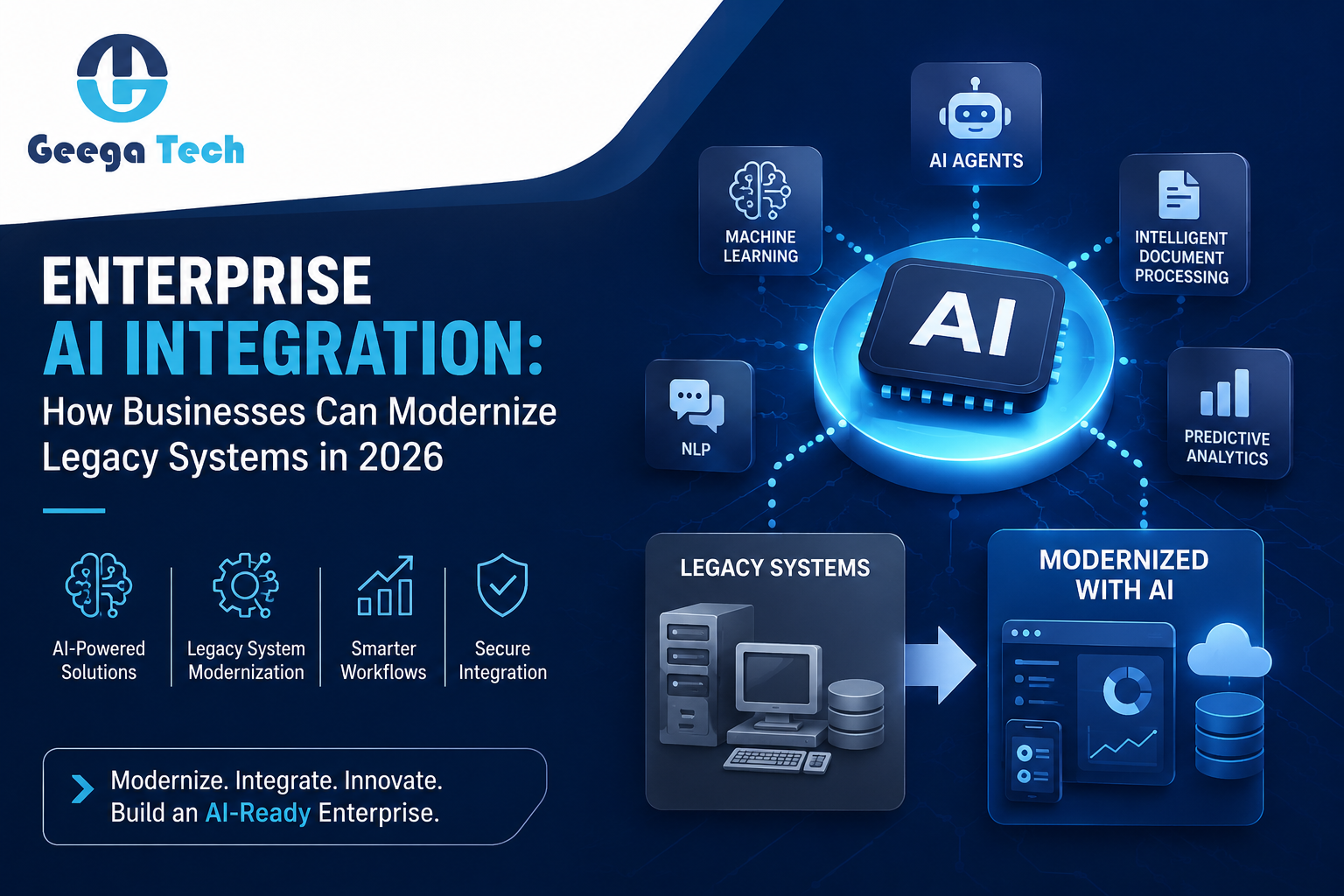
Enterprise AI Integration is the process of connecting artificial intelligence technologies with existing business applications, databases, APIs, cloud platforms, and operational workflows.
The goal is not simply to add an AI chatbot to an application. A well-designed integration allows AI to securely access relevant information, analyze data, automate tasks, assist employees, and support business decisions.
AI capabilities may include:
For example, a company may already have a CRM system containing thousands of customer records. Instead of replacing the CRM, an AI solution can be integrated to analyze customer interactions, summarize conversations, prioritize leads, recommend next actions, and automate routine follow-ups.
Legacy applications are not necessarily bad software. Many continue to perform essential business functions reliably.
The challenge is that older systems were often designed for a very different technology environment.
Businesses may experience problems such as:
As organizations generate more data and customers expect faster digital experiences, these limitations can affect productivity and business growth.
Completely rebuilding enterprise software is not always the best first step.
Large systems may contain years of business logic, integrations, historical data, and workflows that employees already understand.
Enterprise AI Integration allows businesses to modernize incrementally.
Instead of replacing everything, organizations can identify high-value processes and introduce AI where it can deliver measurable improvements.
This approach can provide:
Businesses can modernize one workflow at a time while keeping critical operations running.
Traditional enterprise workflows often require employees to manually move information between systems, verify data, send approvals, or generate reports.
AI-powered automation can analyze information and determine appropriate next steps.
For example, AI can:
This reduces repetitive administrative work and improves operational efficiency.
Businesses can integrate AI assistants with existing CRM, helpdesk, or customer support platforms.
Instead of simply answering predefined FAQs, modern AI systems can use approved business knowledge to provide more relevant assistance.
AI can help:
Human support teams can then focus on cases requiring judgment, empathy, or specialized expertise.
Many businesses still manually process documents such as:
AI-powered document processing can extract and classify information before sending structured data to existing enterprise applications.
This can significantly reduce manual data entry and processing time.
Traditional reporting usually explains what has already happened.
AI-powered predictive analytics can help businesses understand what may happen next.
Organizations can use historical business data to support:
These insights can help business leaders make faster, data-driven decisions.
One of the most valuable enterprise AI use cases in 2026 is the internal AI assistant.
An enterprise AI assistant can connect with approved organizational knowledge and help employees locate information more efficiently.
Employees could ask questions such as:
“Show me the latest sales summary.”
“Summarize this customer account.”
“Find the relevant company policy.”
“Generate a project status report.”
“Which orders require attention?”
Instead of manually searching through multiple applications, employees can interact with business information through a conversational interface.
Access controls and data permissions remain critical when implementing these systems.
AI agents take automation beyond simple question-and-answer interactions.
An AI agent can potentially perform multi-step tasks across connected systems.
For example, a sales AI agent could:
Businesses should define clear permissions, approval steps, monitoring, and human oversight before allowing AI agents to perform sensitive actions.
| Traditional Modernization | AI-Powered Modernization |
|---|---|
| Mainly upgrades technology | Adds intelligent capabilities |
| Manual workflows remain | Processes can be automated |
| Traditional reporting | Predictive and AI-assisted analytics |
| Users search for information | AI can help retrieve and summarize it |
| Fixed business workflows | More adaptive workflows |
| Manual document processing | Intelligent document processing |
| Reactive operations | Potential for proactive insights |
AI does not eliminate the need for conventional modernization. Businesses may still need API development, cloud migration, database upgrades, security improvements, and application re-engineering.
The strongest strategy often combines both.
Healthcare organizations can integrate AI into existing systems to assist with:
AI implementations involving health information require particularly strong privacy, security, governance, and human oversight.
Financial organizations can use AI for:
AI integration can improve:
Manufacturers can integrate AI with operational systems for:
AI can help logistics companies improve:
Existing HR platforms can be enhanced with AI capabilities for:
Organizations should ensure that consequential employment decisions remain appropriately governed and reviewed.
Employees can spend less time performing repetitive administrative tasks and more time on strategic work.
AI can help organizations analyze information already stored across enterprise systems and turn it into actionable insights.
Real-time analytics and AI-assisted insights can help managers understand operational conditions faster.
Automating repetitive processes can reduce processing time, manual effort, and certain operational expenses.
AI-assisted systems can help organizations provide faster responses and more personalized interactions.
Automated workflows can help businesses handle increasing workloads without requiring every process to scale linearly with headcount.
Enterprise AI projects require more than connecting an AI model to an API.
Businesses should carefully consider:
Security and governance should be part of the architecture from the beginning rather than added after deployment.
Businesses considering AI modernization can follow a structured approach.
Find workflows that involve repetitive work, large amounts of data, slow processing, or frequent manual decisions.
Understand current applications, databases, APIs, infrastructure, security requirements, and dependencies.
Choose AI opportunities based on potential business value, feasibility, risk, and implementation complexity.
Start with a focused use case rather than transforming the entire organization at once.
Use appropriate APIs, authentication, authorization, encryption, logging, and access controls.
Track metrics such as processing time, automation rate, error reduction, user adoption, operational cost, and customer satisfaction.
Once the solution demonstrates measurable value, expand AI capabilities to additional workflows and departments.
Businesses often need to decide between purchasing an existing AI product and developing a custom solution.
Off-the-shelf AI tools can be effective when business requirements are standardized.
Custom AI development becomes more valuable when organizations have:
Many organizations ultimately use a hybrid strategy—combining established AI technologies with custom software and integrations tailored to their operations.
At Geega Technologies, we help businesses modernize software systems and integrate intelligent AI capabilities into existing digital infrastructure.
Our services include:
Our approach focuses on building secure, scalable, and business-focused technology solutions that integrate with existing workflows rather than forcing organizations to replace everything at once.
Enterprise software is evolving from systems that simply store and process information into platforms that can assist users, automate workflows, analyze data, and provide intelligent recommendations.
However, successful AI transformation is not about adding AI everywhere.
Businesses should identify where AI creates measurable value, integrate it securely, maintain appropriate human oversight, and continuously monitor performance.
Organizations that modernize strategically can gain the benefits of AI while protecting their existing technology investments.
Transform your existing software into a smarter, more efficient digital ecosystem with Geega Technologies.
Whether you need AI integration, workflow automation, AI agents, custom software development, or legacy system modernization, our team can help you design and build a solution aligned with your business requirements.
Contact Geega Technologies today for a free consultation and start your enterprise AI transformation journey.


Speak directly with our engineering team to audit your requirements, architecture, and timeline.