Home » AI-Ready Data Infrastructure: Why It Is Essential for Business Success in 2026
Artificial intelligence has become a major part of business transformation in 2026. Companies are using AI for customer support, workflow automation, data analysis, software development, sales forecasting, fraud detection, and business decision-making.
However, simply purchasing an AI tool or integrating an AI model does not guarantee successful results.
The real performance of an AI system depends heavily on the quality, accessibility, security, and structure of the data behind it. If business data is incomplete, outdated, scattered across different systems, or poorly managed, even the most advanced AI solution may provide inaccurate and unreliable results.
This is why businesses now need to build an AI-ready data infrastructure before adopting AI at scale.
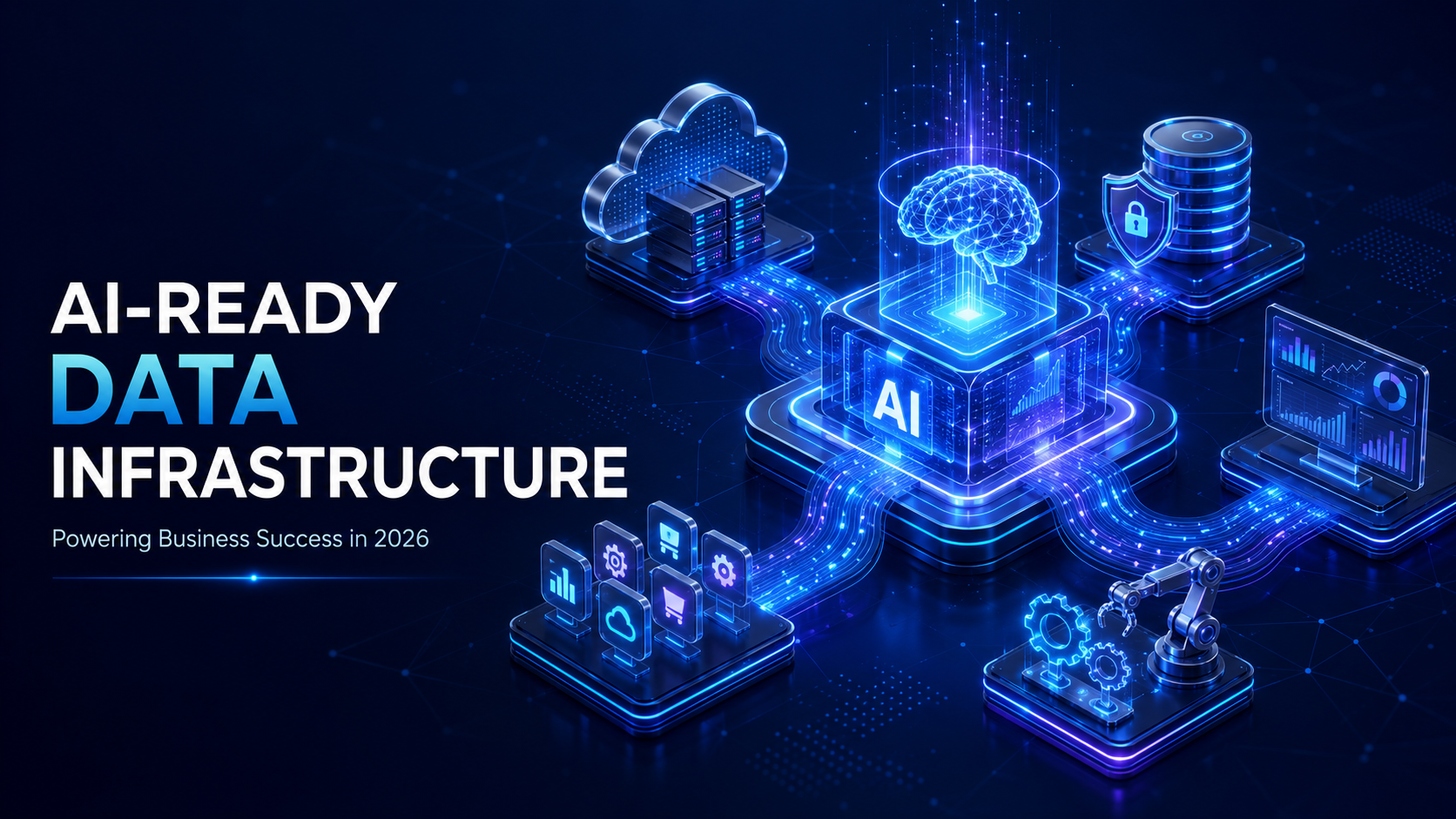
AI-ready data infrastructure is a technology environment designed to collect, store, organize, process, protect, and deliver data for artificial intelligence applications.
It connects business data from sources such as:
CRM and ERP software
Websites and mobile applications
Customer support platforms
Accounting and payroll systems
Cloud databases
Marketing platforms
IoT devices
Internal documents
Third-party applications
Instead of keeping information isolated in separate systems, an AI-ready infrastructure makes relevant data available in a consistent and controlled format.
This enables AI applications to understand business information and generate more accurate outcomes.
AI systems learn, analyse, and make decisions using the information provided to them. Therefore, the quality of an AI output is directly connected to the quality of its input data.
Common data problems include:
Duplicate customer records
Missing information
Incorrect data formats
Outdated contact details
Inconsistent product names
Unstructured documents
Disconnected databases
Unverified information
For example, an AI-powered sales forecasting system cannot produce reliable predictions if historical sales data is incomplete. Similarly, a customer support AI agent may provide incorrect answers when product and policy information is outdated.
Before implementing AI, businesses must clean, validate, standardize, and organize their data.
Many organizations begin their AI journey by selecting tools and models first. They focus on features such as automation, intelligent chatbots, predictive analytics, and autonomous AI agents.
However, they often ignore the condition of their existing data infrastructure.
As a result, AI projects may face several challenges:
When an AI application receives incomplete or incorrect information, its responses become unreliable. This may create confusion for customers and employees.
AI agents need access to multiple systems to complete business tasks. If these systems are not properly connected, the agent can only perform limited actions.
Uncontrolled data access may expose confidential customer, employee, or financial information. Every AI implementation requires proper permissions and security policies.
An AI prototype may work successfully with a small dataset but fail when used across multiple departments, locations, or thousands of users.
Employees will hesitate to use AI solutions if the system repeatedly generates incorrect suggestions or decisions.
A strong data foundation helps businesses avoid these problems before expanding AI across their operations.
Business information is often distributed across different software platforms. Data integration connects these systems through APIs, middleware, or automated data pipelines.
This allows AI applications to access relevant information without requiring employees to transfer it manually.
Cloud platforms provide flexible computing resources for storing and processing large amounts of data. Businesses can increase or reduce resources depending on application demand.
Cloud infrastructure also supports real-time processing, remote accessibility, backup management, and easier integration with AI services.
Data should follow consistent formats and naming conventions. Duplicate, outdated, or incorrect records must be identified and corrected regularly.
Automated data validation can help maintain accuracy as new information enters the system.
Data governance defines how information is collected, accessed, modified, retained, and deleted.
A proper governance framework should answer questions such as:
Who owns the data?
Who can access it?
Where is it stored?
How long should it be retained?
How is sensitive data protected?
Which AI applications can use it?
Many AI applications require current information rather than data that is several hours or days old.
Real-time processing is especially important for fraud detection, inventory management, customer support, logistics, monitoring, and personalized recommendations.
AI applications should only access the minimum information required to complete a task.
Businesses should implement:
Role-based access control
Data encryption
Secure APIs
Activity logging
User authentication
Backup and recovery systems
Regular security audits
These controls reduce the risk of unauthorized access and data misuse.
Clean and organized data enables AI models to generate more reliable recommendations, predictions, and responses.
Integrated systems allow AI agents to complete multi-step workflows without repeatedly requesting information from employees.
For example, an AI agent could receive a customer enquiry, check the CRM, verify product availability, prepare a quotation, and schedule a follow-up.
AI-powered analytics can identify customer behaviour, operational problems, sales opportunities, and financial trends when it has access to accurate business data.
Connected data helps businesses provide faster and more personalized customer service across websites, mobile applications, email, and support platforms.
Fixing data problems during or after AI deployment can be expensive. Preparing the infrastructure early reduces integration issues, redevelopment, and operational disruption.
A properly designed architecture enables businesses to introduce new AI features, add more users, connect additional systems, and process larger amounts of data.
Businesses do not need to transform their complete technology infrastructure at once. They can begin with a structured, step-by-step approach.
Start with a clear objective instead of implementing AI simply because it is popular.
The objective may be reducing customer response time, automating manual reporting, improving lead qualification, or forecasting inventory demand.
Identify where important business information is stored and evaluate its quality, security, structure, and accessibility.
Remove duplicates, correct errors, standardize formats, and define common data structures.
Use secure APIs and data pipelines to integrate relevant applications, databases, and cloud services.
Establish user permissions, approval processes, monitoring, and data retention policies before giving AI systems access.
Launch a controlled pilot project with measurable goals. Evaluate its accuracy, performance, security, and business impact.
AI systems require continuous evaluation. Businesses should review output quality, update data sources, monitor system actions, and collect employee feedback.
AI-ready infrastructure does not mean removing humans from every business process.
Human oversight remains essential for:
High-impact decisions
Financial approvals
Legal or compliance-related tasks
Sensitive customer interactions
Reviewing unusual AI actions
Correcting inaccurate outputs
The most effective approach is to let AI handle repetitive and data-intensive tasks while employees manage strategy, creativity, judgment, and final approvals.
Geega Technologies helps startups and businesses plan, build, scale, and optimize secure digital solutions.
Our team can help organizations with:
AI application development
Business process automation
Custom software development
Cloud application development
API and third-party integrations
Data management solutions
AI-powered dashboards
Legacy software modernization
Mobile and web application development
Application maintenance and scaling
We focus on building practical AI solutions that connect with your existing business systems and support measurable operational goals.
In 2026, successful AI adoption depends on more than selecting a powerful AI model. Businesses need accurate data, connected systems, secure access, reliable infrastructure, and clear governance policies.
An AI-ready data infrastructure creates the foundation required for trustworthy automation, intelligent decision-making, and long-term digital growth.
Organizations that prepare their data before scaling AI will be better positioned to reduce operational costs, improve customer experiences, and build more efficient business processes.
Planning to introduce AI into your business?
Connect with Geega Technologies to build secure, scalable, and business-focused AI solutions tailored to your requirements.