Home » AI-Powered SaaS Development: How AI Is Transforming SaaS Products in 2026
Software-as-a-Service (SaaS) has transformed how businesses access and use software. Instead of installing complex applications on individual systems, organizations can use cloud-based platforms that are accessible from anywhere and can scale as their requirements grow.
In 2026, SaaS is entering another major phase of transformation: Artificial Intelligence.
Modern SaaS products are evolving beyond dashboards, forms, reports, and fixed workflows. Businesses increasingly want applications that can understand natural language, automate repetitive tasks, analyze large amounts of data, generate content, provide recommendations, and assist users in completing complex workflows.
This shift is driving the growth of AI-Powered SaaS Development.
By integrating AI into SaaS applications, businesses can build smarter products, improve customer experiences, automate operations, and create new opportunities for recurring revenue.
In this article, we’ll explore how AI is transforming SaaS development, the most valuable AI features businesses can build, key benefits and challenges, and what organizations should consider when developing an AI-powered SaaS product in 2026.
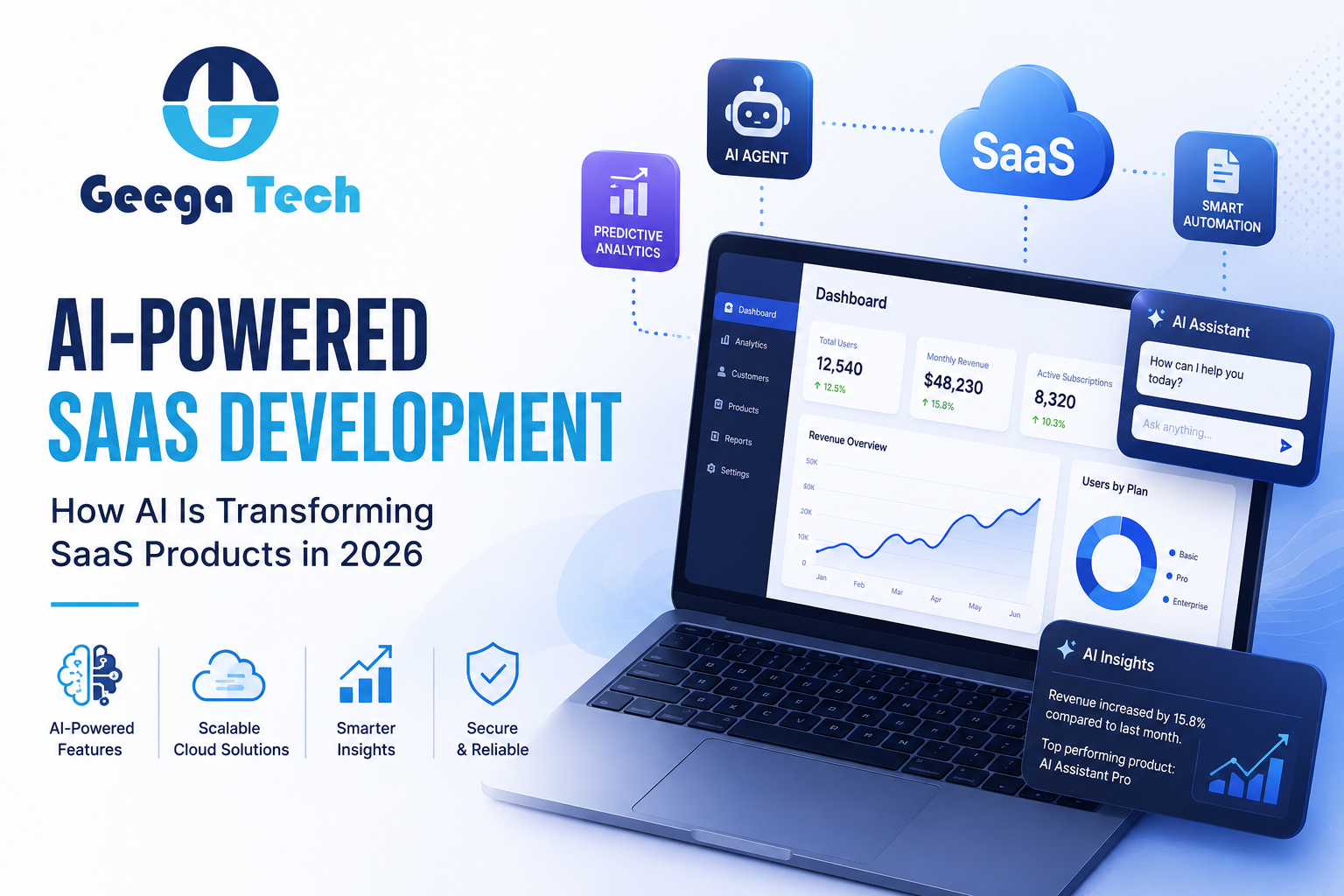
AI-Powered SaaS Development is the process of building cloud-based software products that integrate artificial intelligence capabilities into their core features and workflows.
These applications may use technologies such as:
Traditional SaaS applications generally respond to predefined user actions.
AI-powered SaaS applications can go further by analyzing information, understanding user intent, providing recommendations, generating outputs, and automating certain tasks.
| Traditional SaaS | AI-Powered SaaS |
|---|---|
| Fixed workflows | Intelligent workflows |
| Manual data processing | AI-assisted processing |
| Standard search | Natural-language search |
| Static dashboards | AI-generated insights |
| Manual customer support | AI-assisted support |
| Rule-based automation | Context-aware automation |
| Standard personalization | Behavior-driven personalization |
| Reactive software | More proactive assistance |
AI does not replace the core SaaS architecture. Instead, it adds an intelligence layer to the application.
Customer expectations are changing.
Users increasingly expect software to help them complete tasks rather than simply provide tools for doing those tasks manually.
For example, instead of only displaying sales data, an AI-enabled platform could summarize performance and highlight unusual changes.
Instead of requiring users to manually search hundreds of documents, an AI assistant could help retrieve relevant information.
Instead of manually creating every report, AI could prepare a first draft based on approved business data.
Businesses are therefore exploring AI SaaS development to achieve benefits such as:
AI assistants are becoming one of the most valuable features inside modern SaaS platforms.
Users can interact with software using natural language rather than navigating through multiple menus.
For example:
“Show me this month’s sales performance.”
“Summarize my latest customer conversations.”
“Create a project status report.”
“Which invoices are overdue?”
“Find customers who haven’t responded this week.”
When properly integrated with business data and permissions, AI assistants can make complex software easier to use.
AI agents can take SaaS automation beyond simple question answering.
Instead of only providing information, an AI agent may be designed to perform multi-step tasks using approved tools and workflows.
For example, a sales SaaS AI agent could:
Businesses should implement appropriate approval controls before allowing AI agents to perform sensitive or irreversible actions.
Many SaaS platforms process large numbers of documents.
AI can help extract and organize information from:
This can reduce manual data entry and improve processing efficiency.
Traditional keyword search can become inefficient when SaaS platforms contain thousands of records or documents.
AI-powered search can allow users to search using natural-language questions.
Instead of searching:
“invoice + pending + June”
A user might ask:
“Show me all unpaid invoices from June above ₹50,000.”
The application can interpret the request and return relevant information based on the user’s permissions.
AI-powered SaaS applications can use historical information to identify patterns and support forecasting.
Potential applications include:
Predictive analytics helps transform SaaS platforms from reporting tools into decision-support systems.
Traditional SaaS products often provide the same interface and recommendations to every user.
AI can help personalize experiences based on factors such as:
This could influence recommendations, dashboards, notifications, and suggested actions.
SaaS businesses frequently handle repetitive customer questions.
AI support systems can help:
Human support teams can then focus on higher-value or more complex cases.
Creating reports manually can consume significant employee time.
AI-enabled SaaS platforms can assist with:
Instead of presenting only raw numbers, AI can help explain relevant trends and highlight areas requiring attention.
AI capabilities may assist with:
Healthcare applications require strong privacy, security, regulatory compliance, and appropriate human oversight.
AI can support:
AI-powered HR platforms can assist with:
Organizations should maintain appropriate human review for consequential employment decisions.
AI can improve sales platforms through:
Potential AI features include:
AI can help teams with:
Natural-language interfaces and intelligent recommendations can make complex applications easier to use.
AI can reduce repetitive manual tasks and help users complete workflows faster.
Employees can spend more time on strategic work while software assists with routine processing.
AI capabilities can help SaaS businesses differentiate their products in competitive markets.
AI can help convert large datasets into summaries, predictions, and actionable insights.
Advanced AI capabilities can potentially be offered through premium subscription plans, usage-based features, or enterprise packages.
When AI features genuinely save users time or improve outcomes, they can increase the overall value customers receive from the platform.
AI does not only change product features—it can also influence SaaS pricing strategies.
Traditional SaaS pricing commonly uses:
AI-enabled SaaS businesses may additionally consider:
Pricing should account for infrastructure, AI processing, support, and other operating costs so that increased product usage remains financially sustainable.
AI introduces additional development considerations.
Businesses need to plan for:
Simply connecting an AI model to an existing SaaS application is not enough.
The AI layer must be designed around real business workflows and appropriate security controls.
A modern AI SaaS product may include several layers.
Web or mobile interfaces where users interact with the platform.
Handles business logic, authentication, workflows, subscriptions, and APIs.
Stores structured application and customer data.
Provides capabilities such as language processing, recommendations, predictions, or AI agents.
Connects the SaaS platform with third-party tools and enterprise systems.
Provides scalable computing, storage, monitoring, and deployment.
Manages authentication, authorization, encryption, logging, access controls, and data protection.
A scalable architecture should keep these responsibilities clearly separated.
Do not start by asking:
“What AI feature can we add?”
Start by asking:
“What problem are our users trying to solve?”
AI should solve a measurable business problem rather than being included only because it is trending.
Start with the smallest product that delivers meaningful value.
The MVP should focus on:
Plan the application architecture before scaling development.
Consider:
AI functionality should be evaluated for more than whether it technically works.
Testing should include:
Sensitive workflows should include appropriate approval mechanisms.
Businesses should define what AI can:
AI processing can introduce variable infrastructure costs.
Monitor metrics such as:
After validating the core AI feature, businesses can introduce additional capabilities such as AI agents, predictive analytics, automation, and advanced integrations.
For startups, building every planned feature from day one is usually unnecessary.
An AI SaaS MVP can focus on:
Once the product gains real users and feedback, additional features can be developed based on validated requirements.
This reduces development risk and helps businesses reach the market faster.
At Geega Technologies, we help startups and enterprises design and develop secure, scalable, and intelligent SaaS products.
Our services include:
Whether you’re launching a new SaaS startup or adding AI capabilities to an existing platform, our team can help transform your idea into a scalable digital product.
The next generation of SaaS applications will not simply provide tools.
They will increasingly help users understand information, automate workflows, make decisions, and complete tasks.
However, successful AI SaaS development requires more than adding an AI chatbot.
Businesses need to combine strong software engineering, scalable cloud architecture, secure data handling, thoughtful AI integration, and a clear understanding of user problems.
Companies that build AI capabilities around genuine customer needs can create products that deliver stronger long-term value.
Turn your SaaS idea into a secure, scalable, and intelligent digital product with Geega Technologies.
Whether you need an AI SaaS MVP, enterprise platform, AI agent, custom automation, or an AI upgrade for an existing application, our development team can help.
Contact Geega Technologies today for a free consultation and start building your AI-powered SaaS product.


Speak directly with our engineering team to audit your requirements, architecture, and timeline.