Home » How Much Does It Cost to Build an AI Application in 2026?
Artificial Intelligence is rapidly becoming a core part of modern software products. Businesses are integrating AI into customer support platforms, SaaS products, healthcare applications, financial systems, e-commerce platforms, internal business tools, and enterprise software.
But before starting an AI project, one question almost every founder and business leader asks:
How much does it cost to build an AI application in 2026?
There is no single fixed answer.
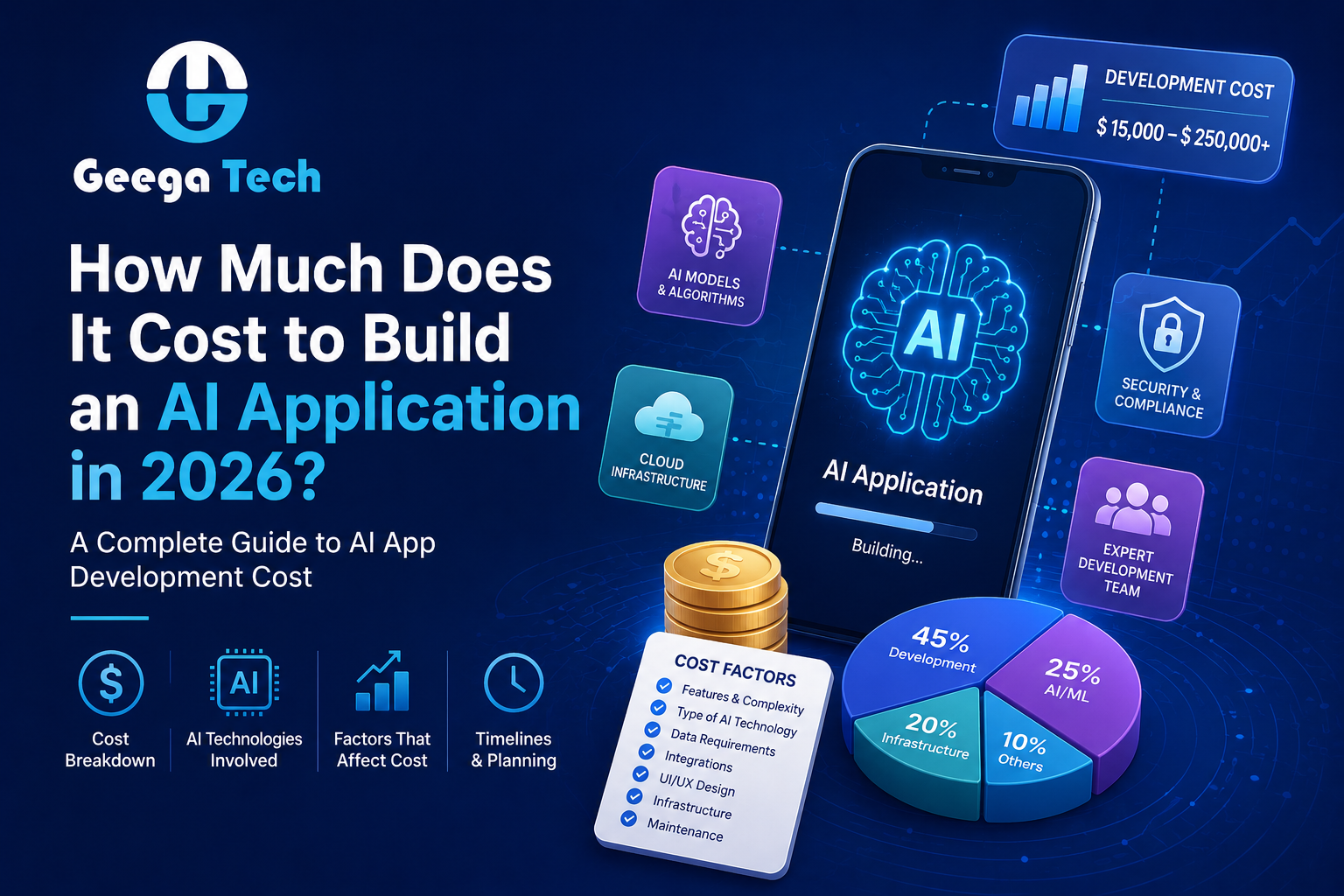
The AI App Development Cost depends on the complexity of the application, AI capabilities, integrations, data requirements, security, cloud infrastructure, development team, and ongoing operational requirements.
A simple AI-enabled application may require a relatively small development investment, while a complex enterprise AI platform with custom workflows, AI agents, multiple integrations, advanced analytics, and strict security requirements can require a significantly larger budget.
In this guide, we’ll break down the major factors affecting AI application development cost, common AI application types, development timelines, hidden expenses, and how businesses can plan an AI project effectively in 2026.
AI Application Development is the process of designing and building software that uses artificial intelligence to provide intelligent functionality.
Depending on the product, an AI application may use technologies such as:
AI can be integrated into web applications, mobile applications, SaaS products, enterprise software, and existing business systems.
AI application development costs can vary significantly depending on the project’s scope.
A practical estimated range may look like this:
| AI Application Type | Estimated Development Cost |
|---|---|
| Basic AI Feature Integration | $5,000 – $15,000 |
| AI Chatbot / Virtual Assistant | $8,000 – $25,000 |
| AI-Powered MVP | $15,000 – $40,000 |
| AI SaaS Application | $25,000 – $80,000+ |
| AI Agent Platform | $30,000 – $100,000+ |
| Custom Machine Learning Solution | $40,000 – $120,000+ |
| Enterprise AI Platform | $75,000 – $250,000+ |
These figures are broad planning estimates rather than fixed prices.
The actual AI App Development Cost depends on product requirements, technical complexity, development location, AI architecture, integrations, security requirements, and infrastructure.
A detailed discovery phase is usually necessary before estimating a production AI project accurately.
Several factors directly influence the overall cost of building an AI application.
Application complexity is one of the biggest cost factors.
A simple application with one AI capability may require considerably less development than an enterprise platform containing multiple modules.
For example:
May include:
May include:
As complexity increases, development time, testing requirements, and infrastructure requirements also increase.
Different AI capabilities require different levels of development effort.
Generative AI applications can create:
The development cost depends heavily on how deeply generative AI is integrated into the business workflow.
Custom machine learning projects may require:
These requirements can make custom ML projects more expensive than straightforward AI integrations.
Computer vision applications may analyze:
These systems can require specialized data, infrastructure, and model evaluation.
AI agents can potentially perform multi-step tasks across business systems.
An AI agent may:
Because AI agents interact with business systems and may perform actions, they require strong permissions, security, monitoring, testing, and failure handling.
Another major cost decision is whether to use existing AI technologies or develop specialized models.
Businesses can integrate existing AI models and services into their applications.
Advantages include:
However, businesses must consider usage costs, privacy requirements, vendor dependencies, and model limitations.
Some organizations may require specialized machine learning models trained for a specific problem.
Custom development may involve:
This can substantially increase development costs.
For many business applications, combining existing AI capabilities with custom software and business-specific data can be more practical than training a model entirely from scratch.
AI systems depend heavily on data.
If your application requires proprietary or historical business information, development may involve:
Poor-quality data can increase both development time and project risk.
AI functionality still needs a good user experience.
Development may require interfaces such as:
A simple MVP interface costs less than a highly polished multi-platform product with complex interactions.
Modern AI applications rarely operate independently.
Businesses may need integrations with:
Each integration increases development and testing requirements.
Security is particularly important when AI applications process sensitive business or customer information.
Common security requirements include:
Some industries may also have specific regulatory or compliance requirements.
Healthcare, finance, insurance, and enterprise applications generally require additional security planning.
AI applications require infrastructure to run application logic, databases, AI services, file storage, monitoring, and other components.
Infrastructure expenses can include:
These expenses are generally ongoing rather than one-time development costs.
An AI chatbot can be used for:
$8,000 – $25,000+
The price depends on integrations, knowledge sources, admin controls, security, analytics, and workflow complexity.
AI agents can perform multi-step workflows rather than only responding to questions.
Potential use cases include:
$30,000 – $100,000+
Advanced enterprise agent systems may cost significantly more.
AI-powered SaaS platforms may combine:
$25,000 – $80,000+
Complex enterprise SaaS products can exceed this range.
AI can be integrated into mobile applications for:
$15,000 – $60,000+
The final cost depends on platform requirements, backend complexity, AI features, and design.
Enterprise AI applications typically require advanced capabilities such as:
$75,000 – $250,000+
Large or highly specialized systems may require substantially higher investment.
Cost and development time are closely related.
Typical timelines may include:
| Project Type | Estimated Timeline |
| AI Prototype | 2–4 Weeks |
| AI Chatbot | 4–8 Weeks |
| AI MVP | 8–14 Weeks |
| AI SaaS Product | 3–6 Months |
| AI Agent Platform | 3–8 Months |
| Enterprise AI Solution | 6–12+ Months |
These timelines depend heavily on requirements and should be treated as planning estimates.
A structured development process can reduce unnecessary cost and project risk.
Define:
Determine:
Design:
Build the core product and primary AI workflow.
Integrate required AI capabilities into the application and business logic.
Test:
Deploy the application to production infrastructure.
Track performance and improve the product based on real user behavior.
Businesses should consider costs beyond initial development.
Potential ongoing expenses include:
Understanding these costs early helps businesses create a more realistic long-term budget.
Businesses can control development expenses without sacrificing product quality.
Do not build every planned feature immediately.
Start with the core business problem.
Build AI capabilities that provide measurable value to users.
Integrate with existing systems when appropriate instead of rebuilding everything.
Good technical planning reduces expensive changes later.
Validate the product with real users before investing heavily in advanced functionality.
For many startups and businesses, yes.
An AI MVP allows organizations to test:
before investing in a full-scale platform.
A focused MVP can significantly reduce early project risk.
Development location can also affect the overall budget.
Companies in the United States, United Kingdom, Canada, Australia, and other markets often work with offshore development teams to access experienced engineers while controlling development costs.
However, businesses should evaluate development partners based on more than hourly rates.
Consider:
A low initial quote can become expensive if the application requires significant redevelopment later.
Before selecting an AI development partner, ask:
The right partner should understand both AI and software engineering.
Geega Technologies helps startups and enterprises design, develop, and scale intelligent digital products.
Our services include:
We focus on developing secure, scalable, and business-focused applications that solve real operational challenges.
Whether you need an AI MVP, SaaS platform, intelligent enterprise application, or AI integration for existing software, our development team can help turn your idea into a production-ready solution.
The AI App Development Cost in 2026 depends on much more than the AI model itself.
Application architecture, features, integrations, data, security, cloud infrastructure, UI/UX, and development complexity all influence the final investment.
For businesses starting their AI journey, the most effective approach is often to begin with a focused MVP, validate the solution with real users, and expand based on measurable results.
AI should not be added simply because it is popular.
The strongest AI products solve a clear business problem and deliver measurable value.
Have an AI application idea but aren’t sure about the development cost?
Partner with Geega Technologies to plan and build a secure, scalable, and intelligent AI solution tailored to your business requirements.
From AI MVP development and AI agents to SaaS platforms and enterprise applications, our team can help you move from idea to launch.
Contact Geega Technologies today for a free consultation and AI project cost estimate.


Speak directly with our engineering team to audit your requirements, architecture, and timeline.