Home »AI Agent Security in 2026: How Businesses Can Automate Without Putting Data at Risk
Artificial intelligence has moved beyond simple chatbots and content-generation tools. In 2026, businesses are increasingly using AI agents that can independently complete tasks, interact with software, analyse information and make operational decisions.
An AI agent can answer customer questions, update CRM records, generate reports, process documents, monitor systems and coordinate workflows. This level of automation can significantly improve productivity—but it also introduces serious security risks.
The key question for modern businesses is no longer whether they should adopt AI agents. It is how they can adopt them without exposing sensitive business and customer data.
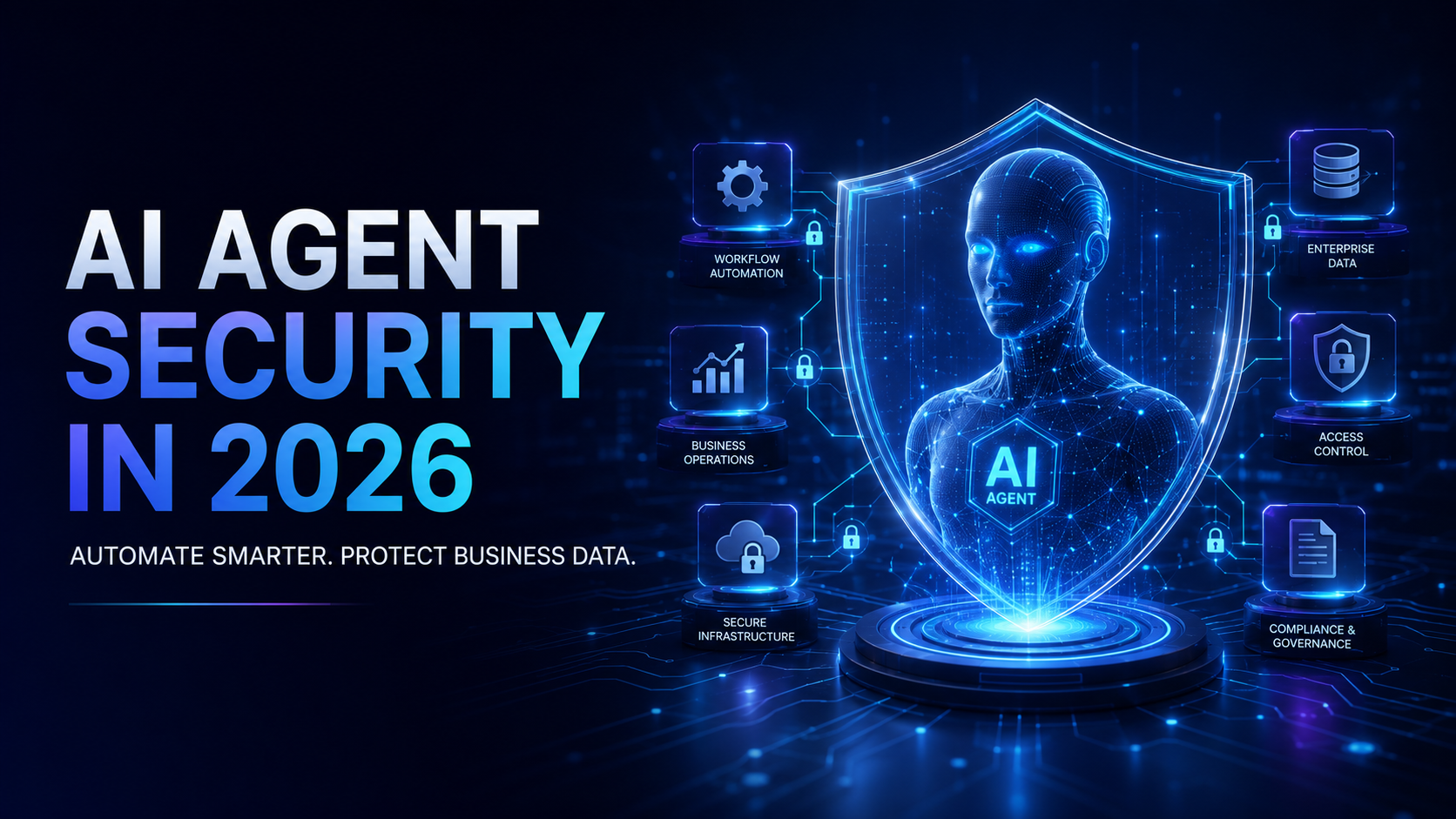
An AI agent is an intelligent software system that can understand a goal, plan the required steps and perform actions using connected applications or business data.
Unlike a traditional chatbot that only responds to questions, an AI agent may be authorised to:
Multi-agent systems, where specialised agents collaborate on complex processes, are becoming an important technology trend in 2026. Gartner’s technology trends highlight multi-agent systems and industry-specific AI models as significant developments shaping enterprise technology.
AI agents often require access to multiple systems to perform useful work. If permissions are poorly configured, an agent may access information beyond what it actually needs.
A compromised or incorrectly designed agent could potentially expose customer records, modify business data, execute unauthorised actions or share confidential information with an external service.
The major security concerns include:
An AI agent should not receive unrestricted access to the entire business infrastructure. A customer-support agent, for example, may need access to support tickets but should not be able to view payroll or financial records.
Businesses should follow the principle of least privilege—giving every agent only the minimum access required to complete its assigned tasks.
Prompt injection occurs when malicious instructions are inserted into a document, email, webpage or user message processed by an AI system.
If the agent cannot distinguish trusted instructions from untrusted content, it may disclose sensitive information or perform an unwanted action.
Input validation, content isolation and approval checkpoints can help reduce this risk.
AI agents may process customer details, financial records, internal documents or intellectual property. Sending this information to an unapproved AI platform can lead to privacy and compliance problems.
Companies should clearly define:
AI agents can operate faster than human employees, but that also means a mistake can affect hundreds of records in a short period.
High-impact actions—such as processing payments, deleting data, changing permissions or communicating with customers—should require human approval.
Every important action performed by an AI agent should be recorded. Without proper logs, companies may not know what information an agent accessed, what decision it made or why a particular action occurred.
Detailed audit trails make it easier to investigate problems, meet compliance requirements and improve the AI system over time.
Businesses should begin with a small, clearly defined workflow instead of immediately connecting AI to every department.
Good starting use cases include internal knowledge search, ticket classification, document summarisation and report preparation.
Each AI agent should have its own system identity and permissions. Companies should avoid using shared administrator accounts because they make it difficult to identify which agent performed an action.
AI agents should prepare recommendations and automate routine work, while critical decisions remain under human supervision.
Approval should be mandatory for financial transactions, permanent data deletion, legal communication and major account changes.
APIs used by AI agents should include authentication, rate limits, input validation and role-based access control. API credentials should be securely stored and regularly rotated.
Businesses should track unusual login activity, unexpected data access, repeated failures and abnormal workflow patterns.
Security monitoring is especially important because AI agents can interact with several applications during a single task.
Before an AI agent is released into a live environment, it should be tested against malicious prompts, incorrect data, unavailable services and unauthorised requests.
Regular security assessments should continue after deployment because models, integrations and business processes change over time.
AI agents can help businesses reduce repetitive work, deliver faster customer service and make better use of organisational data. However, automation without security can create new operational and privacy risks.
Security must therefore be included from the beginning—not added after the AI system has already been deployed.
Organisations that combine AI innovation with strong access control, continuous monitoring, human oversight and clear governance will be better prepared to benefit from intelligent automation.
Gartner predicts that AI-focused security platforms will become increasingly important as organisations protect against threats such as prompt injection, data leakage and unauthorised agent activity. Read Gartner’s 2026 security outlook.
Geega Technologies helps businesses design and develop secure, scalable and AI-powered software solutions.
Our team can support organisations with:
Whether you are exploring your first AI automation project or upgrading an existing business platform, we can help you build a solution that is practical, secure and ready to scale.
Ready to introduce secure AI automation into your business? Contact Geega Technologies today to discuss your requirements.