Home » AI Agents vs Traditional Automation: What’s Right for Your Business in 2026?
Automation has transformed the way modern organizations operate.
Businesses have spent years automating repetitive processes such as sending emails, generating invoices, updating databases, processing orders, creating reports, and managing internal workflows.
Traditional automation has helped organizations improve productivity while reducing the amount of manual work required for predictable business processes.
But automation is changing.
The rapid development of artificial intelligence has introduced a new generation of systems known as AI agents.
Instead of simply following predefined instructions, AI agents can understand goals, analyze information, interact with software tools, make context-based decisions, and execute approved actions.
This creates an important question for businesses in 2026:
Should your organization continue using traditional automation, move toward AI agents, or combine both technologies?
The answer depends on the complexity of your workflows, the type of information your employees handle, your security requirements, and the level of decision-making involved.
In this guide, we’ll explore AI agents vs traditional automation, how both technologies work, their benefits and limitations, real-world business applications, and how organizations can decide which approach is right for them.
Businesses have used automation for years to reduce repetitive work, improve productivity, and speed up operations. From automated emails and invoice generation to CRM updates and reporting, traditional automation has become an important part of modern business.
But in 2026, businesses are increasingly exploring AI agents.
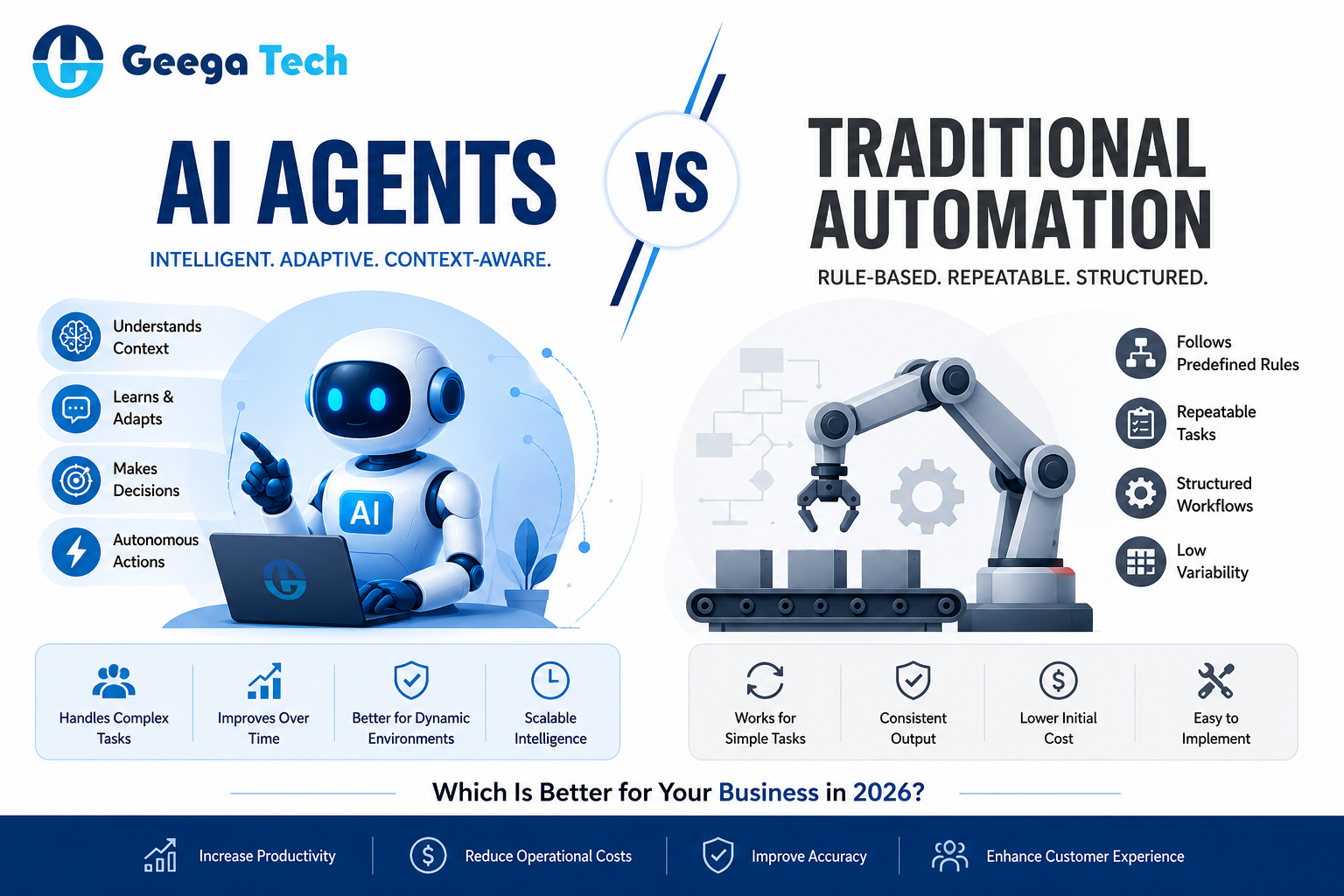
Unlike traditional automation, which follows predefined rules, AI agents can understand information, analyze context, interact with different systems, and assist with decision-making.
So, when comparing AI agents vs automation, which approach is right for your business?
Let’s understand the differences.
Traditional automation uses predefined rules, triggers, and workflows to perform repetitive tasks automatically.
A simple workflow may look like:
Trigger → Rule → Action
For example, when a customer completes a payment:
The system performs exactly what has been configured.
Traditional automation works best for predictable and repetitive processes such as:
For these processes, traditional automation remains highly effective.
AI agents are intelligent software systems that can understand goals, analyze information, make context-based decisions, and perform approved actions.
Instead of only following a fixed workflow, an AI agent can determine what steps may be required to complete a task.
A simplified workflow looks like:
Goal → Understand → Analyze → Decide → Act
For example, an AI customer-support agent could:
This makes AI agents useful for workflows where information and situations frequently change.
| Feature | Traditional Automation | AI Agents |
|---|---|---|
| Decision Making | Rule-based | Context-aware |
| Workflow | Predefined | More dynamic |
| Flexibility | Limited | Higher |
| Unstructured Data | Limited | Better suited |
| Natural Language | Limited | Advanced |
| Predictability | Very high | Depends on design |
| Complexity | Lower | Higher |
| Best For | Repetitive tasks | Complex workflows |
Traditional automation is generally better for predictable processes, while AI agents can provide more value when workflows require interpretation and contextual understanding.
Traditional automation follows predefined rules, making results easier to predict and test.
Simple workflows can often be developed and deployed quickly.
Businesses don’t need advanced AI infrastructure for straightforward processes.
Traditional automation works extremely well for high-volume processes such as invoices, notifications, reports, and data synchronization.
AI agents can analyze information from multiple sources before recommending or taking an approved action.
AI agents can work with:
An AI agent can potentially interact with multiple business systems.
For example:
Email → AI Analysis → CRM → Database → Recommended Action
AI agents can reduce repetitive knowledge work, allowing employees to focus on more valuable business activities.
Properly configured AI agents can assist with approved business processes around the clock.
AI agents can understand customer questions, search relevant information, prepare responses, and escalate complicated requests.
Sales teams can use AI agents for:
AI agents can assist with employee FAQs, onboarding, document processing, and internal information retrieval.
Finance teams can use AI systems for invoice analysis, expense classification, reporting assistance, and anomaly identification.
AI agents can analyze support tickets, search technical documentation, recommend troubleshooting steps, and escalate serious problems.
Traditional automation is usually the better option when:
For example:
Geega Technologies engineers bespoke SaaS platforms, Generative AI models, and enterprise IT infrastructure with CMMI Level 3 process quality.
Payment Successful → Generate Invoice → Send Email
Using an advanced AI agent for such a simple process may add unnecessary complexity.
Consider AI agents when:
The key question is:
Does the process simply require execution, or does it require understanding?
If it requires execution, traditional automation may be sufficient.
If it requires understanding and interpretation, AI agents may provide additional value.
Businesses don’t necessarily have to choose between AI agents and traditional automation.
In many situations, combining both can provide better results.
For example:
Customer Request
↓
AI Understands the Request
↓
AI Selects the Appropriate Workflow
↓
Traditional Automation Executes Approved Actions
↓
Human Reviews Sensitive Decisions
This approach combines AI intelligence with predictable business automation.
AI agents can interact with important business information and applications, making security essential.
Businesses should implement:
AI agents should only have access to the information and tools required for their assigned tasks.
Businesses should introduce AI automation gradually.
Find tasks consuming significant employee time.
Document the inputs, decisions, systems, actions, and outputs involved.
Separate simple rule-based tasks from activities requiring contextual understanding.
Choose a workflow with measurable business value and manageable risk.
Define data access, permissions, APIs, approvals, and monitoring.
Track metrics such as:
Once the system performs reliably, it can gradually be expanded.
Business automation is evolving from simple rule-based systems toward more intelligent workflows.
However, traditional automation will continue to play an important role because businesses still require reliable and predictable software systems.
The future is likely to combine:
AI Agents + Traditional Automation + Human Oversight
AI can provide intelligence and contextual understanding, while traditional software can handle predictable execution.
At Geega Technologies, we help startups and enterprises build secure, scalable, and intelligent digital solutions.
Our development capabilities include:
Whether you’re planning to automate existing workflows or build an AI-powered application, our team can help you design a solution around your business requirements.
The AI agents vs automation decision depends on the type of business process you want to automate.
Traditional automation is ideal for predictable and rule-based tasks.
AI agents are more suitable for workflows involving language, context, documents, multiple systems, and dynamic decision-making.
For many organizations, the best solution will be a hybrid approach combining:
AI Intelligence + Traditional Automation + Human Oversight
The objective isn’t to use AI everywhere. It’s to use the right technology for the right business problem.
Planning to build an AI agent, automate business workflows, or develop an AI-powered application?
Partner with Geega Technologies to build secure, scalable, and business-focused AI solutions.
Contact Geega Technologies today for a free consultation.


Speak directly with our engineering team to audit your requirements, architecture, and timeline.