Home » Generative AI for Business: Top Use Cases & Benefits in 2026
Generative AI has rapidly evolved from an experimental technology into a practical business tool.
Organizations are exploring generative AI to assist employees, automate content creation, summarize documents, improve customer support, analyze business information, accelerate software development, and build smarter digital products.
But the real opportunity goes beyond simply adding an AI chatbot to a website.
In 2026, Generative AI for Business is increasingly about integrating intelligent capabilities directly into business workflows, enterprise applications, SaaS platforms, customer experiences, and internal operations.
When implemented strategically, generative AI can help businesses reduce repetitive work, improve productivity, accelerate decision-making, and create entirely new digital experiences.
In this guide, we’ll explore what generative AI is, how businesses are using it, the most valuable use cases, implementation challenges, and how organizations can successfully integrate generative AI into their software and operations.
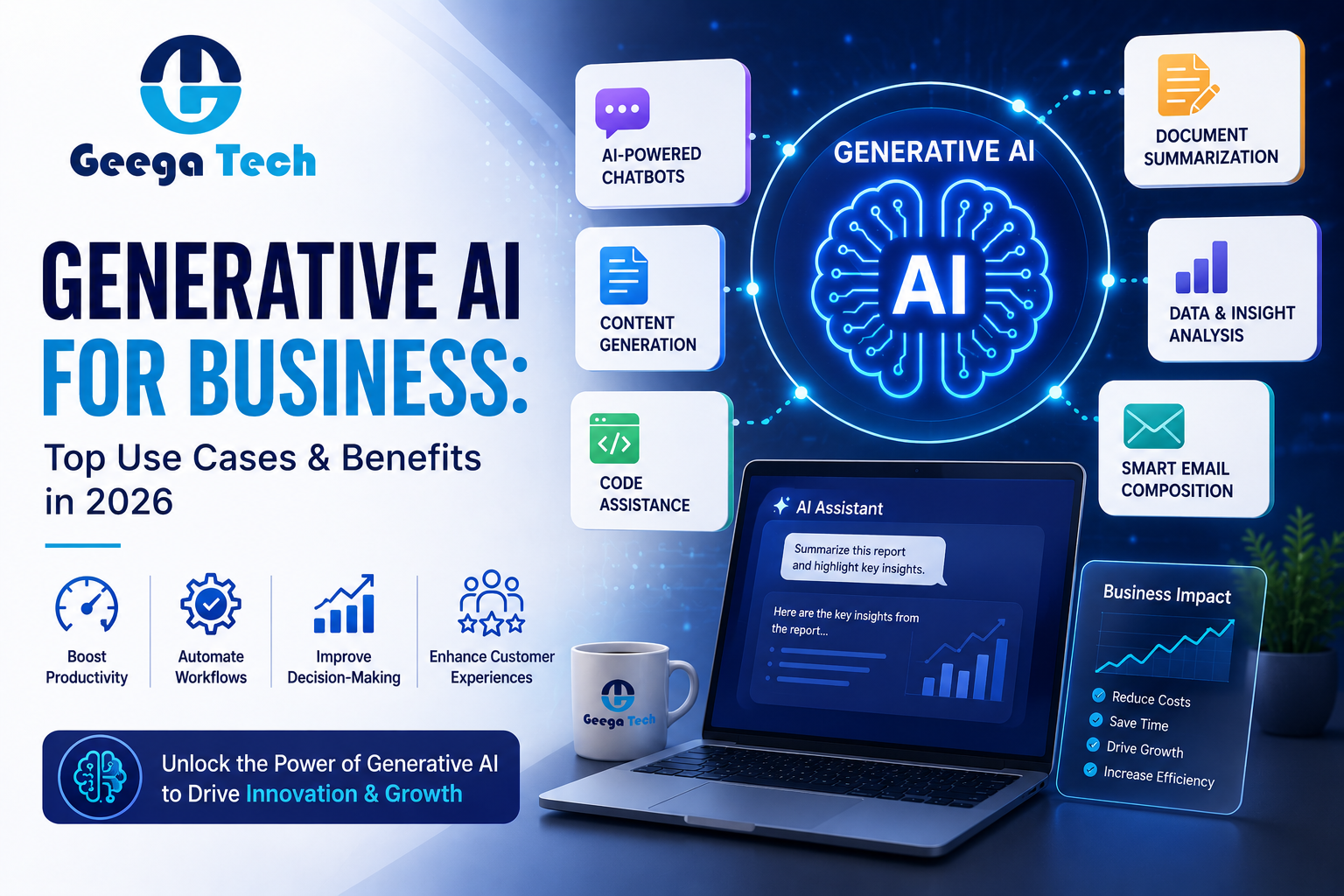
Generative AI is a category of artificial intelligence capable of creating new content based on user instructions and available context.
Depending on the system, generative AI can produce or assist with:
Traditional software typically follows predefined instructions.
Generative AI allows users to interact with software through natural language and can generate responses dynamically based on the information available to it.
Traditional AI and generative AI can solve different types of problems.
| Traditional AI | Generative AI |
|---|---|
| Predicts outcomes | Generates new content |
| Classifies information | Creates responses |
| Detects patterns | Summarizes information |
| Uses structured outputs | Can produce natural-language outputs |
| Often task-specific | Can support multiple language-based tasks |
| Primarily analytical | Generative and conversational |
Businesses can also combine traditional machine learning and generative AI within the same application.
For example, machine learning might predict customer churn while generative AI explains the results to a sales manager in natural language.
Organizations generate enormous amounts of information every day.
Employees work with:
Finding, analyzing, summarizing, and acting on this information can require significant manual effort.
Generative AI can provide a more conversational and automated way to interact with business information.
Key potential benefits include:
Customer support is one of the most common applications of generative AI.
Traditional chatbots typically rely on predefined questions and answers.
Generative AI support systems can potentially understand more flexible customer requests and use approved business information to generate relevant responses.
Businesses can use generative AI to:
Human support representatives can then focus on situations requiring specialized expertise or judgment.
Employees often spend time searching across documents, policies, reports, and internal systems.
A generative AI knowledge assistant can provide a conversational interface to approved company information.
Employees could ask:
“What is our refund policy?”
“Summarize this project report.”
“Find the latest product documentation.”
“What were the main decisions from this meeting?”
“Compare these two proposals.”
The AI system can retrieve relevant information and generate a concise response.
Access controls should ensure employees only receive information they are authorized to view.
Marketing teams can use generative AI to assist with:
Generative AI can accelerate the first-draft process, while human teams remain responsible for accuracy, brand voice, originality, and final approval.
Sales teams spend considerable time researching leads, writing follow-ups, updating CRM records, and preparing proposals.
Generative AI can assist with:
When combined with workflow automation and AI agents, these capabilities can become part of a larger sales automation system.
Generative AI is also changing software engineering workflows.
Development teams can use AI to assist with:
AI-generated code should still be reviewed and tested by experienced developers, particularly for security-sensitive or production applications.
Organizations process large numbers of documents every day.
Generative AI can help employees work with:
Potential capabilities include:
This can significantly reduce time spent manually reviewing large documents.
Many organizations manually prepare weekly, monthly, and quarterly reports.
Generative AI can help transform structured business information into readable summaries.
For example, an AI reporting assistant might generate:
The application can highlight important changes and provide context around key metrics.
Generative AI can assist HR departments with repetitive administrative tasks.
Potential use cases include:
AI should be used carefully for employment-related decisions, with appropriate human oversight and governance.
Generative AI can help businesses provide more personalized digital interactions.
Applications may generate personalized:
Personalization should be based on appropriate data permissions and privacy practices.
One of the most important developments in enterprise AI is the transition from AI that only generates information to AI that can assist with multi-step workflows.
An AI agent may be designed to:
For example, an AI customer support agent could identify a customer, review previous interactions, retrieve relevant information, prepare a response, update a support ticket, and escalate the issue if necessary.
Appropriate permissions, logging, validation, and human oversight are essential for these systems.
Generative AI can assist with:
Geega Technologies engineers bespoke SaaS platforms, Generative AI models, and enterprise IT infrastructure with CMMI Level 3 process quality.
Healthcare implementations require particularly strong privacy, security, compliance, and human oversight.
Financial organizations can explore generative AI for:
Generative AI can support:
Manufacturing businesses can use generative AI for:
Potential applications include:
Generative AI can help with:
SaaS businesses can integrate generative AI into their products for:
AI can assist employees with repetitive information-based tasks, allowing them to spend more time on strategic and creative work.
AI-generated summaries can help managers understand large amounts of information more quickly.
AI-assisted support can provide faster responses while helping human agents handle more complex issues.
Tasks such as summarization, drafting, classification, and information retrieval can be partially automated.
Employees can interact with business knowledge through natural-language questions instead of manually searching multiple systems.
AI-assisted workflows can help organizations manage growing volumes of customer interactions and information.
Businesses can integrate generative AI capabilities into existing applications to create new user experiences and services.
Generative AI and AI agents are related but not identical.
| Generative AI | AI Agents |
| Generates content | Performs workflows |
| Responds to prompts | Can determine next actions |
| Creates summaries | Can interact with tools |
| Produces recommendations | Can execute approved tasks |
| Usually response-oriented | More action-oriented |
| Often one interaction | Can involve multiple steps |
AI agents frequently use generative AI as part of their reasoning or language capabilities.
Generative AI provides significant opportunities, but businesses should also understand its limitations.
Key considerations include:
A successful implementation requires both technical and organizational planning.
Businesses should avoid deploying AI everywhere at once.
A structured implementation strategy can reduce risk.
Find processes involving repetitive knowledge work, information retrieval, content generation, or manual analysis.
Understand current processing time, cost, error rates, and employee effort.
Choose a use case where AI can provide measurable business value.
Determine which information the AI needs and whether users have appropriate permission to access it.
Start with a controlled implementation.
Define permissions, logging, human approvals, and acceptable AI behavior.
Evaluate accuracy, reliability, security, user experience, and failure scenarios.
Compare performance against the original baseline.
Expand AI capabilities once the initial use case demonstrates measurable value.
Businesses can choose between existing AI products and custom development.
Off-the-shelf solutions may work well for common tasks such as basic writing assistance or general productivity.
Custom Generative AI Development becomes more valuable when a business requires:
Many organizations use a hybrid approach by combining established AI models with custom software designed around their business processes.
The cost varies significantly based on the application.
Approximate planning ranges may include:
| Project Type | Estimated Cost |
| Basic Generative AI Integration | $5,000 – $15,000 |
| Custom AI Chatbot | $8,000 – $25,000 |
| Generative AI MVP | $15,000 – $40,000 |
| AI Knowledge Platform | $20,000 – $60,000+ |
| AI-Powered SaaS Product | $25,000 – $80,000+ |
| AI Agent Platform | $30,000 – $100,000+ |
| Enterprise Generative AI Solution | $75,000 – $250,000+ |
These figures are broad estimates.
Actual costs depend on features, architecture, integrations, data requirements, security, infrastructure, and project complexity.
Businesses should measure AI based on business outcomes rather than the number of AI features deployed.
Useful metrics may include:
These metrics can help determine whether the AI implementation is producing measurable value.
At Geega Technologies, we help startups and enterprises integrate artificial intelligence into modern digital products and business workflows.
Our capabilities include:
Our approach focuses on combining AI capabilities with secure, scalable software engineering.
Instead of adding AI simply because it is trending, we help businesses identify practical use cases where intelligent software can deliver measurable value.
Generative AI is gradually changing how people interact with software.
Instead of manually navigating every application, users will increasingly be able to communicate their goals using natural language.
Software can then help retrieve information, generate content, summarize data, recommend actions, and assist with workflows.
At the same time, businesses need to maintain strong security, governance, transparency, and human oversight.
The companies that gain the greatest value from generative AI will be those that integrate it strategically into real business processes.
Generative AI for Business is more than a technology trend.
It represents a new way for organizations to interact with information, automate knowledge work, improve customer experiences, and build intelligent digital products.
However, successful adoption requires a clear business objective.
Instead of asking, “Where can we add AI?” businesses should ask:
“Which business problem can AI help us solve better?”
Starting with that question helps organizations invest in AI solutions that deliver meaningful and measurable results.
Looking to integrate generative AI into your business, SaaS platform, mobile application, or enterprise software?
Partner with Geega Technologies to build secure, scalable, and business-focused AI solutions.
From custom AI assistants and AI agents to enterprise automation and AI-powered SaaS products, our development team can help transform your idea into an intelligent digital solution.
Contact Geega Technologies today for a free consultation and start your Generative AI journey.


Speak directly with our engineering team to audit your requirements, architecture, and timeline.