MVP Development Cost & Timeline for Startups: A Realistic Breakdown

Home » Geegatech: AI-Powered Software Vs Traditional Software with CMMI Level 3 Expertise in Indore

MVP Development Cost & Timeline for Startups: A Realistic Breakdown

Every successful startup begins with an idea, but turning that idea into a successful product requires validation before investing heavily in full-scale development.

This is where an MVP (Minimum Viable Product) becomes essential.

The truth is that MVP development is not about building a perfect product. It is about building the smallest version of a product that solves a real problem and allows startups to gather user feedback quickly.

In this guide, we’ll break down the factors that influence MVP costs, realistic development timelines, and strategies startups can use to launch successfully.
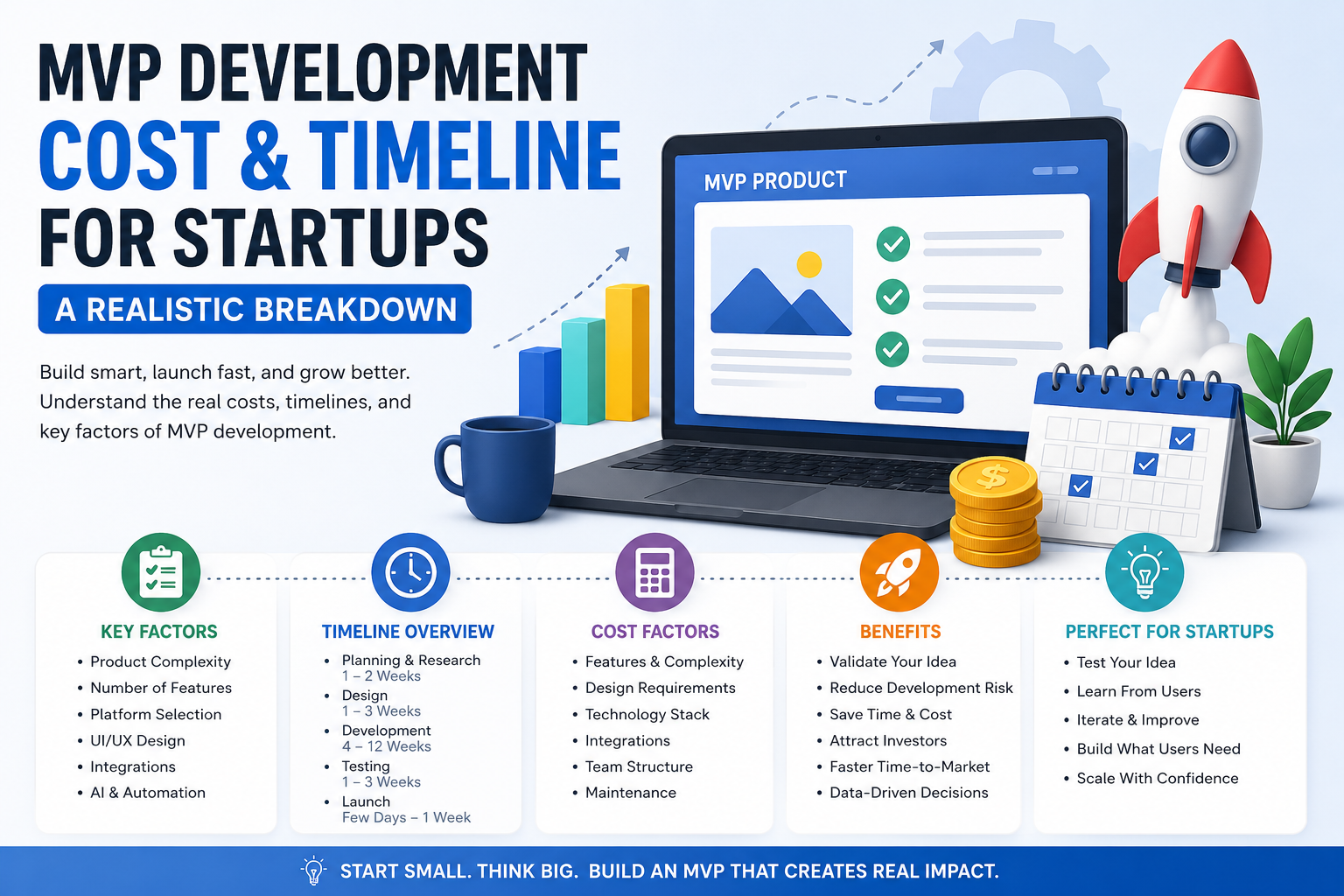
MVP Development Cost and Timeline for Startups showing MVP product planning, development stages, cost factors, and launch roadmap.

What is MVP Development?

A Minimum Viable Product (MVP) is the first functional version of a software product that includes only the essential features needed to solve a core problem for early users.

Instead of investing significant time and resources into building a complete product, startups use MVPs to validate ideas, gather user feedback, and reduce development risk.

Many successful companies, including Airbnb, Dropbox, Uber, and Instagram, began with MVPs before scaling into global platforms.

Why Startups Build MVPs Before Full Product Development

Launching a full-scale product without validating market demand can be expensive and risky.

An MVP helps startups:

  • Validate business ideas
  • Test product-market fit
  • Gather real user feedback
  • Reduce development costs
  • Accelerate time-to-market
  • Attract investors
  • Minimize business risks

By focusing only on essential functionality, startups can make informed product decisions based on actual user behavior rather than assumptions.

Key Components of a Successful MVP

Core Feature Set

The MVP should solve one primary problem effectively.

Examples:

  • User Registration & Login
  • Profile Management
  • Dashboard
  • Search Functionality
  • Basic Notifications
  • Payment Integration

Simple User Experience

A clean and intuitive interface improves adoption and helps collect meaningful feedback.

Scalability Foundation

Although MVPs are simplified products, the architecture should support future growth and feature expansion.

Factors That Influence MVP Development Cost

Several factors determine the overall effort required to build an MVP.

Product Complexity

Low Complexity MVP

Examples:

  • Appointment Booking Platform
  • Event Management App
  • Business Directory
  • Portfolio Marketplace

Medium Complexity MVP

Examples:

  • CRM Software
  • SaaS Platforms
  • Learning Management Systems
  • Multi-Vendor Marketplaces

High Complexity MVP

Examples:

  • FinTech Applications
  • Healthcare Platforms
  • AI-Powered Products
  • Real-Time Collaboration Tools

Number of Features

The more features included, the higher the development effort.

Successful startups focus only on features required to validate their idea.

Platform Selection

Web Application MVP

Suitable for faster market validation.

Mobile Application MVP

Designed for Android, iOS, or Cross-Platform deployment.

Web + Mobile MVP

Provides broader reach but requires additional development effort.

UI/UX Design Requirements

Simple interfaces generally require less effort than highly customized experiences.

The focus should remain on usability rather than visual complexity.

Third-Party Integrations

Examples include:

  • Payment Gateways
  • CRM Systems
  • Maps APIs
  • Messaging Services
  • Analytics Platforms
  • Cloud Storage Solutions

AI and Automation Features

Modern startups increasingly incorporate:

  • AI Chatbots
  • Recommendation Engines
  • Predictive Analytics
  • Intelligent Search
  • Workflow Automation

AI integrations add additional planning, testing, and optimization requirements.

Typical MVP Development Timeline

Discovery & Planning

1–2 Weeks

Activities:

  • Business Analysis
  • Competitor Research
  • Requirement Gathering
  • Feature Prioritization
  • Technical Planning

UI/UX Design

1–3 Weeks

Activities:

  • Wireframes
  • User Flows
  • Interactive Prototypes
  • Design Systems

Development Phase

4–12 Weeks

Activities:

  • Frontend Development
  • Backend Development
  • Database Setup
  • API Development
  • Third-Party Integrations

Quality Assurance & Testing

1–3 Weeks

Activities:

  • Functional Testing
  • Security Testing
  • Performance Validation
  • Bug Fixing

Deployment & Launch

Few Days – 1 Week

Activities:

  • Cloud Deployment
  • Monitoring Setup
  • Analytics Configuration
  • Production Release

MVP Development Timeline by Project Type

MVP TypeTypical Timeline
Simple MVP4–8 Weeks
SaaS MVP8–12 Weeks
Marketplace MVP10–16 Weeks
Enterprise MVP12–20 Weeks
AI-Powered MVP12–24 Weeks

Common MVP Development Mistakes

Building Too Many Features

Many startups mistake an MVP for a complete product.

Ignoring User Feedback

The purpose of an MVP is learning and validation.

Delaying Launch

Perfect products rarely exist.

Launching early helps startups learn faster.

Overengineering

Complex architectures often increase costs without providing immediate value.

Best Practices for MVP Development

  • Focus on one core problem
  • Prioritize essential features
  • Launch quickly
  • Gather user feedback continuously
  • Measure user behavior
  • Iterate based on real data
  • Build scalable architecture
  • Follow Agile development practices

Technologies Commonly Used for MVP Development

Frontend

  • React.js
  • Next.js
  • Angular
  • Vue.js

Backend

  • Node.js
  • Python
  • Java
  • .NET

Databases

  • PostgreSQL
  • MySQL
  • MongoDB
  • Firebase

Cloud Platforms

  • AWS
  • Microsoft Azure
  • Google Cloud Platform

Why Startups Choose MVP Development Partners

Professional MVP development teams help startups:

  • Define product requirements
  • Reduce technical risks
  • Accelerate development
  • Improve scalability
  • Optimize cloud infrastructure
  • Support future growth

Future Trends in MVP Development

AI-First Products

AI capabilities are increasingly becoming part of startup MVPs.

Low-Code Development

Low-code platforms are helping startups validate ideas faster.

Cloud-Native Architecture

Cloud-first development enables greater flexibility and scalability.

Data-Driven Product Decisions

Analytics and user behavior tracking play a critical role in product evolution.

Conclusion

MVP development remains one of the most effective approaches for startups looking to validate ideas, reduce risk, and accelerate growth.

Rather than building a fully featured product from day one, startups can focus on delivering core value, learning from users, and continuously improving based on market feedback.

With the right strategy, technology stack, and development approach, an MVP can become the foundation for a scalable and successful digital product.

What is MVP development?

MVP development is the process of building a minimum viable product with only the essential features required to validate a business idea.

How long does MVP development take?

Most MVPs can be launched within 4 to 20 weeks depending on complexity and requirements.

Why do startups build MVPs?

Startups use MVPs to validate ideas, gather feedback, reduce risks, and accelerate product launches.

Get in touch with us

Looking for a certified tech partner? Contact Geega Technologies today.

Looking for Custom Software, AI Integration or Infrastructure Retainers?