Home » Geegatech: AI-Powered Software Vs Traditional Software with CMMI Level 3 Expertise in Indore
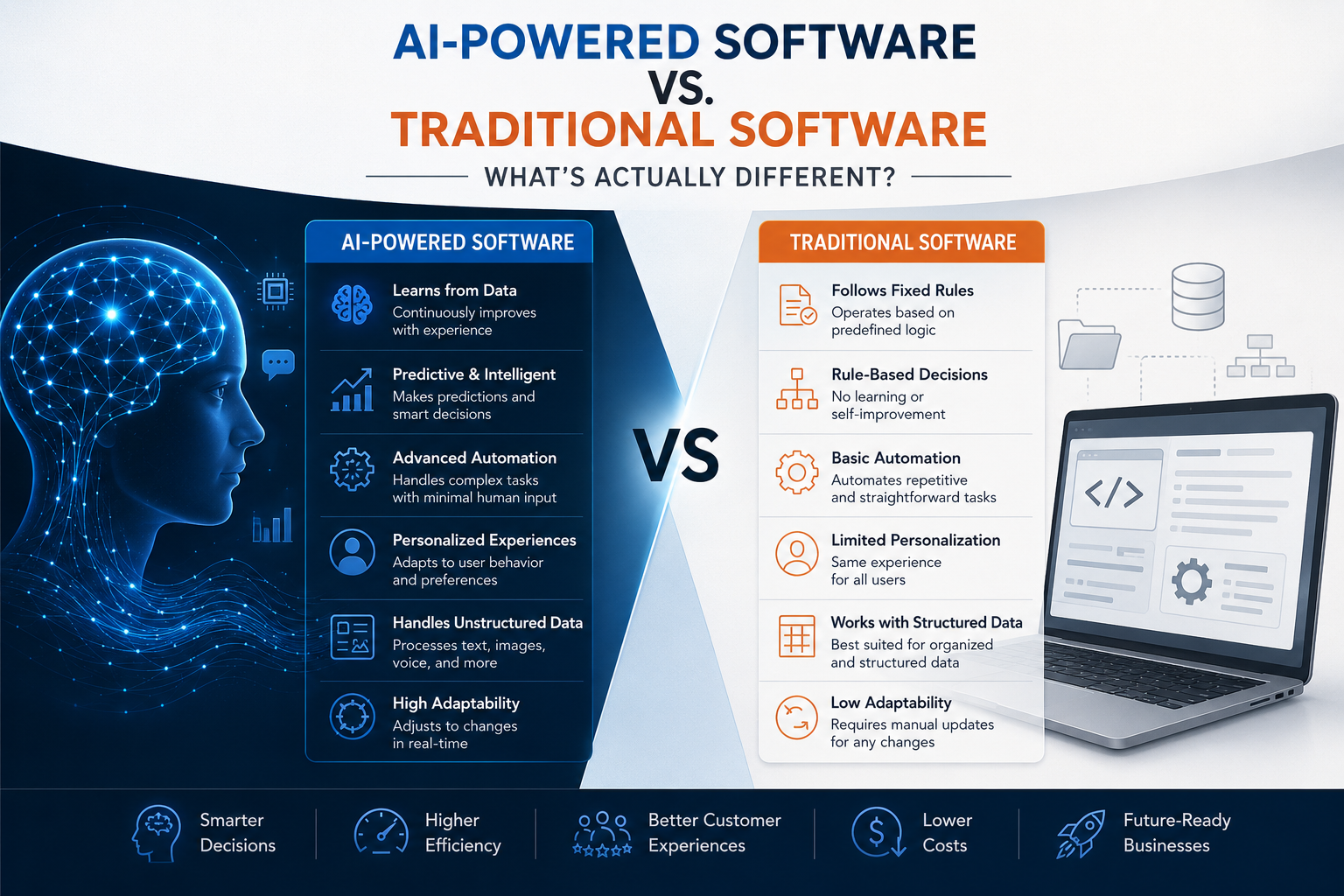
Software has evolved significantly over the last decade. While traditional software continues to power many business operations, AI-powered software is introducing a new level of intelligence, automation, and adaptability.
Traditional software works by following predefined rules written by developers. It performs tasks exactly as programmed and requires manual updates whenever business requirements change.
AI-powered software, on the other hand, can learn from data, identify patterns, make predictions, and improve its performance over time. This allows businesses to automate complex workflows, personalize user experiences, and gain valuable insights from large amounts of data.
AI-powered software is a type of application that uses Artificial Intelligence (AI), Machine Learning (ML), Natural Language Processing (NLP), and data analytics to learn from information, automate tasks, make predictions, and continuously improve its performance.
Unlike traditional software that follows predefined rules, AI-powered software can adapt to new data and make intelligent decisions based on patterns and insights.
AI-powered solutions are widely used across industries including healthcare, finance, retail, manufacturing, logistics, and customer service.
Traditional software is built using predefined rules and logic created by developers. It performs tasks exactly as programmed and typically requires manual updates whenever business requirements change.
These applications are ideal for structured processes where outcomes are predictable and rules remain consistent over time.
Examples include accounting software, inventory management systems, payroll software, and standard ERP solutions.
AI-powered chatbots can understand customer queries, provide instant responses, and improve support experiences without human intervention.
Examples include customer service bots, virtual assistants, and AI help desks.
These solutions analyze historical data and forecast future outcomes.
Businesses use predictive analytics for:
Recommendation systems suggest products, services, or content based on user preferences and behavior.
Common examples include:
AI can automatically extract, classify, and process information from invoices, contracts, forms, and other business documents.
Computer vision software analyzes images and videos for automation and decision-making.
Applications include:
Applications designed to manage day-to-day operations.
Examples include:
Traditional CRM systems help businesses manage customer data, sales pipelines, and communication processes.
ERP software integrates various business functions such as finance, procurement, operations, and reporting into a single platform.
Project management applications help teams organize tasks, timelines, and resources efficiently.
AI automates repetitive tasks while making context-aware decisions, reducing manual effort and operational costs.
Businesses can use predictive insights to identify opportunities, risks, and trends before they impact operations.
AI-powered applications customize interactions based on user behavior, preferences, and historical data.
Automated workflows and intelligent processes increase productivity and reduce human error.
Unlike traditional software, AI systems improve over time as they process more data.
Traditional software delivers consistent and predictable outcomes based on predefined rules.
These systems often require less data and fewer resources to deploy.
For straightforward business processes, traditional software may be more cost-effective than AI-based solutions.
Applications with fixed logic are generally easier to troubleshoot and maintain.
| Feature | AI-Powered Software | Traditional Software |
|---|---|---|
| Decision Making | Intelligent & Predictive | Rule-Based |
| Learning Capability | Learns from Data | No Learning |
| Adaptability | High | Low |
| Automation | Advanced | Basic |
| Personalization | Dynamic | Limited |
| Data Processing | Structured & Unstructured | Mostly Structured |
| Scalability | Highly Flexible | Depends on Development |
| Continuous Improvement | Yes | No |
Identify objectives, challenges, data sources, and automation opportunities.
Gather, clean, and organize data for training AI models.
Choose appropriate machine learning or AI models based on project requirements.
Create user-friendly interfaces that simplify interactions with AI-powered systems.
Develop frontend, backend, APIs, databases, and AI components.
Validate model accuracy, performance, security, and user experience.
Deploy applications and continuously monitor performance for optimization.
AI systems require high-quality data to deliver accurate results.
Achieving reliable predictions requires continuous training and optimization.
Connecting AI with existing business systems can be technically demanding.
Organizations must protect sensitive information and comply with regulations.
AI applications should support increasing users, data volumes, and workloads.
Businesses are adopting generative AI for content creation, customer support, coding assistance, and workflow automation.
AI agents are increasingly capable of handling complex business processes with minimal human intervention.
Future applications will deliver highly personalized experiences based on real-time user behavior.
Organizations will rely more heavily on predictive and prescriptive analytics for decision-making.
Customized AI applications will continue expanding across healthcare, finance, manufacturing, education, and logistics.
Organizations are investing in AI to:
The primary difference between AI-powered software and traditional software lies in intelligence and adaptability. Traditional software follows predefined instructions, while AI-powered applications learn from data, adapt to changing conditions, and continuously improve over time.
Both approaches have their place in modern business environments. However, organizations seeking advanced automation, predictive analytics, and personalized user experiences are increasingly turning to AI-powered solutions to drive innovation and growth.
As AI technology continues to evolve, businesses that embrace intelligent software solutions will be better positioned to compete, scale, and succeed in the digital future.
AI-powered software uses artificial intelligence technologies such as machine learning and natural language processing to automate tasks, analyze data, and make intelligent decisions.
Traditional software follows fixed rules, while AI software learns from data and improves its performance over time.
Not entirely. Traditional software remains effective for structured and predictable processes, while AI excels in dynamic and data-driven environments.
Healthcare, finance, retail, manufacturing, logistics, education, and customer service industries are among the biggest adopters of AI-powered solutions.
Initial development costs may be higher, but AI software often delivers long-term savings through automation, efficiency improvements, and better decision-making.
If you’re looking to build an AI-powered application or modernize your existing software with intelligent automation, Geega Technologies can help.
Our team specializes in AI Software Development, Machine Learning Solutions, Enterprise Applications, Cloud Development, and Digital Transformation Services.
Contact us today to discuss your project and discover how AI-powered software can accelerate your business growth.


Speak directly with our engineering team to audit your requirements, architecture, and timeline.