Home » Geegatech: Leading Digital Transformation with CMMI Level 3 Expertise in Indore
As businesses continue to embrace digital transformation, custom software development has become a key strategy for improving efficiency, enhancing customer experiences, and gaining a competitive advantage.
Unlike off-the-shelf solutions, custom software is designed specifically to meet unique business requirements, workflows, and objectives. From startups to large enterprises, organizations are investing in tailored software solutions to support long-term growth and scalability.
This guide covers everything you need to know about custom software development in 2026, including its benefits, types, technologies, development process, challenges, and future trends.
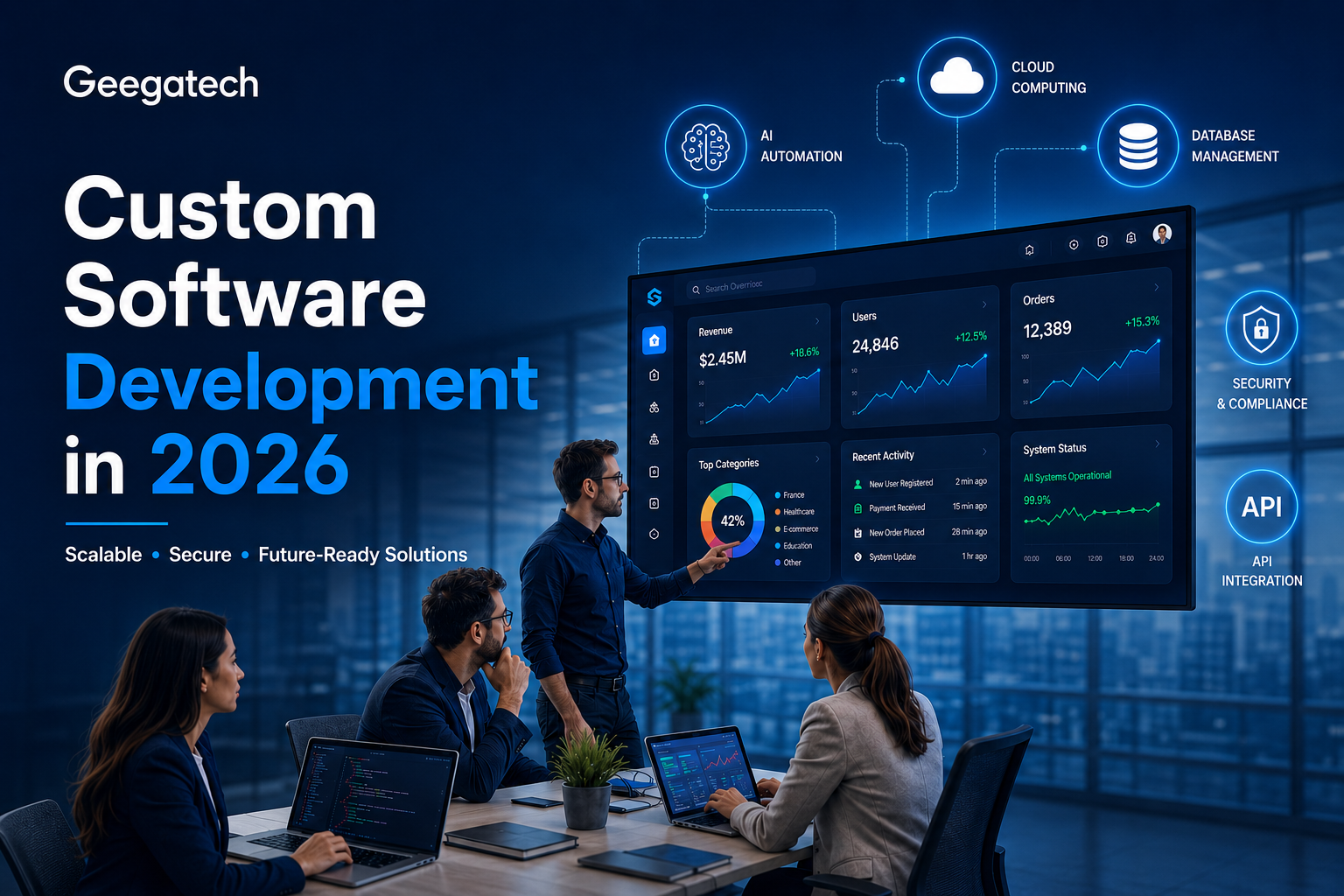
Custom software development is the process of designing, developing, deploying, and maintaining software applications tailored to the specific needs of a business or organization.
Unlike generic software products, custom applications are built with unique features and functionalities that align with business processes and goals.
Custom software can be developed for web platforms, mobile devices, enterprise systems, cloud environments, and industry-specific applications.
Web applications are accessible through browsers and help businesses manage operations, customer interactions, and online services.
Examples include customer portals, booking platforms, and management systems.
Mobile applications provide users with convenient access to services through smartphones and tablets.
Businesses use mobile apps for customer engagement, e-commerce, healthcare, logistics, and communication.
Enterprise software solutions support large-scale business operations such as human resources, inventory management, finance, and customer relationship management.
Software-as-a-Service platforms are cloud-based applications that allow users to access software through subscriptions and web browsers.
Many organizations require specialized software designed for industries such as healthcare, education, manufacturing, logistics, and finance.
Custom software is built around business objectives, ensuring that every feature serves a specific purpose.
As business requirements evolve, custom software can be expanded with additional features and capabilities.
Custom-built applications allow organizations to implement advanced security measures based on their unique requirements.
Automation and workflow optimization help employees complete tasks more efficiently.
Businesses can create unique digital experiences and capabilities that differentiate them from competitors.
The user interface is the visual layer that users interact with while using the application.
This layer handles workflows, data processing, rules, and application functionality.
The database stores and manages application data securely and efficiently.
This component connects the software with third-party tools, APIs, payment gateways, and enterprise systems.
Security mechanisms protect sensitive information and ensure compliance with industry standards.
The development team works closely with stakeholders to understand business goals, user expectations, and technical requirements.
Project scope, timelines, technology stack, and architecture are defined during the planning phase.
Designers create wireframes, prototypes, and user-friendly interfaces to ensure an optimal user experience.
Developers build the frontend, backend, APIs, databases, and integrations based on project specifications.
Comprehensive testing is performed to identify and resolve bugs, performance issues, and security vulnerabilities.
The software is deployed to production environments and made available to users.
Ongoing monitoring, updates, and feature enhancements ensure long-term software performance.
| Project Type | Estimated Timeline |
|---|---|
| Basic Business Application | 6 – 10 Weeks |
| Medium Complexity Application | 10 – 16 Weeks |
| Enterprise Software Solution | 16 – 24 Weeks |
| Large-Scale Custom Platform | 24 Weeks and Above |
Project requirements may evolve during development, requiring flexibility and proper planning.
Connecting software with existing systems and third-party services can be technically challenging.
Applications must be protected against cyber threats, unauthorized access, and data breaches.
Software should be designed to accommodate future business growth and user demand.
Organizations must ensure employees and customers can easily adapt to new software systems.
AI-powered applications are transforming business operations through automation, analytics, and intelligent decision-making.
Cloud-native applications provide greater scalability, flexibility, and reliability.
Organizations are adopting low-code tools to accelerate software delivery and innovation.
Businesses are increasingly implementing automated processes to improve productivity and efficiency.
Connected devices continue to drive innovation across healthcare, manufacturing, logistics, and smart infrastructure.
Developing custom software requires expertise in architecture, design, development, security, testing, and deployment.
A professional software development company helps businesses:
By partnering with experienced professionals, businesses can focus on their core operations while ensuring successful software delivery.
Custom software development continues to play a critical role in helping businesses achieve digital transformation in 2026. Whether developing a web application, mobile solution, enterprise platform, or cloud-based system, custom software provides the flexibility and functionality needed to support unique business goals.
By leveraging modern technologies, following best practices, and working with experienced development teams, organizations can build reliable, scalable, and future-ready software solutions that drive long-term success.
Custom software development is the process of creating software applications specifically designed to meet the unique needs of a business or organization.
Businesses choose custom software because it provides tailored functionality, scalability, improved security, and better alignment with operational processes.
Development timelines vary depending on project complexity, features, integrations, and business requirements.
Popular technologies include React, Angular, Node.js, Python, .NET, PostgreSQL, MongoDB, AWS, Azure, and Google Cloud.
Yes. Custom software can be designed with scalable architecture to support future growth and evolving business requirements.
If you are planning to develop a custom software solution for your business, Geega Technologies can help you design, build, and deploy secure, scalable, and high-performance applications tailored to your requirements.
Contact us today to discuss your custom software development project and explore the best solution for your business goals.


Speak directly with our engineering team to audit your requirements, architecture, and timeline.